
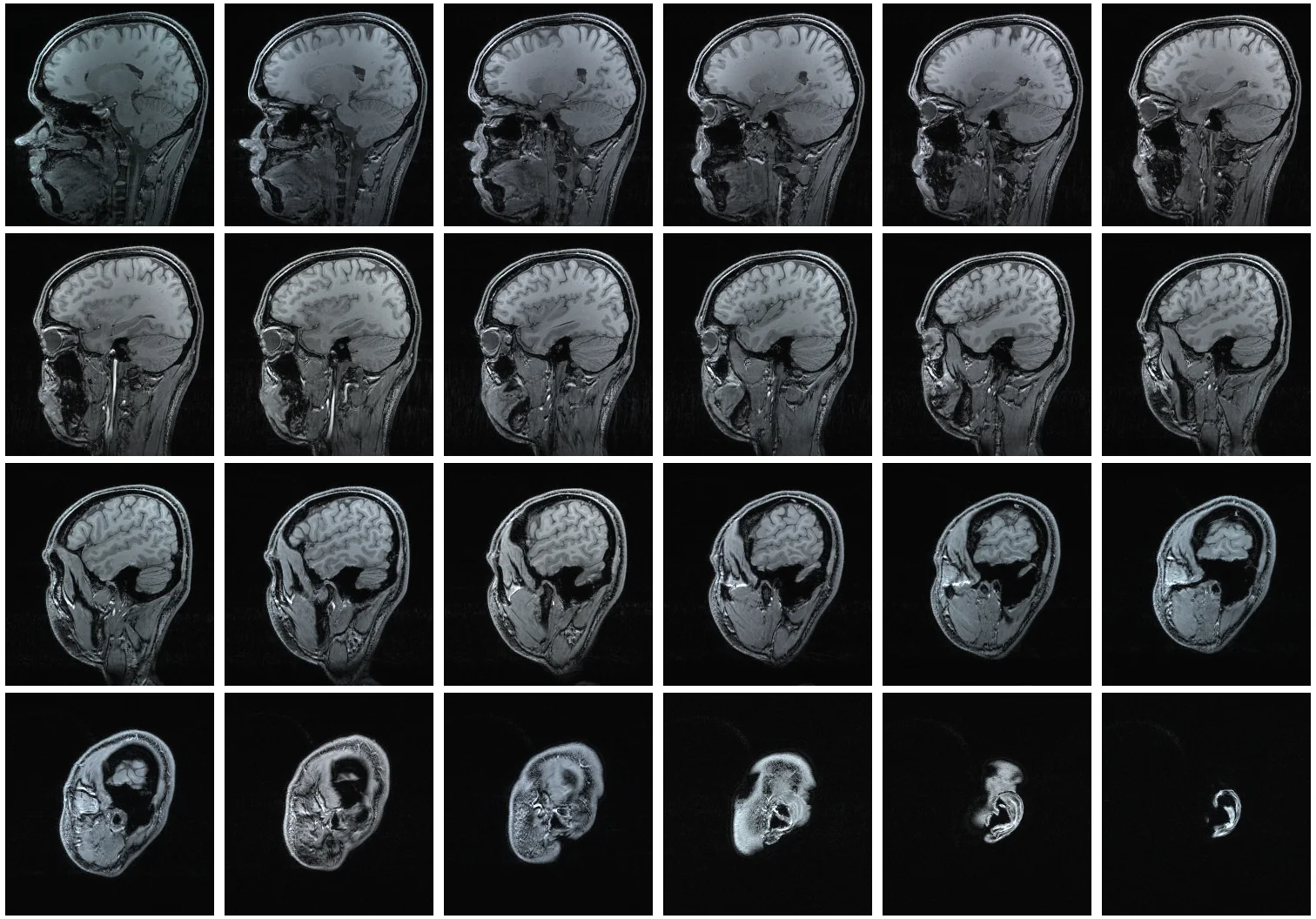

A brain scan can look like a portrait of a thought. Against a gray outline of the head, a patch glows orange or yellow. The temptation is immediate: there is love; there is prayer; there, perhaps, is the self.
But the colors are a way of displaying measurements. They do not arrive with their own interpretation. Understanding what the machine measures makes the image more impressive, while making some claims about it less plausible.
The question of the soul begins here: what could a brain scan establish, and what additional reasoning would be needed to move from an image to an account of a person?
What the colors measure
Magnetic resonance imaging uses magnetic fields and radio waves to investigate tissue. Functional MRI can track changes associated with blood oxygenation as someone performs a task. This is an indirect measure connected with neural activity, rather than a photograph of an idea. Researchers compare conditions and analyze patterns, using experimental design to distinguish a meaningful signal from other variation. The US National Institute of Biomedical Imaging and Bioengineering explains the distinction between structural and functional MRI.
Suppose activity increases while volunteers recall a personal experience. That can help identify the brain systems involved in remembering. It does not follow that every occurrence of the same activity means that the person is recalling an experience. A region can contribute to several processes.
Neuroscientist Russell Poldrack called attention to this problem of reverse inference: reasoning backward from an observed activation to a particular mental state. Such reasoning can be informative when supported by evidence about how selective the signal is. It is not automatically conclusive. His methodological analysis makes the difference clear. A map becomes evidence through a carefully defended inference, not through the vividness of its colors.
The strongest challenge deserves an answer
A serious materialist argument is broader than a picture. Mental life depends intimately on the brain. Altering or damaging its systems can change what a person remembers, understands, or expresses. Why introduce a spiritual principle if increasingly detailed physical explanations do the work?
That is a substantial philosophical challenge. Calling it reductionist does not answer it. A Catholic account has to take bodily dependence seriously, rather than treating the brain as an inconvenient obstacle to a supposedly complete inner person.
Yet dependence and identity are different claims. Evidence that an activity requires particular bodily conditions does not, by itself, settle everything about the kind of activity it is. Moving from findings about neural mechanisms to the conclusion that only physical reality exists adds a philosophical premise. That premise can be argued for, but it is not another colored region on the scan.
The reverse overreach is equally tempting. If scientists have not explained an aspect of consciousness, we have not thereby detected a soul. An unanswered question is not a positive measurement of an immaterial cause. Both positions need arguments beyond the present limits of an instrument.
A soul is not a second brain
Catholic teaching describes the human being as a unity of body and spiritual soul. Calling the soul the form of the body means that it is the principle of this living human being, not a small invisible passenger operating a biological machine. The Church also teaches its immediate creation by God and its immortality. These are theological claims, not results obtained from imaging. See the Catechism, paragraphs 362–366.
The distinction matters when discussing disability. If the body were merely replaceable equipment for a fully independent mental operator, profound changes after brain injury would look especially puzzling. In an account of embodied unity, bodily injury is injury to the person's life and powers of expression. Its seriousness is expected.
Thomas Aquinas offers an argument that can be examined. In Summa Theologiae I.75.2, he reasons that intellect can know bodies of any kind. A power operating through a bodily organ would, he argues, be constrained by that organ's particular physical nature. Intellectual understanding must therefore have a different mode of operation. This is his route to an immaterial intellectual principle. He also acknowledges that human thinking requires sensory images; his reply distinguishes dependence on bodily input from understanding being an act of a bodily organ.
A materialist can challenge the crucial premise. A physically definite thing can represent things with very different properties: black ink can describe red, and a computer can model many materials. Those examples don't show that understanding reduces to inscription or calculation. They identify the point needing defense: why should the range of things we understand require an immaterial act, rather than a flexible physical system? The disagreement concerns what understanding involves. More detailed brain measurements inform it, but neither side can win merely by naming its preferred account.
When a scan reveals someone we could not hear
Brain imaging can sometimes change our assessment of another person's awareness. In a widely discussed 2006 study, researchers asked a woman diagnosed as being in a vegetative state to imagine playing tennis and, separately, moving through her home. Different patterns of activation corresponding to those tasks supported the conclusion that she understood the instructions and intentionally responded. Owen and colleagues reported the case in Science.
The finding was striking precisely because the interpretation depended on the task. A generic patch of activity would not have established the same thing. Here, appropriately different responses to different instructions supplied evidence that bedside behavior had missed.
This was one patient, not proof that every apparently unresponsive patient is aware. Nor would failure on such a task, by itself, prove an absence of all experience: the task also requires hearing or understanding instructions and carrying them out under demanding conditions. The discovery expands a route to communication while reminding us how much a test can depend on the abilities it asks someone to display.
The person exceeds the result
There is an ethical difference between asking whether a patient can respond and asking whether that patient deserves care. The first is an empirical question with potentially important answers. The second should not be decided by awarding or removing human worth according to a performance threshold.
The Second Vatican Council's account of embodied humanity treats bodily life as good and worthy of honor. Gaudium et Spes, paragraph 14, provides a theological reason to take physical vulnerability seriously. In practice, that means the study of the brain is part of caring for persons, including those who cannot explain their own experience.
A scan may identify an injury, test an account of memory, or help someone communicate. It can challenge a careless account of mind and body. Neuroimaging can improve a person’s care while leaving the theological question about a spiritual soul open.