

A family tree and a DNA report tell related stories, but they do not contain the same information. A family tree lists people connected by parenthood. A DNA report follows pieces of inherited material. Over many generations, someone can remain your ancestor even when no identifiable stretch of that person's DNA reaches you.
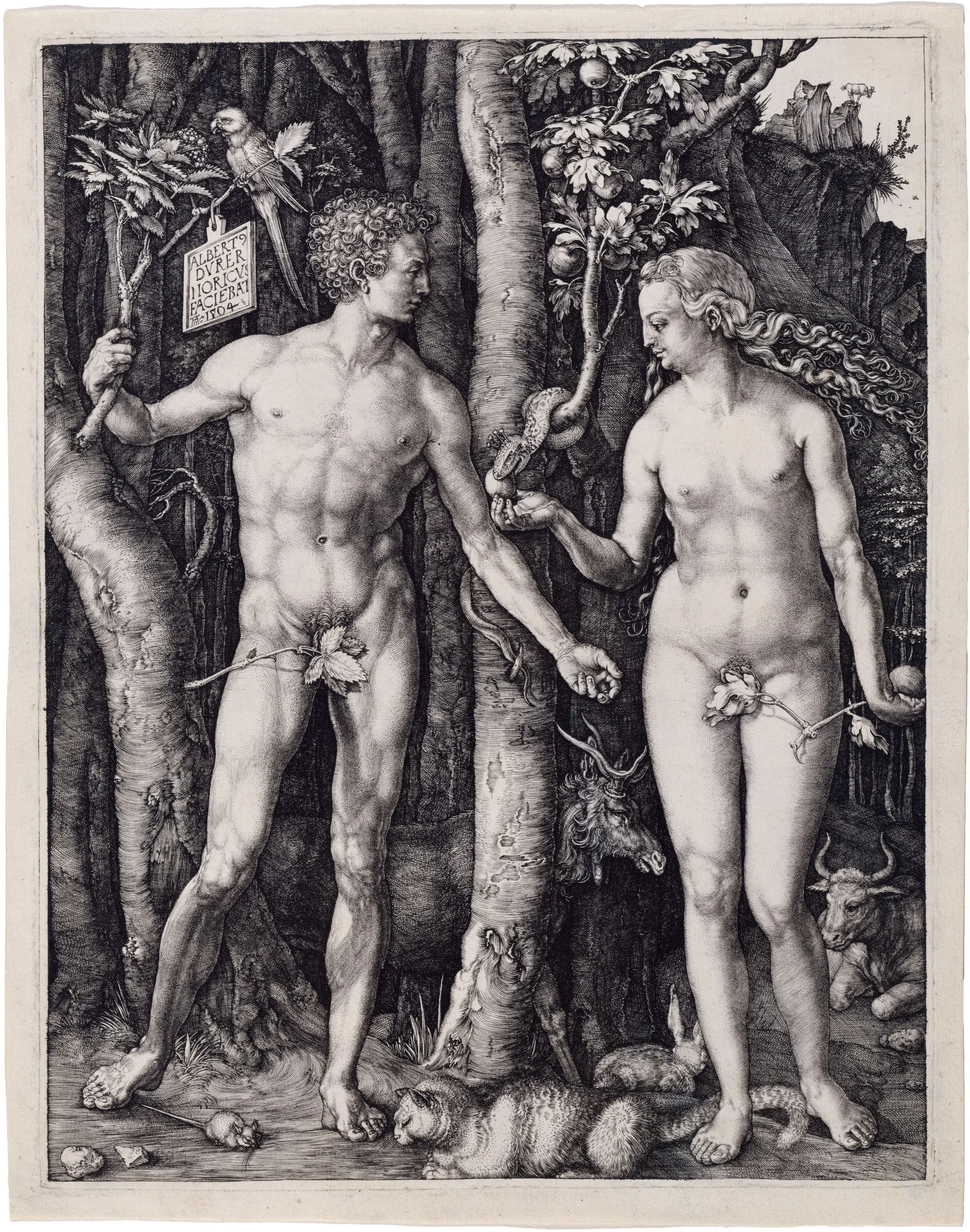
That distinction becomes crucial when discussion turns to Adam and Eve. “First parents,” “common ancestors,” and “a population of two” are not interchangeable expressions. Before asking whether science and Catholic teaching fit together, we need to identify which claim is actually under discussion.
How a genome records a population
You carry two copies of most chromosomes, one inherited through each parent. Those copies differ at some positions. Across many generations, mutation introduces variation and recombination rearranges inherited stretches. Different stretches can therefore trace back to shared ancestral copies at different times.
In a landmark 2011 study, Heng Li and Richard Durbin used variation across whole genomes to infer histories of ancestral population size. Their method reconstructs patterns of common ancestry across genomic regions; it does not count ancient people directly. They also showed limitations, including reduced resolution for recent periods and the smoothing of abrupt population changes. Li and Durbin, Nature
The resulting “effective population size” is a technical measure of how ancestry and genetic variation behave under a model. It is not a census. Migration, population structure, reproductive differences, and assumptions about mutation rates can affect the inference. Those qualifications matter, but they do not make genetics arbitrary. A model must still explain the observed variation and survive comparison with alternatives.
Human population research describes a history involving populations and exchanges among them. It does not supply evidence that the entire human population recently consisted of one isolated breeding couple. Conversely, a single population-size curve should not be advertised as a mathematical proof against every imaginable ancestral scenario.
Common ancestors need not be the only ancestors
A 2004 study by Douglas Rohde, Steve Olson, and Joseph Chang modeled genealogical ancestry across structured populations. Under its assumptions about migration and reproduction, common ancestors of everyone living today could occur surprisingly recently. The paper is a demonstration of how pedigrees overlap, not the discovery of a named historical couple. Rohde and colleagues, Nature
Imagine two large communities connected by a few migrating families over many generations. Descendants of those families can spread through both communities without either community ever shrinking to two people. Shared ancestry can become universal while the population remains large. This is the kind of distinction genealogical models make intelligible.
It also explains a familiar source of confusion. “Mitochondrial Eve” refers to common ancestry along a particular maternal genetic lineage, not the only woman alive in her generation. Other women could contribute ancestry through other paths. Genetic lineage labels are not biblical identifications, and tracing one lineage does not reconstruct the whole human family tree.
What the Catholic teaching commits to
In Humani Generis 36, Pius XII allowed qualified investigation of the human body's origin from prior living matter, while affirming the immediate creation of spiritual souls. Paragraph 37 then restricted acceptance of polygenism, including the claims that true humans existed after Adam without descending from him, or that Adam represents multiple first parents. The stated concern is the connection between an individual Adam's sin, generation, and universal original sin. Humani Generis, 36–37
The Catechism retains both figurative expression and a primeval Fall. It describes original sin as a received deprivation of original holiness, not a personal act committed by each descendant. Its transmission belongs to a theological account of human solidarity and the need for redemption. Catechism, 390 and 404–405
Original sin is therefore not a defective gene awaiting identification. Nor can baptism be treated as a genetic intervention. Translating the doctrine into DNA would change the kind of claim being made before any biological test began.
Why attractive reconciliations still need scrutiny
One proposal distinguishes universal genealogical ancestors from a sole genetic founding pair. That distinction is scientifically meaningful. It can remove a mistaken assumption that common ancestry requires a recent population bottleneck of two.
The doctrinal difficulty appears when we work through the proposal. Suppose a couple's descendants eventually include every living person, while other people lived alongside the couple at the outset. Universal ancestry today would not tell us whether those contemporaries descended from Adam or shared the condition that Catholic teaching calls original sin. A reconciliation must explain their status and the transmission of original sin, as well as the later family tree. It must also explain how its account meets Humani Generis 37's concern about true humans after Adam who do not descend from him. The genealogical result solves a problem about ancestry; these additional claims need their own defense.
Another proposal speaks of a first community rather than a first couple. It must confront Humani Generis 37 directly, rather than quietly treating the document as though it said the opposite. Further theological development requires argument and attention to the Church's teaching authority; an author's imaginative reconstruction is not an official settlement.
The International Theological Commission's 2004 discussion of creation and human origins illustrates serious engagement with evolutionary science and theological anthropology. Its role is theological reflection, however, and it does not provide a license to treat every proposed reconciliation as established doctrine. Communion and Stewardship, 63–70
What can be held together now
John Paul II's 1996 address recognized the strengthened scientific case for evolution while distinguishing it from philosophical reductions of the person. That is permission to take the evidence seriously, not a claim that every detailed theological question has disappeared. Message to the Pontifical Academy of Sciences, 4–6
A responsible discussion can therefore make progress without manufacturing a final model. It can explain genetic evidence accurately, preserve the actual doctrinal difficulty, and compare proposals by the questions they answer and leave open. Where a reconciliation depends on an unsupported historical assertion, that dependency should remain visible.
There is also a claim that no reconstruction should obscure: human dignity is shared. Ancestry must not become a device for sorting living people into different spiritual ranks. Catholic teaching presents humanity as a unity with common dignity and solidarity. Catechism, 360–361
Ancestry can help reconstruct our past; it cannot rank the worth of living people. That limit should guide comparisons between genealogies, genetic models, and religious accounts.