
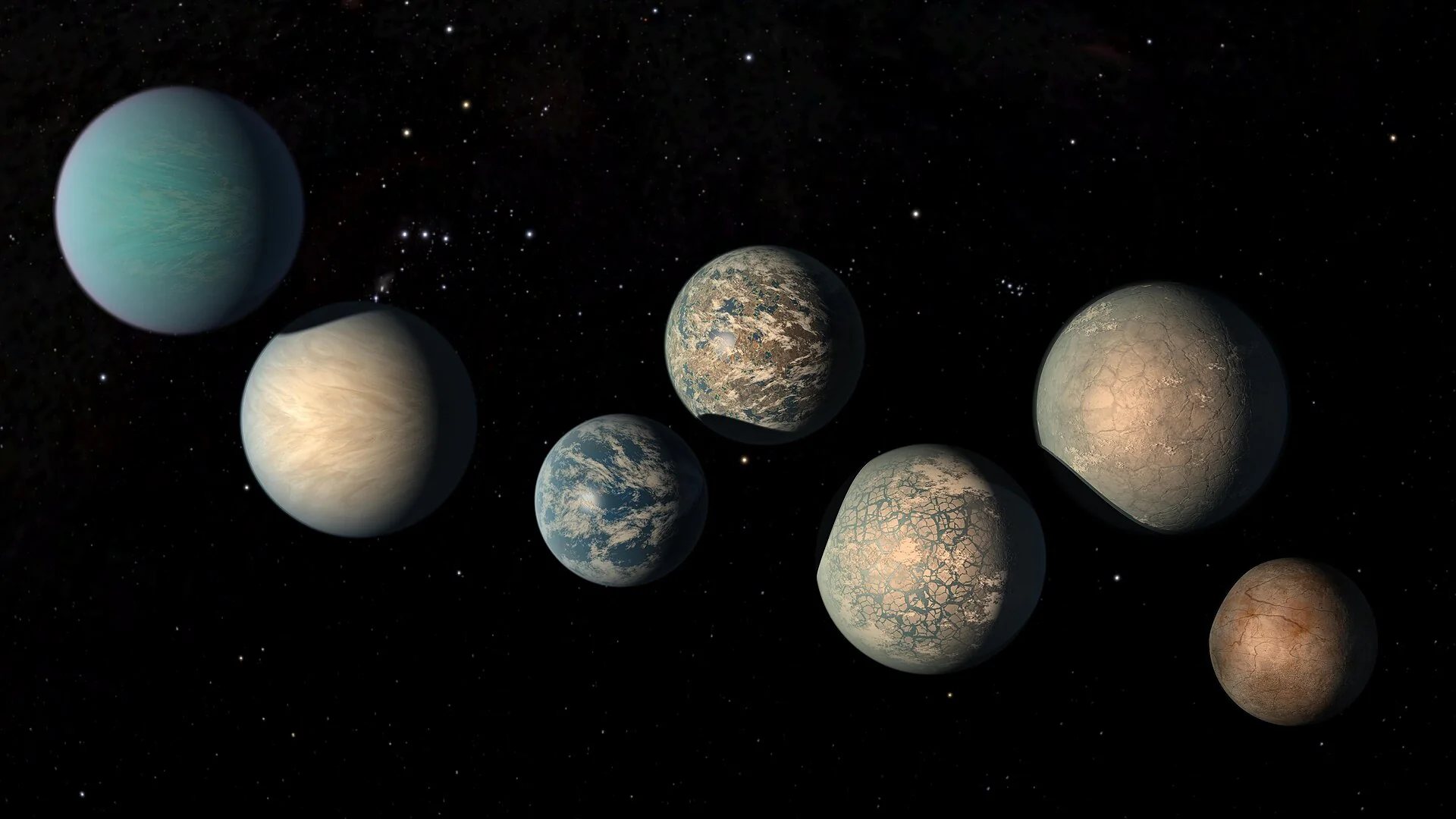
A telescope records a slight dip in starlight as a planet crosses its star. At some wavelengths, the dip is deeper: gases in the planet's atmosphere absorb some of the passing light. From differences like these, astronomers can investigate a world they cannot visit.
Now imagine a molecule appears that life on Earth sometimes produces. The discovery would be exciting. It would not yet amount to a conversation with extraterrestrials—or necessarily to evidence that anything on that planet is alive. Before asking what alien life would mean for Christianity, we need to distinguish several very different possible discoveries.
First establish what has been found
As checked for this article on 27 October 2026, NASA's astrobiology overview states that life beyond Earth has not been found. Research nevertheless investigates many possible traces of it. A biosignature is a feature that may provide evidence of present or past life: a chemical pattern, structure, or other measurable result. NASA: About Astrobiology; What is a biosignature?
The word “potential” often does important work. A gas associated with organisms here might arise through nonliving chemistry elsewhere. Its significance depends on abundance, accompanying gases, the star's radiation, the planet's environment, and the reliability of the measurement. A persuasive case needs more than one suggestive resemblance.
NASA's Ladder of Life Detection organizes questions about measurements and possible biosignatures. It encourages evaluation of specificity and evidence while remaining a working framework. It is not a device that automatically converts a promising signal into a confirmed organism. Ladder of Life Detection
For a sample closer to home, investigators would also ask whether terrestrial contamination could explain the result. If living organisms were found elsewhere, a further question would be whether they arose independently or share ancestry with Earth life. “Life in another place” and “a second origin of life” are distinct findings.
Microbes would change biology first
A confirmed extraterrestrial microbe would be a major discovery even if it never wrote a poem, built a machine, or asked a religious question. It could transform our understanding of where life can exist and which chemical arrangements support it.
But a microorganism does not raise the same theological questions as a rational, morally responsible creature. We already distinguish many kinds of life on Earth. Discovering another living form would not automatically tell us that it has language, conscience, spiritual awareness, or a history of moral wrongdoing.
Catholic belief in creation is not a claim that God made only the organisms humans had already catalogued. Brother Guy Consolmagno's discussion of extraterrestrial intelligence develops this point as theological reflection: a wider creation would still fall within the scope of the Creator. His speculation should be read as an astronomer's reasoned exploration, not a declaration that extraterrestrials exist. Consolmagno: Intelligent Life in the Universe?
A second biosphere could make familiar words such as “creation” harder to picture and richer to contemplate. Whether life is rare or widespread, however, its frequency alone cannot establish a divine purpose. Scientific discovery and theological interpretation would each still require their own reasoning.
Intelligence would add another layer
The search for technosignatures looks for possible evidence of technology, such as engineered signals or atmospheric substances with plausible industrial origins. Researchers must distinguish such evidence from natural phenomena and human interference. NASA describes this as a broader search than listening for radio messages alone. NASA: Searching for technosignatures
Even a compelling technological signal would leave much unknown. It might be old. Its source might no longer exist. Its makers might have forms of cognition difficult for us to recognize. A transmitter does not disclose its builders' moral life merely by being technically impressive.
Should contact become possible, interpretation would be a formidable task. A repeated pattern could establish that information is being exchanged without immediately revealing what the information means. We should resist filling silence with familiar human stories, whether friendly visitors, conquering enemies, or beings who confirm our preferred worldview.
The difficult Christian questions are real
Christianity makes particular claims about Jesus Christ and universal claims about his significance. Colossians places all created things in relation to Christ, while Dominus Iesus affirms the uniqueness and universality of his saving mediation. Those commitments would remain part of any serious Catholic consideration of rational extraterrestrial life. Colossians 1:15–20; Dominus Iesus, 9–15
How might another rational species relate to that history? Would it have experienced a Fall? Would its relationship with God involve features unknown to us? How should the cosmic significance of Christ be understood in relation to creatures with a different biological ancestry?
These are theological questions, not consequences already contained in a spectrum or radio pulse. Consolmagno's treatment acknowledges the speculative character of proposals about alien salvation. It is possible to explore alternatives while refusing to promote one imagined scenario into a settled Catholic answer.
The strongest skeptical challenge is therefore not simply “aliens would disprove God.” It is that a genuinely different intelligent life could unsettle assumptions Christians have made about humanity's place in the story. That challenge deserves thought. It cannot be answered adequately by assuring readers that no interpretation would ever need revision.
A larger neighborhood demands humility
There would also be an ethical question before any full theological system was ready. Encountering unfamiliar life would create responsibilities concerning contamination, exploitation, and harm. A lack of familiarity would not establish a lack of value. A cautious response could be required even while scientists debated the capacities of the organisms involved.
This is a reason to strengthen our habits now: distinguish a measured signal from its interpretation; listen before assigning motives; avoid treating what is unfamiliar as disposable. Those habits matter in our existing earthly relationships, where we already have ample evidence of lives beyond our own.
If a discovery comes, its form will determine the next inquiry. A possible biological trace, a living organism, and a message would each bring different evidence and different questions for science and theology.