
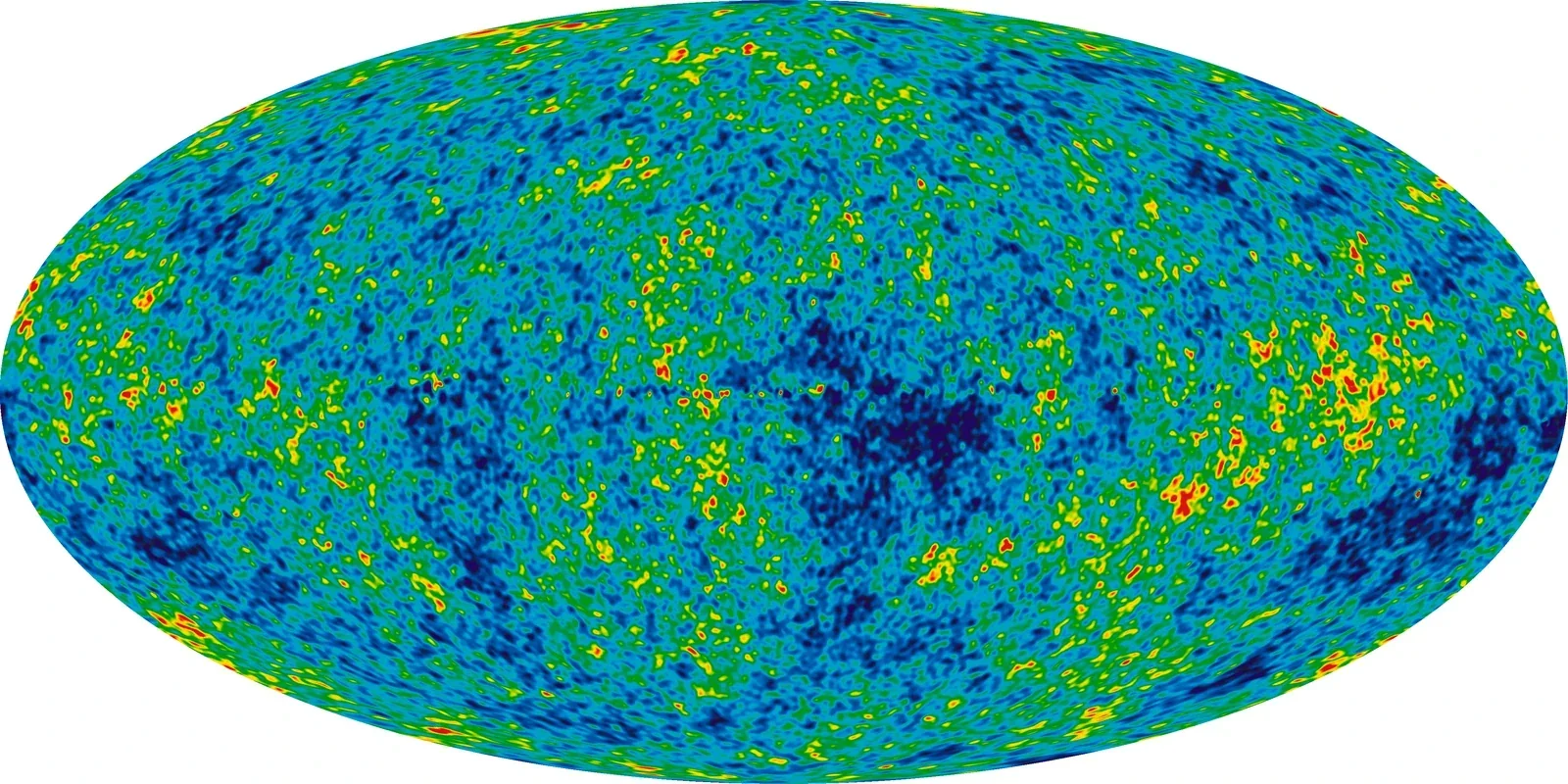
A map of the cosmic microwave background looks like a mottled oval: patches of warmer and cooler color spread across the whole sky. It is easy to mistake it for a photograph of the instant everything began. What the map actually records is radiation that began traveling freely through the universe when it was about 380,000 years old. The colors represent tiny temperature differences, greatly exaggerated so that we can see them. NASA's explanation of the cosmic background
That is astonishingly early. It is also late enough to leave the question in our title unanswered. To think clearly about what preceded the Big Bang, we first need to ask which meaning of “Big Bang” we have in mind.
A history, and a possible boundary
The expression can name the hot, dense early universe and its subsequent expansion. It can also name the hypothetical initial boundary reached when a classical mathematical model is extrapolated backward. Those are different claims. Evidence for a hot early phase does not automatically establish that our equations describe an absolute beginning correctly. The Max Planck Institute's Einstein Online makes this distinction central to its explanation of the theory. A tale of two big bangs
Working backward means applying equations to progressively hotter, denser conditions. Eventually the classical description reaches conditions where its reliability is in question. Physicists then need a better account of gravity and quantum effects. A model can reconstruct a long stretch of cosmic history successfully while leaving that earliest interval unresolved.
The universe's expansion is also unlike a bomb exploding into an empty room. On large scales, the distances between regions participating in cosmic expansion increase. The model does not require a privileged center from which every galaxy was thrown. Asking what surrounded the explosion can therefore start us with the wrong picture. NASA's Big Bang questions and answers
What the surviving evidence can tell us
Cosmologists connect several kinds of evidence: the expansion seen in galaxy observations, the background radiation, and the production of light elements in the early universe. They build models that must account for these traces together. A proposal cannot succeed simply by telling an appealing story about the beginning; it has to produce a universe resembling the one measured today. NASA's cosmic history
The microwave background is especially useful because its patterns carry information about conditions before the light began traveling freely. Waves in the early mixture of matter and radiation left a statistical pattern. Comparing predicted patterns with observed ones lets researchers test an earlier period indirectly. This is ordinary historical reasoning made extraordinarily precise: a surviving trace can constrain events that nobody observed firsthand. ESA on the background and early structure
A proposed earlier history therefore has a demanding job: it must lead to the later pattern we observe. Different models can sometimes produce similar traces. Researchers look for predictions that separate them, rather than treating a good fit as proof of a unique history.
Inflation offers an earlier chapter
Inflation proposes a brief period of accelerated expansion before the familiar hot phase. It offers explanations for the universe's large-scale smoothness and the small initial differences from which structure grew. In this usage, something can happen “before the Big Bang” because the term refers to the hot phase following inflation. NASA's cosmic timeline uses this convention. NASA's discussion of inflation
Measurements from the Planck mission constrain inflationary ideas, but they do not identify a uniquely established physical mechanism. The mission's 2018 results strengthened the observational case for important features associated with inflation while leaving major questions about its implementation. Evidence consistent with a family of models should not be presented as a direct recording of one particular model. ESA's account of the Planck legacy results
Other proposals explore a contracting phase followed by a bounce, or descriptions in which familiar time does not extend through the earliest boundary. These possibilities require mathematical development and observational discrimination. Naming several alternatives is not evidence that they are equally successful, and none supplies a settled answer merely by being imaginable.
Does “before” always make sense?
In general relativity, time belongs to the structure of spacetime. It is not an independent clock hanging outside the universe. Some classical cosmological descriptions reach a singular boundary where they cease to supply a usable continuation. Such a boundary signals a limit of the description; it is not an observed object whose infinite density has been measured. A reliable account of those conditions may require a theory combining gravity and quantum physics. Einstein Online on the limits of the classical account
If time itself has a first boundary, “before” could be inapplicable. If a more complete theory extends the history, it could be meaningful. We do not resolve that difference by announcing that asking the question is foolish. The question is reasonable; the assumptions inside it are what need examination.
The answer depends on which boundary we mean. Before the hot phase, inflation may supply an earlier chapter. Before time itself, the word “before” may have no application. Present evidence has not selected a complete account of that earliest boundary.
Creation reaches beyond a first timestamp
Catholic belief in creation includes the claim that everything depends on God for its existence. The Catechism describes God as sustaining creatures in existence at every moment, including the present. Catechism, paragraphs 300–301
This gives believers a reason to resist premature victories. If a bouncing model gained compelling support, the philosophical question of why its entire reality exists would remain. If physics established a temporal beginning, identifying that boundary with the Christian doctrine of creation would still require an argument. John Paul II expressly cautioned against hurried apologetic uses of Big Bang cosmology while welcoming serious theological engagement with it. His 1988 letter to George Coyne
When a discovery is said to reveal what came before the Big Bang, ask which beginning it crosses and what observation tests the proposal. Reconstructing conditions before the microwave background, explaining the start of the hot phase, and explaining why a universe exists are three different tasks. A compelling answer to one can leave the others open.