THE PERSON BEHIND THE ACCOUNT
Bernardino preached to merchants, magistrates, and divided cities.
Before his reputation as a preacher, Bernardino served with other young Sienese people during plague. He later joined the Observant Franciscans, choosing a demanding form of religious life. The public career grew from that earlier commitment to care and discipline. [1]
Preaching as a learned craft
Born at Massa Marittima in 1380, Bernardino became a preacher whose work took him across central and northern Italy. His preparation drew on Scripture, theology and other learning. Different listeners—merchants, officials, married people and clergy—were addressed as people whose conduct could be examined in public. [1] [2]
The sign brought suspicion as well as recognition
An older scholarly biography recounts accusations of heresy associated with his promotion of the name of Jesus and his subsequent defense. His message was not automatically welcomed by every churchman. The Order’s later account remembers him seeking to preserve communion during disputes over Observant authority. [3] [2]
Who was excluded from that moral community?
The same scholarly account identifies an exclusionary side of the framework: Jewish people and those labeled heretics were treated as outside full civic trust. That prejudice belongs in an assessment of his legacy. Concern for the common good could be narrowed by defining who counted as a reliable member of the community. [4]
Readers can study his religious teaching while naming the harm in those assumptions. Historical context helps explain how they operated; it does not turn distrust of a religious minority into a lesson to preserve.
IN OUR OWN LIVES
The responsibility of a public voice
A preacher can influence whom a city trusts, protects, or excludes. Bernardino’s economic teaching gives readers particular judgments to examine: responsibility in exchange, and suspicion directed at religious minorities. A public speaker’s own words deserve the scrutiny he applies to his listeners. [4]
THROUGH THE EYES OF FAITH
Faith and daily life
Devotion to the name of Jesus stood at the center of his preaching. The Franciscan Order describes prayer and study supporting that work, with the IHS sign giving the devotion a recognizable public form. He wanted religious language to change the conduct of listeners. [2]
The merchant was part of a community
Scholar Oreste Bazzichi’s discussion of just price places Bernardino’s economic thought within concern for civic well-being. A merchant’s reputation and conduct mattered because exchange affected other people. The account notes his opposition to exploiting a buyer’s ignorance or particular need. [4]
These questions are still recognizable, though their medieval answers cannot simply be imported into a modern market. Bernardino treated trade as human conduct with obligations; the desire for profit did not put it beyond moral judgment. [4]
The friar and his reputation
The Franciscan account says Bernardino declined to exercise disputed privileges after appointment over the Italian Observants. It remembers a concern for personal and communal poverty alongside sensitivity toward other friars. He died at L’Aquila in 1444 and was canonized in 1450. [2]
THROUGH THE LENS OF SCIENCE
The evidence about the remains
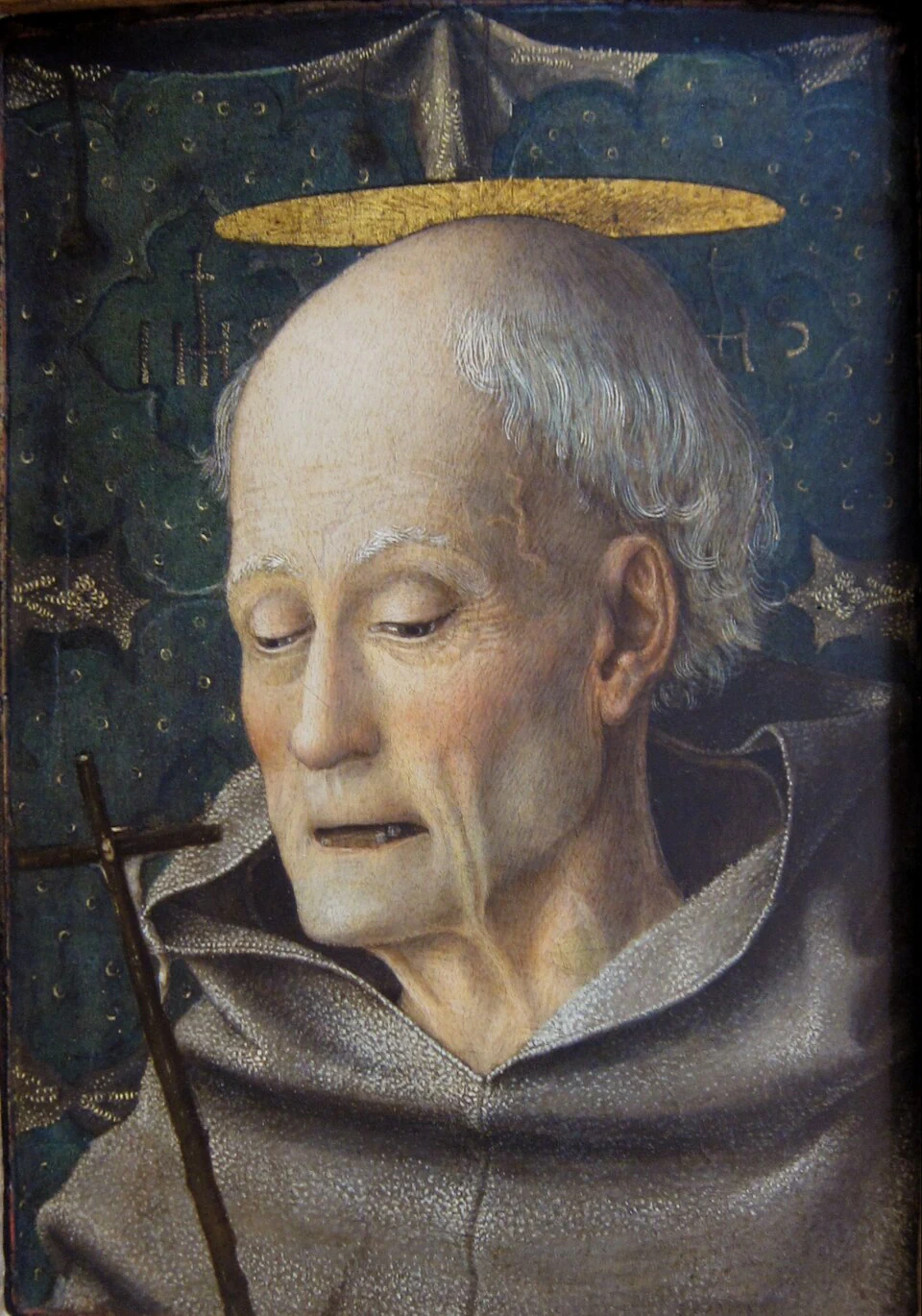
John Paul II called Bernardino’s body incorrupt in 1980. That wording records a devotional description; a material account also needs the history of any treatment. [1]
Preservation and human intervention
A 2021 paleopathology review lists Bernardino among artificial mummies. Its direct survey concerns Ranieri da Borgo. [5]
The pope’s wording records a devotional description. The scholarly classification introduces a treatment history. Neither gives a complete present-day tissue inventory or an account of every later restoration. The remains’ current condition requires evidence specific to the body and its care.
READER QUESTIONS
Questions and answers
What was his distinctive devotion?
The name of Jesus, publicly represented by the IHS sign, shaped his preaching and religious renewal. [2] [3]
Why discuss prejudice on a saint’s page?
His economic and civic teaching included exclusionary assumptions about Jewish people and those called heretics. An account of his influence must leave that documented problem visible. [4]
How can a treated body also be called incorrupt?
The word has been used in devotional accounts of exceptional preservation. It does not specify which tissues survived or which treatments were used. Those details require an examination and conservation records.
FOLLOW THE SOURCES
Sources and further reading
- John Paul II — Message for Massa Marittima, 6 September 1980
Primary historical record
Plague service, preparation for preaching and explicit 1980 incorrupt-body wording. A devotional message, not a medical report.
- Franciscan Order — Bernardino of Siena
Church or shrine source
Name-of-Jesus devotion, Observant responsibilities, death, canonization and current shrine location.
- Enciclopedia Italiana — Bernardino of Siena, 1930
Scholarly account
Historical account of heresy allegations and defense.
- Oreste Bazzichi — Just Price, Bernardino section, 2012
Scholarly account
Economic conduct, exploitation, civic membership and explicit Jewish/heretic exclusionary assumptions.
- Mandarano, Czortek and Ventura — Medieval body embalming (2021)
Scholarly account
Comparative table; direct survey concerns Ranieri.
Sources checked: 2026-10-27. Suggest a correction or a source.