THE PERSON BEHIND THE ACCOUNT
She helped build a religious community while caring for her sick husband.
When Francesca’s companions began living together at Tor de’ Specchi, she remained at home caring for her seriously ill husband, Lorenzo. She joined the community after his death. Founding a religious house had not removed her immediate obligation to the person beside her. [4]
A household in a troubled city
Francesca was born in 1384 and married into the Ponziani family while young. She had three children, only one of whom survived. The diocesan account places her life amid Roman family violence, shortages and epidemics. These losses belong in the biography without treating grief as something erased by a later religious achievement. [4]
Opening the family’s resources
The Church biography remembers her household as a place where poor people could find food, clothes and assistance. It also describes her seeking donations from people of her own social standing. Her charity involved using access to wealth and asking others to share it. The account includes miracle traditions; the practical use of the house is the focus here. [1]
Companions and permission
Rome’s municipal history distinguishes the women’s 1425 oblation at Santa Maria Nova from the start of common life in 1433. Their unusual arrangement needed legal recognition. Francesca sought privileges from Eugene IV, including the ability to elect a leader and receive other women; the Olivetan congregation later recognized their autonomy. The foundation required an institutional place for women’s shared work and prayer. [6]
A community remembered in paintings
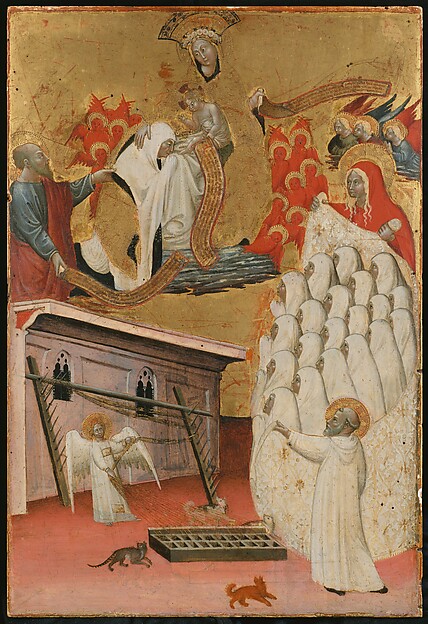
At Tor de’ Specchi, a cycle of twenty-five scenes completed by Antoniazzo Romano in 1468 depicts her life. These images show how the community remembered its founder soon after her death. They are devotional narratives with captions, not photographs or neutral records of every incident they portray. [4]
IN OUR OWN LIVES
When care changes the timetable
Francesca’s life is recognizable to anyone whose hopes must share time with a family member’s illness. Her story allows a founding achievement and household care to occupy the same biography. Neither has to vanish for the other to count.
Her use of family resources also raises a practical question for people with space, influence or money: what could those advantages make possible for someone else? A spare room, a reliable meal and an introduction to someone who can help are modest arrangements until a person needs them. The continuing community suggests how individual generosity can become a shared responsibility.
THROUGH THE EYES OF FAITH
Faith and daily life
Her vocation crossed marriage, motherhood, widowhood and religious community. Benedict XVI described her legacy as a union of recollection and practical service, sustained by prayer and experience among people needing help. [5]
Recollection with obligations attached
During his 2009 visit, Benedict XVI connected the sisters’ vocation with Mary’s visit to Elizabeth: prayer bearing fruit in help for another person. He included care for sick people, marginalized neighbors and children in difficulty. This gives a practical Catholic reading of Francesca’s life. Religious attentiveness should deepen a person’s ability to recognize an obligation, including one that interrupts a preferred plan. [5]
THROUGH THE LENS OF SCIENCE
The evidence about the remains
The basilica now called Santa Francesca Romana contains her tomb. Italy’s archaeological-park authority describes its later architectural setting; it does not provide an anatomical account of the remains. [3]
Her basilica and the tomb
Santa Maria Nova became associated with Francesca’s burial in 1440. The archaeological authority identifies the seventeenth-century funerary structure commissioned from Bernini. That is evidence for the tomb’s history and artistic setting. A determination about preserved tissue would require examination and conservation records, which this architectural account does not supply. [3]
READER QUESTIONS
Questions and answers
FOLLOW THE SOURCES
Sources and further reading
- Dicastery for the Causes of Saints — Francesca Romana
Institutional source
Religious biography, household charity and canonization.
- Parco archeologico del Colosseo — Santa Maria Nova
Institutional source
Tomb, basilica and Bernini architectural history; no anatomical examination.
- Diocese of Rome — Santa Francesca Romana
Institutional source
Family care, community and early painted cycle; devotional retrospective.
- Benedict XVI — Tor de’ Specchi, 9 March 2009
Institutional source
Primary Catholic interpretation of prayer and service.
- Roma Capitale tourism — Women of Rome
Institutional source
Distinguishes oblation, communal life and legal recognition; its century typo is not repeated.
Sources checked: 2026-10-27. Suggest a correction or a source.