THE PERSON BEHIND THE ACCOUNT
A widowed mother built a community that could teach and care through years of upheaval.
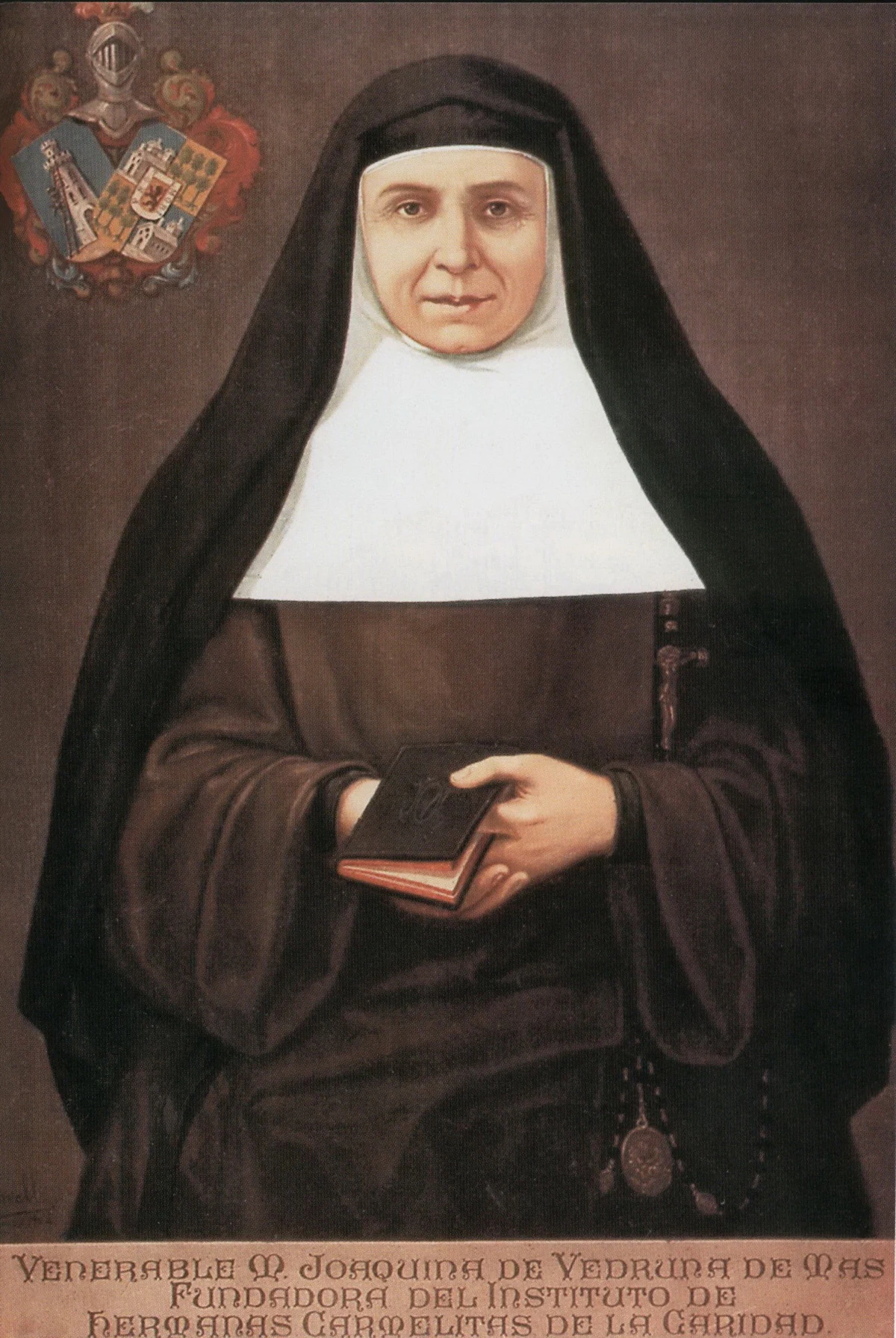
When Teodoro de Mas died in 1816, Joaquina was left with six surviving children. Ten years later she founded the Carmelites of Charity at Vic. [4]
Marriage, children and widowhood
Born in Barcelona in 1783, Joaquina married Teodoro in 1799. [1]
The congregation remembers nine children, six still living when she became a widow. These were substantial responsibilities before there was any institute bearing her name. [4]
War made home insecure
The same chronology records eight months of exile at Prades with her family in 1822. In 1840 another war forced her to Perpignan with fifteen sisters for three years. The foundation’s history includes interruption and displacement. Its growth cannot be imagined as a continuous sequence of schools opening without loss, risk or the need to find shelter. [4]
A religious community in 1826
Joaquina made her religious profession in January 1826 and established the congregation that February. The sisters remember her receiving nine young women into her home; together they began serving girls, women and sick people. Opening the household to a new community required other women to share its work and decisions. [4]
Two hundred years later at Vic
The congregation’s February 2026 bicentenary report describes sisters, lay collaborators and invited communities gathering at Vic. It includes the inauguration of the Casa Manso project and participation by vocational students. The gathering brought the foundation’s anniversary into the lives of students and collaborators who now share its work. [2]
IN OUR OWN LIVES
A later vocation can include the earlier one
Joaquina’s biography is useful to anyone who wonders whether family duty has delayed or displaced their contribution to a larger community. Her story does not require those parts of life to compete for the title of a “real” vocation.
Its repeated displacement also gives institutional perseverance a practical meaning. People have to find accommodation, maintain relationships and begin work again after plans fail. A lasting foundation depends on the people who take those decisions together. Remembering them makes a two-hundred-year history less remote: its continuity was made through households and communities facing the next available task.
THROUGH THE EYES OF FAITH
Faith and daily life
At her canonization, John XXIII emphasized that Christian holiness is possible in different circumstances and responsibilities. Joaquina’s life gave that teaching a particular shape across marriage, widowhood and religious leadership. [1]
Finding God within the responsibility
John XXIII’s canonization homily opens with Francis de Sales’s teaching that holiness can be pursued in any condition of life or office. Read through Joaquina’s biography, it makes household care and later leadership intelligible within the same vocation. A change of role need not make earlier responsibilities spiritually insignificant. [1]
The charism the sisters describe today
The present congregation describes its spirituality through attentiveness to God in ordinary life, community, solidarity and the places where people suffer. The sisters understand contemplative prayer as a source of their education and care: attention to God accompanies attention to the person in need. [5]
THROUGH THE LENS OF SCIENCE
The evidence about the remains
The congregation’s cause history records examinations and changes of reliquary. Those are custodial events. The public chronology is not a modern anatomical report describing every tissue that survives or its treatment. [3]
A chronology of recognition and relics
The congregation’s cause page traces the long process leading to beatification in 1940 and canonization in 1959. It records a new embossed-metal urn at the motherhouse around beatification. Recognition of a life and the material history of a reliquary are related events, but answer different questions. The public account does not provide sufficient anatomical and conservation details for a preservation mechanism. [3]
READER QUESTIONS
Questions and answers
Did she establish the congregation before raising a family?
No. Her marriage and years of motherhood came first; she was widowed in 1816 and founded the congregation in 1826. [4]
Do the reported cure cases establish the condition of her body?
No. The congregation’s cause page presents intercession cases separately from the chronology of relics. A patient’s reported recovery is not an anatomical examination of the person invoked. [3]
FOLLOW THE SOURCES
Sources and further reading
- Dicastery for the Causes of Saints — Joaquina de Vedruna
Institutional source
Includes John XXIII’s canonization homily; family counts within the page are inconsistent.
- Vedruna congregation — Bicentenary opening, February 2026
Institutional source
Current institutional commemoration and Casa Manso inauguration.
- Vedruna Europe — Cause chronology
Institutional source
Recognition and reliquary history; devotional cure accounts are not bodily findings.
- Vedruna congregation — Origins
Institutional source
Family chronology, profession, foundation and two periods of exile.
- Vedruna congregation — Spirituality
Institutional source
The community’s present explanation of its charism; not an independent assessment.
Sources checked: 2026-10-27. Suggest a correction or a source.