THE PERSON BEHIND THE ACCOUNT
Pibrac remembers a shepherd whose neighbors failed to protect her.
Germaine tended sheep at Pibrac and, according to the Church’s retrospective biography, was denied education and a dignified place in her family after her mother’s death. She lived with disability and illness. The account remembers someone who continued seeking worship and contact with others in circumstances she had not chosen. [1]
The person in the later accounts
The checked Church sources disagree about her birth year. [1] [2]
The biography places her at Pibrac, tending sheep and living with physical impairment, before her death in 1601. It also records ridicule and family rejection; those are harms done to her, not necessary conditions for holiness. [1]
Faith within a constrained life
The diocesan narrative remembers her attending morning Mass and giving some of her bread to people in need. Her daily work and prayer became the setting of stories later told about her. The checked pages provide no diary or contemporary statement from Germaine herself, so her private thoughts cannot responsibly be reconstructed. [2]
IN OUR OWN LIVES
Recognizing the person who is overlooked
Germaine’s remembrance is most useful when it changes how a vulnerable person is treated now. Who is left outside the conversation, deprived of ordinary opportunities or expected to bear a household’s frustration without complaint?
Her story should offer companionship to people who have been excluded, without giving them another requirement to satisfy. They do not have to become a saint, forgive on command or perform a miracle to deserve care. The responsibilities of neighbors and institutions remain ordinary and concrete: listen, include and respond when someone is being harmed.
THROUGH THE EYES OF FAITH
Faith and daily life
The Toulouse diocese remembers her sharing bread with poor people and participating in Mass. These acts are presented within the local religious tradition. Her worth as a person did not depend on performing extraordinary acts or responding perfectly to mistreatment. [2]
The flock, the stream and the roses
Stories about a protected flock, a stream parting and bread becoming roses appear in the shrine’s account. They express the community’s belief that God cared for a young person others dismissed. They are miracle narratives transmitted through devotion; they should not be retold here as independently verified observations. [3]
An example does not excuse neglect
The Church biography praises her endurance. A present reader should also ask what the adults around her owed her: safety, education, care and inclusion. Calling someone patient does not make their abandonment acceptable. Prayer in her memory can be joined to attention to the disabled or isolated person whose needs are being treated as an inconvenience. [1]
THROUGH THE LENS OF SCIENCE
The evidence about the remains
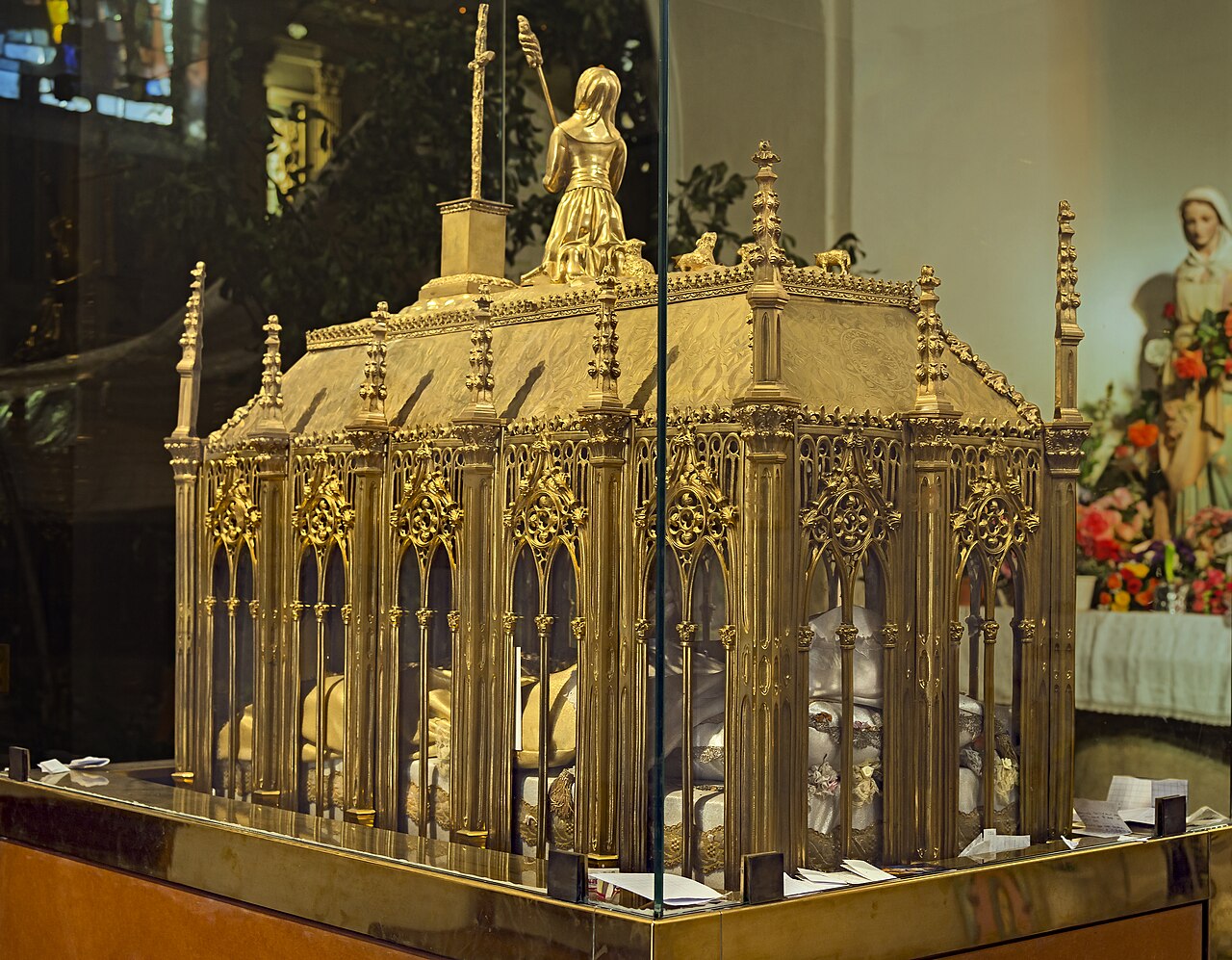
The shrine recounts a discovery of her body in 1644 and an attempt to destroy it with lime in 1793, followed by recovery of remains. That interrupted history is essential to interpreting the present reliquary. [3]
Discovery, destruction and recovered remains
The shrine’s account moves from a reportedly preserved body in 1644 to damaged and recovered remains after 1793. Toulouse identifies the relics’ continuing veneration and procession at Pibrac. Neither checked page supplies an anatomical inventory or conservation history. The early discovery narrative cannot, by itself, describe what survives today. [2] [3]
READER QUESTIONS
Questions and answers
Can we give her an exact age at death?
The checked institutional pages give different birth years. This profile uses her agreed death year, 1601, without choosing a precise age. [1] [2]
Does the 1644 story describe the remains today?
No. The shrine also records destructive treatment in 1793; its account gives no present anatomical inventory. [3]
FOLLOW THE SOURCES
Sources and further reading
- Dicastery for the Causes of Saints — Germaine Cousin
Institutional source
Brief retrospective life; disability, rejection and canonization.
- Diocese of Toulouse — Sanctuary of Sainte Germaine
Institutional source
Local life traditions and relic procession; birth year differs from Dicastery.
- Sanctuary of Pibrac — Who is Saint Germaine?
Institutional source
Custodial retelling of 1644 discovery, miracle traditions and 1793 destruction.
Sources checked: 2026-10-27. Suggest a correction or a source.