THE PERSON BEHIND THE ACCOUNT
Before she became a saint, Maria was a child helping her family survive.
Maria Goretti kept house, cooked, and watched a younger sister while her family worked to earn its living. Her father had died, and there was no money or time for her schooling. Vatican News describes a child carrying responsibilities many adults would find difficult. She was eleven when Alessandro Serenelli killed her in 1902 after she resisted his attempted sexual assault. [1]
A family on the move
Born in Corinaldo in 1890, Maria moved with her parents as they searched for work. They eventually lived at Le Ferriere in the Pontine Marshes. John Paul II’s centenary message recalls her father’s death from malaria and the faith her parents taught at home. Poverty restricted her opportunities, but the family remembered her as someone who could encourage others in bereavement. [2]
A threat inside a shared household
The Gorettis shared living quarters with the Serenelli family. Alessandro, an adult, made sexual advances toward Maria and threatened to kill her if she told anyone. On 5 July 1902 he attacked her. She died in hospital at Nettuno the following day. Those facts concern an adult’s violence against a child; her courage must never become an excuse for overlooking his responsibility. [1]
IN OUR OWN LIVES
Keeping the child in view
A child who cooks, keeps house, and cares for a younger sibling can disappear into the work she does for everyone else. Remembering those responsibilities helps restore Maria’s place within a family struggling to survive. Adults reading her life should notice both her generosity and how much she needed protection. [1]
Her forgiveness can be read alongside truth-telling and responsibility. For parents, teachers, and parish communities, a faithful retelling must leave a child certain that threats can be reported and that abuse is the offender’s fault. Maria’s memory deserves that care. [4]
THROUGH THE EYES OF FAITH
Faith and daily life
Maria’s recognition concerns a child’s faith and martyrdom. Her story also calls attention to the duty adults owe children who depend on them. John Paul II expressly affirmed a child’s right to grow up protected from danger. [2]
Faith learned without a classroom
Pius XII’s canonization homily remembered Maria’s eagerness for religious instruction and prayer despite her lack of formal education. He also described her sustained help with domestic work. These ordinary acts give some shape to a childhood that a retelling focused only on the attack can erase. The Church canonized her on 24 June 1950 as a virgin and martyr. [3]
Forgiveness and accountability
The Church’s accounts remember Maria forgiving Alessandro before her death. John Paul II emphasized that forgiveness requires an offender to acknowledge what he has done and accept responsibility. His message also remembers her mother’s forgiveness. Maria’s words offer a demanding Christian response to harm; they give no permission to conceal abuse or escape justice. [2]
Catholic teaching identifies rape as a grave violation of a person’s freedom and integrity. A victim’s dignity does not depend on resisting successfully, suffering an injury, or being ready to forgive. That principle is essential when discussing Maria with children, survivors, or anyone who has heard her story used carelessly. [4]
THROUGH THE LENS OF SCIENCE
The evidence about the remains
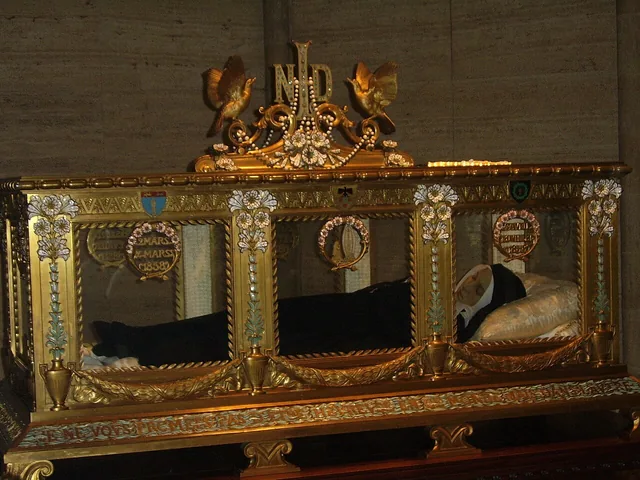
The casket contains a wax figure enclosing skeletal remains. The custodial pilgrimage account rejects the claim that Maria’s body is incorrupt. That explanation should accompany photographs of the display. [5]
The face in the casket
The shrine’s pilgrimage organizers explicitly say Maria’s body is not incorrupt. It decomposed after burial. Her skeletal remains lie within a wax statue, and none are visible. The account describes a substantially complete skeleton, with fragments removed and her right arm kept at Corinaldo. [5]
The same source explains how the likeness was made. Artists used a painted portrait based on her mother’s description; no photograph of Maria was available. The face visitors see is an artistic representation. Its lifelike surface should not be presented as preserved skin. [5]
READER QUESTIONS
Questions and answers
Is the visible figure her incorrupt body?
No. The shrine’s pilgrimage account describes skeletal remains inside a wax statue, with none of the bones visible. [5]
Does honoring Maria imply blame for other victims?
No. Catholic teaching condemns rape as a violation of the victim’s freedom and integrity. The offender bears responsibility. A person’s dignity is not measured by how an assault ends. [4]
How old was she?
Maria died on 6 July 1902, aged eleven. [1]
FOLLOW THE SOURCES
Sources and further reading
- Vatican News — Saint Maria Goretti
Church or shrine source
Childhood work, shared household, threats, attack and death. No graphic reconstruction or quoted dialogue reproduced.
- John Paul II — centenary message, 6 July 2002
Papal
Family history, death, forgiveness with accountability, and children’s right to protection.
- Pius XII — canonization of Maria Goretti, 24 June 1950
Papal
Primary canonization text and homily on family labor, instruction and prayer. It supplies no preservation finding.
- Catechism of the Catholic Church — paragraph 2356
Church teaching
Condemnation of rape as a violation of justice, charity, freedom and personal integrity.
- Shrine pilgrimage organizers — The Body
Custodian
Explicit correction of incorruption claim, skeletal contents and transfers, wax figure and likeness based on her mother’s description.
Sources checked: 2026-10-27. Suggest a correction or a source.