THE PERSON BEHIND THE ACCOUNT
The cure did not happen; her life continued
The diocesan account says Margaret’s parents brought her to a tomb hoping for healing. No healing followed, and they abandoned her in Città di Castello. The story’s moral failure belongs to the people who left her. Margaret’s worth did not depend on her body changing in the way they wanted. [1]
The kind of story that survives
Her diocese identifies two Latin versions of a legenda as the basis of the biography. Scholar Pierluigi Licciardello’s published abstract dates both versions to the fourteenth century and distinguishes a longer life associated with a local canon from a shorter Dominican version. The accounts belong near her lifetime, but they were written to present sanctity. [4]
A hagiographer may preserve people, places and testimony while also arranging a life around a religious argument. Reading with that purpose in mind is more responsible than treating every motive, miracle or reported medical detail as independently documented.
Venturino and Grigia opened their home
According to the diocese, Margaret experienced homelessness and a brief stay in a religious house before the couple Venturino and Grigia welcomed her. She spent the remainder of her life in their household, taking part in prayer and efforts to reconcile families. She died there on 13 April 1320. [1]
The named household changes the scale of the story. Hospitality offered somewhere to live; Margaret contributed relationships and guidance. Receiving care and giving something valuable were parts of the same life, without a miraculous recovery being needed to join them.
IN OUR OWN LIVES
Who belongs before anything changes?
Margaret’s transmitted story confronts a familiar condition placed on belonging: someone will be accepted after becoming easier for others to understand or accommodate. The account of an unsuccessful search for healing exposes the cruelty in that condition.
The alternative appears in a household with two names. A place to live allowed relationships to develop and contributions to be recognized. The practical questions are still close at hand: whose participation requires support, who provides it and who is asked to remain invisible?
THROUGH THE EYES OF FAITH
Faith and daily life
The Dominican postulator’s interpretation emphasizes Margaret as a teacher whose religious understanding could guide people who could see. It draws on the medieval life’s account of her prayer and Eucharistic devotion. That is a spiritual portrait formed through hagiography, not evidence that blindness must have been imposed for a beneficial purpose. [2]
A teacher rather than an emblem
The postulator cites the longer medieval life’s praise of a blind woman teaching people with sight. His interpretation links her understanding of Christ in the Eucharist with a life given to others. For Catholics, the Eucharist is communion with Christ that should shape relations beyond the church. [2]
Margaret should also be allowed to remain a person rather than become a lesson that disabled people must be unusually cheerful or spiritually gifted. Dignity does not have to be earned by exceptional achievement. Nor should an adult’s need for assistance erase the capacity to contribute.
What happened in 2021
On 24 April 2021, Pope Francis extended Margaret’s cult to the universal Church and inscribed her among the saints. The Holy See’s notice calls this equipollent canonization. It was a formal recognition of longstanding veneration, rather than a declaration based on a newly discovered preserved body. [5]
THROUGH THE LENS OF SCIENCE
The evidence about the remains
Paleopathologists Antonio Fornaciari, Valentina Giuffra, Silvia Marvelli and Gino Fornaciari include Margaret’s remains among artificially mummified saints in a comparative discussion. Preservation is therefore not adequately described as an unexplained absence of treatment. [6]
An altar and a devotional account
The team’s principal investigation concerns Christina of Spoleto. Its comparison with Margaret identifies municipal involvement in embalming and names the historical surgeons Vitale da Castello and Manno da Gubbio. It does not supply an equally detailed modern examination of Margaret or establish that Christina’s specific procedures were used on her. [6]
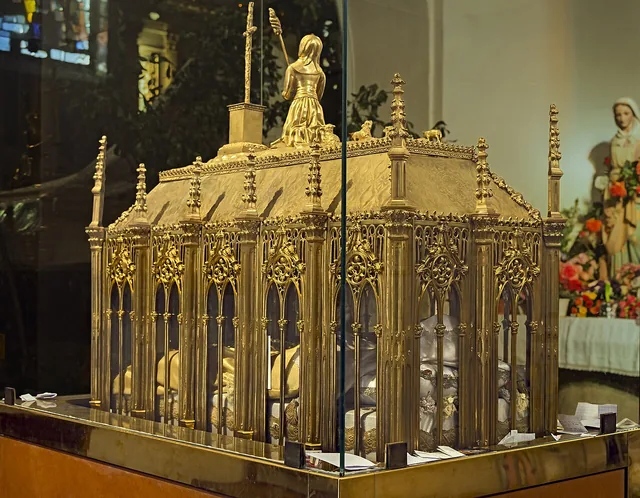
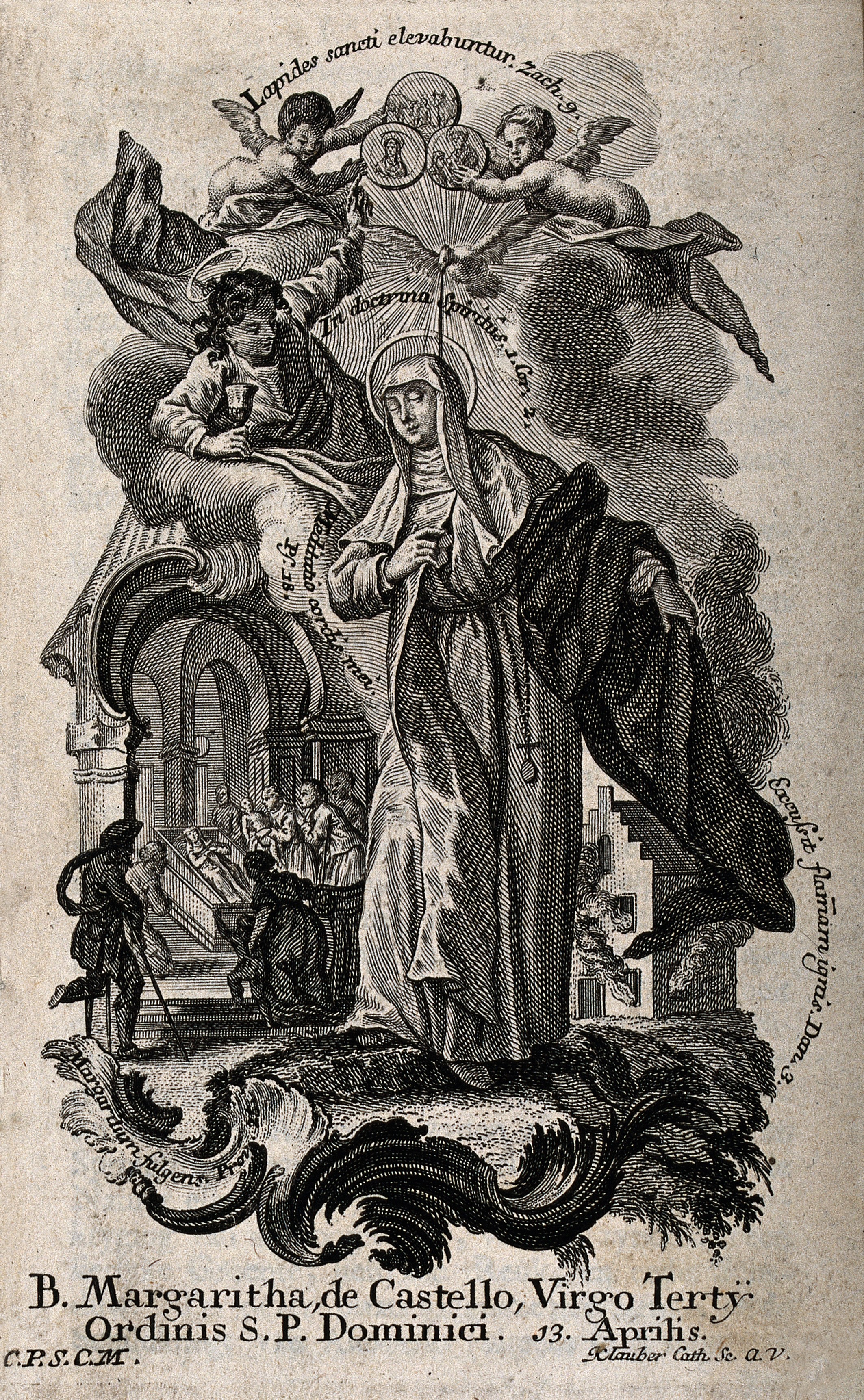
The municipal visitor guide locates Margaret’s remains at San Domenico’s high altar. It gives no current tissue inventory or conservation history. The medieval tradition also describes three sacred-image stones in her heart; the diocese’s retelling supplies no examination record substantiating that extraordinary anatomical claim. [3] [1]
READER QUESTIONS
Questions and answers
Does her story depend on a cure?
No. In the diocesan account the hoped-for cure does not occur. Her later relationships and religious life develop while she remains disabled. [1]
Was she canonized in 2021?
Yes. The Holy See records equipollent canonization on 24 April 2021 through the extension of her cult to the universal Church. [5]
How much certainty do the biographies provide?
The surviving lives are medieval religious narratives. The scholarly abstract distinguishes their authorship and form; detailed historical claims still need assessment within that genre. [4]
FOLLOW THE SOURCES
Sources and further reading
- Diocese of Città di Castello: Saint Margaret, 2022
Institutional source
Retells the medieval biography, household relationships and devotional claims.
- Gianni Festa, Dominican postulator: Presentation of Margaret
Institutional source
Religious interpretation with citations to the longer medieval life.
- Città di Castello municipality: San Domenico
Institutional source
Location of attributed remains and later devotional art.
- Pierluigi Licciardello: Biography and hagiography in Margaret’s Legenda, 2021
Scholarly abstract
Public scholarly abstract identifies two fourteenth-century versions; full chapter was not consulted.
- Holy See Press Office: Decrees, 24 April 2021
Institutional source
Official notice of equipollent canonization.
- Antonio Fornaciari, Valentina Giuffra, Silvia Marvelli and Gino Fornaciari — Christina of Spoleto, comparative discussion
Scholarly research, authors’ institutional publication
Direct examination concerns Christina. Comparison and figure 5 identify Margaret’s artificial mummy; historical discussion names surgeons and municipal embalming involvement.
Sources checked: 2026-10-27. Suggest a correction or a source.