THE PERSON BEHIND THE ACCOUNT
Jeanne de Lestonnac had to leave the monastery before she found her life’s work.
In 1603 Jeanne de Lestonnac entered the Feuillantine monastery in Toulouse. The life of austerity exceeded her strength, and she had to leave for reasons of health. Her own order remembers that disappointment as the setting of a new conviction: she should reach out to girls through education. [5]
Bordeaux’s divisions entered the family
Jeanne was born in Bordeaux in 1556, with a Catholic father and Protestant mother. Her uncle was Michel de Montaigne. The diocesan history places her religious formation within those family differences and the wider conflicts of her time. Her educational world included the humanist influence for which her uncle became famous. [2]
A household before an order
She married Gaston de Montferrand in 1573 and had seven children. Widowhood came in 1597. Before entering religious life, she had already been a mother and had managed a household and property. The chronology resists the tidy idea of a founder carrying out one unchanging plan from childhood. [2] [5]
Pius XII’s canonization homily explicitly recognized her life as wife and mother alongside her later teaching mission. He also recalled service to people during an epidemic. His account treats these responsibilities as part of the life being honored, rather than a preface to the supposedly important years. [1]
The plan took shape after the departure
After leaving Toulouse, Jeanne spent time at La Mothe discerning what to do. She then returned to Bordeaux, gathered companions and sought advice from Jesuits. Paul V approved the Company of Mary Our Lady in 1607. Her physical inability to continue the Feuillantine life did not rule out a demanding religious vocation of another kind. [5]
Girls’ education became a shared commitment
The first Bordeaux community was in the Rue du Hâ. The institute describes the education of women as a means of changing society, connecting intellectual formation with a woman’s capacity to act. The school made the founder’s concern a daily responsibility shared by teachers and pupils. [4]
At Jeanne’s death on 2 February 1640, the diocesan account records thirty houses. Expansion brought the practical problem of sustaining a common purpose across separate communities. [2]
IN OUR OWN LIVES
When the first vocation becomes impossible
A form of life can prove physically unsustainable despite someone’s determination. An honest account of vocation leaves room for that experience and for another way to serve. The support of companions can matter as much as persistence.
THROUGH THE EYES OF FAITH
Faith and daily life
The Company of Mary describes its spirituality through Ignatian discernment: prayer, attention to circumstances and readiness to serve where needed. Jeanne’s project joined a contemplative life with the work of a school, placing Mary at the center of the community’s religious identity. [4]
A union that took centuries
The houses remained autonomous until 1921. The order credits correspondence—first Jeanne’s, then communication among communities—with maintaining their relationship. This is a specific feature of her legacy: shared identity depended for a long time on attention and contact across distances. A single governing structure came much later. [4]
Pius XII canonized Jeanne on 15 May 1949. The formal act names a widow among the saints; the homily places the formation of girls within her Catholic response to the religious disputes of her era. That historical language carries the sharp confessional divisions of its time. [1]
THROUGH THE LENS OF SCIENCE
The evidence about the remains
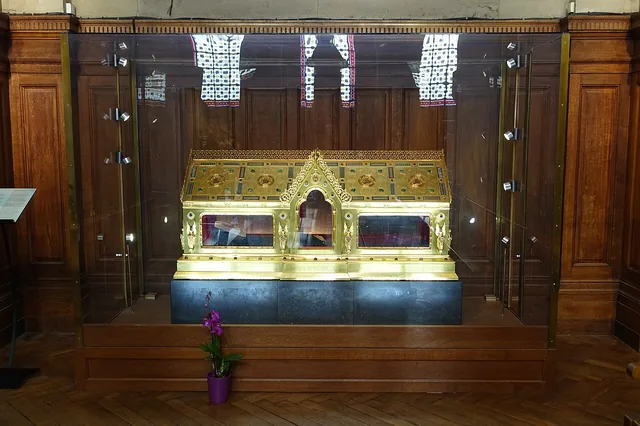
A French heritage inventory documents a small reliquary associated with Jeanne. Its measurements and seals are concrete evidence about that object. They supply no basis for describing a complete preserved body. [3]
The sealed object in Saint-Michel-de-Rieufret
The public inventory describes a reliquary measuring 26 by 28 by 18 centimeters, made between 1900 and 1908. It identifies two archiepiscopal seals, a label naming Jeanne and decorative materials around the relics. This is an object-specific record, at a location distinct from a claim about an entire body. [3]
A sealed reliquary can document the history of veneration without giving an anatomical identification of everything it contains. This inventory records the container and its appearance; no laboratory findings or conservation history of a complete body accompany it. [3]
READER QUESTIONS
Questions and answers
Was she a mother before becoming a founder?
Yes. She married in 1573, had seven children and was widowed in 1597. [2]
Why did she leave the Feuillantines?
Her order’s biography says the austerity exceeded her strength and she left for health reasons. Her educational vocation developed after that departure. [5]
Does the French inventory prove incorruption?
It documents a small sealed reliquary, not an intact body or a study of natural preservation. [3]
FOLLOW THE SOURCES
Sources and further reading
- Pius XII — Canonization homily, 15 May 1949
Primary historical record
Primary canonization formula and papal interpretation of her family life, educational mission and care during epidemic.
- Diocese of Bordeaux — Jeanne de Lestonnac
Church or shrine source
Family, marriage, widowhood, thirty houses and Catholic recognition.
- French Ministry of Culture — Reliquary IM33000812
Cultural heritage record
Object dimensions, materials, seals, label and date range; not a whole-body inventory.
- Company of Mary — Identity and history
Church or shrine source
First community, educational purpose, Ignatian spirituality and autonomous houses until 1921.
- Company of Mary — Jeanne de Lestonnac
Church or shrine source
Chronology of Toulouse departure, La Mothe discernment and 1607 approval; institutional account of her religious experience.
Sources checked: 2026-10-27. Suggest a correction or a source.