THE PERSON BEHIND THE ACCOUNT
A school director who had to ask for money
Asking strangers for money cost Murialdo considerable embarrassment, his congregation recalls. He kept asking to support the boys in his care. [1]
From an oratory to a long responsibility
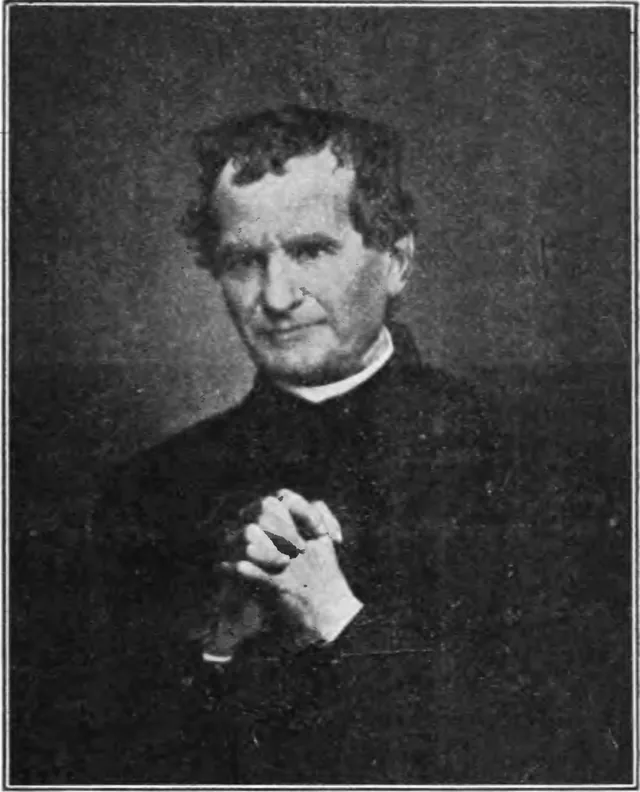
Ordained in 1851, Murialdo worked in Turin’s oratories and directed San Luigi before taking charge of the Collegio Artigianelli in 1866. The congregation’s biography describes his commitment there to welcoming young people, Christian education and professional training. He founded the Congregation of Saint Joseph in 1873 to continue this work. [3]
Taking over an existing school differs from founding everything from nothing. It meant receiving obligations to boys already dependent on the institution and making them sustainable over years. Teaching a trade also required equipment, competent adults and relationships with the working world.
What happened after training?
The congregation’s account describes a family home for young workers that offered food, rooms, laundry and recreation. It addressed the vulnerable interval between learning a trade and establishing a working life. After his nephew and financial supporter Carlo Peretti died in 1883, financial pressure prevented a proposed night dormitory from opening. [1]
A useful skill does not guarantee a place to live. This part of the story asks a question still relevant to education: who helps a young person remain housed and supported after a course is finished? It also shows that sincere charitable purpose does not eliminate financial constraints.
Debt in the letters
The congregation reports 2,379 published letters and describes them as records of his relationships, educational work and recurring economic worries. Its account dates his Spiritual Testament to 1891–99 and identifies it as a retrospective account of crisis, forgiveness and vocation. These are different kinds of evidence: practical correspondence and later spiritual recollection. [5]
Neither should be flattened into a story of effortless confidence. Reading financial concerns alongside his trust in providence gives the trust a real setting. Someone still had to find money, make decisions and face the consequences when a plan could not continue.
IN OUR OWN LIVES
Following care beyond the classroom
Murialdo’s work is especially relevant to anyone concerned with the transition from education to employment. Training, housing and dependable adults solve different problems; a successful course can leave a young person without the other two.
His documented money worries also deserve room in a saint’s life. An institution can serve a serious moral purpose and still need scrutiny of its funding and choices. Taking its mission seriously includes asking whether it can keep its commitments.
THROUGH THE EYES OF FAITH
Faith and daily life
He understood his priesthood through a personal experience of forgiveness. Benedict XVI describes an adolescent spiritual crisis followed by confession and a renewed sense of God’s mercy. Murialdo later treated his vocation as a gift he had received, rather than evidence that he had always been better than other people. [2]
The boys most likely to be turned away
The congregation’s account of his educational method quotes Murialdo’s own writings to identify poor and abandoned young people as the priority. It joins moral, civil, vocational and religious formation. His approach required adults to stay close to the boys rather than reduce their identity to troublesome behavior. [4]
The Catholic teaching underneath was specific: a person already loved by God should be met with care that makes that love believable. An educator’s patience and judgment were part of the religious undertaking, along with prayer.
THROUGH THE LENS OF SCIENCE
The evidence about the remains
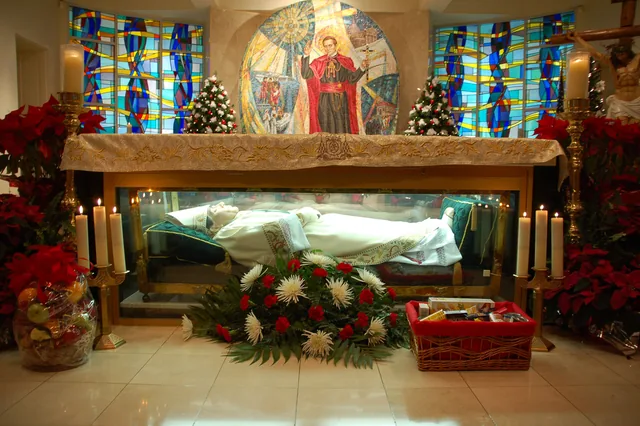
The congregation identifies the visible face and hands at his shrine as artistic work by Giovanni Gianese and Romolo Felici, based on postmortem photographs. Their appearance cannot be used as evidence that those surfaces are naturally preserved tissue. [1]
A reliquary with an artist’s contribution
His remains were moved to Nostra Signora della Salute on 6 June 1971. The congregation’s guide identifies the shrine’s later arrangement and its artists, but supplies no modern tissue-by-tissue examination. The photographed likeness and the contents of the reliquary are separate questions. [1]
READER QUESTIONS
Questions and answers
Did he found the Collegio Artigianelli?
He became its director in 1866. His own foundation was the Congregation of Saint Joseph, established in 1873 to continue educational work. [3]
How did he connect faith with education?
His congregation’s account connects belief in God’s personal mercy with sustained attention to young people, especially those who were poor or abandoned. [4]
Are the face and hands naturally preserved?
The custodial guide names artists who made the face and hands using postmortem photographs. It does not identify those visible features as preserved tissue. [1]
FOLLOW THE SOURCES
Sources and further reading
- Murialdo congregation: Places
Institutional source
Custodial guide; fundraising, workers’ residence, transfers and artificial features.
- Benedict XVI: Murialdo, 28 April 2010
Institutional source
Pastoral biography and the spiritual significance of forgiveness.
- Murialdo congregation: Life
Institutional source
Institutional chronology and educational responsibilities.
- Murialdo congregation: Pedagogy of Love
Institutional source
Educational interpretation with references to Murialdo’s writings.
- Murialdo congregation: Writings
Institutional source
Guide to correspondence, economic concerns and the Spiritual Testament.
Sources checked: 2026-10-27. Suggest a correction or a source.