THE PERSON BEHIND THE ACCOUNT
He crossed the Atlantic without a secure place waiting for him, then spent his life helping other newcomers.
In 1836, after his expected ordination was deferred, John Neumann left Europe for the United States. He traveled without secure assurance that an American bishop would receive him. He was ordained in New York that June and began work near Buffalo. [4]
A long absence from home
The Redemptorist superior general’s 2011 letter discusses Neumann’s correspondence with his family. Fifteen years after emigrating, Neumann told his father of his continuing longing for home while affirming his commitment to the American mission. The loss was not only the cost of a boat fare. It included relationships maintained across an ocean and long waits for news. His sense of purpose did not remove homesickness. [5]
Finding colleagues for the mission
Baltimore’s archdiocesan biography records his contact with Redemptorists, application in 1840 and profession in 1842. He moved among communities serving German-speaking Catholics. His concern was how to sustain pastoral work with others. The same account remembers confessions, visits to sick people, Mass and attention to schools: duties that required continuity beyond occasional enthusiasm. [4]
Language was practical care
The Denver Redemptorists connect his knowledge of six languages with the multilingual society in which he worked. A person seeking confession, instruction or help should not need to cross an avoidable language barrier first. His contribution involved learning and using the means through which particular people could understand and be understood. A familiar language could make the difference between receiving help and leaving without it. [6]
Illness and responsibilities kept arriving
The Baltimore biography recounts a persistent cough and an order to leave Pittsburgh in hope of recovery. Administrative responsibility followed before the expected rest. It also records his efforts to avoid episcopal appointment. These episodes complicate a picture of effortless advancement. The account’s praise of work should not become an expectation that sick people accept every new task without adequate care or support. [4]
The bishop’s lasting structures
Paul VI’s 1977 canonization homily emphasizes his schools and pastoral visits as bishop of Philadelphia, a role he began in 1852. It also remembers the formation of a parish for Italian Catholics. Neumann’s institutional contribution was to create settings where families could find religious instruction and community in a growing city. A school system required people, organization and work continuing after an individual visit. [7]
IN OUR OWN LIVES
Making welcome understandable
Neumann’s story brings an often abstract word down to a practical test. Can the newcomer understand the notice, speak to someone, find a school and receive help without pretending already to know how everything works? Language and dependable institutions make a welcome usable.
His longing for home adds another dimension. Someone can contribute fully to a new place while continuing to miss the people and habits left behind. Treating those feelings as disloyalty misses part of an immigrant’s life. Neumann’s correspondence allows commitment and grief over separation to remain in the same story.
THROUGH THE EYES OF FAITH
Faith and daily life
His decision to join the Redemptorists followed experience as a largely solitary missionary. Community offered spiritual support and a way to make the work more effective. That choice makes dependence on others part of the vocation, rather than a sign of failure. [5]
The sacraments within the work
The homily treats his activity as pastoral service rooted in Catholic faith. Celebrating Mass and hearing confession were central ways of accompanying a community, alongside teaching and visits. For a reader unfamiliar with these practices, their purpose includes shared worship, reconciliation and the formation of conscience. Neumann’s attention to languages made access to such practices an immediate practical concern. [7]
THROUGH THE LENS OF SCIENCE
The evidence about the remains
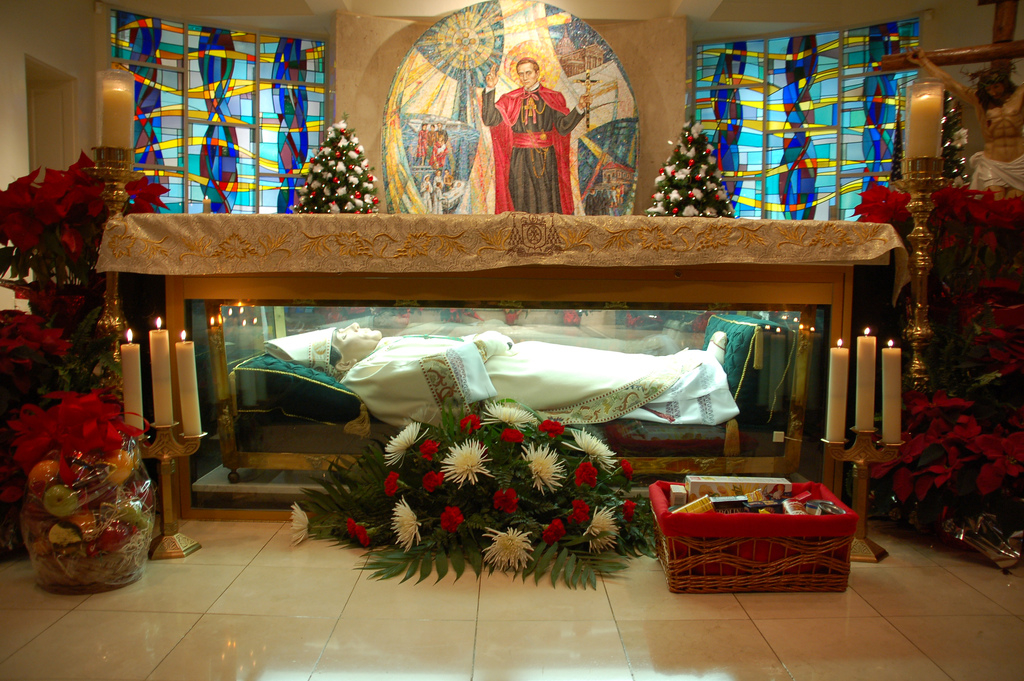
The Philadelphia shrine explicitly describes his remains as wearing a wax mask and episcopal clothing. A visitor sees an arranged devotional presentation, whose face cannot be used as evidence of naturally preserved skin. [2]
The mask is part of the display
At Saint Peter the Apostle in Philadelphia, the shrine identifies a glass case beneath the altar containing his remains with a wax mask and bishop’s vestments. This is useful first-party information about the visible presentation. The public description does not enumerate all surviving tissues or provide a complete treatment history. The face seen in the case is therefore distinct from the condition of the material it covers. [2]
READER QUESTIONS
Questions and answers
Was his ordination in New York?
Yes. The Baltimore biography and Paul VI’s homily identify Bishop John Dubois of New York as the ordaining bishop in June 1836. [4] [7]
Is the visible face his naturally preserved skin?
The shrine calls it a wax mask. That covering cannot demonstrate the condition of the tissue beneath. [2]
FOLLOW THE SOURCES
Sources and further reading
- National Shrine of Saint John Neumann — Custodial description
Institutional source
Explicitly identifies wax mask, clothing and enclosed remains; no tissue inventory.
- Archdiocese of Baltimore — John Neumann
Institutional source
Ordination, religious profession, pastoral work and illness.
- Redemptorist superior general — Bicentenary letter, 2011
Institutional source
Institutional interpretation drawing on letters; homesickness and community.
- Denver Redemptorists — John Neumann
Institutional source
Institutional biography; multilingual ministry and religious community.
- Paul VI — Canonization homily, 19 June 1977
Institutional source
Primary Catholic interpretation and pastoral institutions.
Sources checked: 2026-10-27. Suggest a correction or a source.