THE PERSON BEHIND THE ACCOUNT
Lucy of Syracuse: a martyr’s refusal, remembered across two cities
The traditional story of Lucy centers on a young woman refusing to surrender her Christian allegiance or let a proposed marriage determine her future. It remembers her giving possessions to people in need and facing death rather than abandoning her faith. Those choices explain her enduring appeal, but the detailed narrative comes through later hagiography, not a surviving transcript of her trial. [1][2]
An inscription nearer her time
An epitaph for a woman called Euskia provides evidence that Lucy was already commemorated in late antiquity. The I.Sicily scholarly catalogue dates the Greek marble inscription to the first half of the fifth century. Archaeologist Mariarita Sgarlata discusses its reference to death on the day sacred to Lucy. [5][6]
This is evidence for an early cult, not a full biography. It does not tell us the exact exchanges at Lucy’s trial, describe her childhood or identify the condition of the remains now in Venice. It gives the historian something more modest and valuable: an early community already remembered her. [5][6]
A fortune given away in the received story
The sanctuary’s life tells of Lucy choosing consecrated virginity after a pilgrimage to Agatha’s tomb and a reported cure of her mother. It then connects her distribution of possessions to the anger of the man who wished to marry her. The account makes money, marriage and religious allegiance part of the same conflict. [1]
Within that received narrative, Lucy decides what her wealth is for and whom she will serve. The vision and cure belong to its devotional account; neither comes with a clinical record. [1]
Syracuse and Venice share a patron’s history
The sanctuary connects the arrival of the relics in Venice with the Fourth Crusade in 1204. They later passed through several Venetian churches. The old Santa Lucia church was eventually demolished for the railway station, which retained her name; the remains came to San Geremia in 1860. [4]
A temporary return to Sicily in December 2024 joined the two cities again. Pope Francis’s letter to Syracuse described the journey as an exchange between Churches and called attention to women’s voices, conscience and compassion. That is a contemporary interpretation of Lucy’s importance, distinct from what can be established about her fourth-century life. [3]
IN OUR OWN LIVES
The refusal beneath the later pictures
Lucy’s life is difficult to recover in individual detail. The enduring story nevertheless poses a concrete question about coercion: who can demand control of a person’s conscience, possessions or body? That is a reason to read the martyr tradition carefully, with its historical limits visible. [1][2]
Her later history also belongs to real communities. Syracuse’s attachment, Venice’s custody and the 2024 exchange show how remembrance can connect cities while raising questions about possession. Looking beyond the silver mask reveals both an ancient devotion and the decisions through which people continue it. [3][4]
THROUGH THE EYES OF FAITH
Faith and daily life
Catholics venerate Lucy as a virgin and martyr of Syracuse, traditionally killed during the persecution of Diocletian in 304. Her witness concerns the freedom of Christian conscience under coercion. The medieval stories give that conviction dramatic form; they should not be mistaken for eyewitness reporting. [2][3]
The trial that artists inherited
Medieval retellings describe efforts to force Lucy to abandon Christianity, followed by her death. The National Gallery of Art’s account of Veronese’s painting identifies the Golden Legend as the source for its sequence of failed attempts and final communion. Art preserves a reading of the martyr’s story, rather than independent documentation of each event. [2]
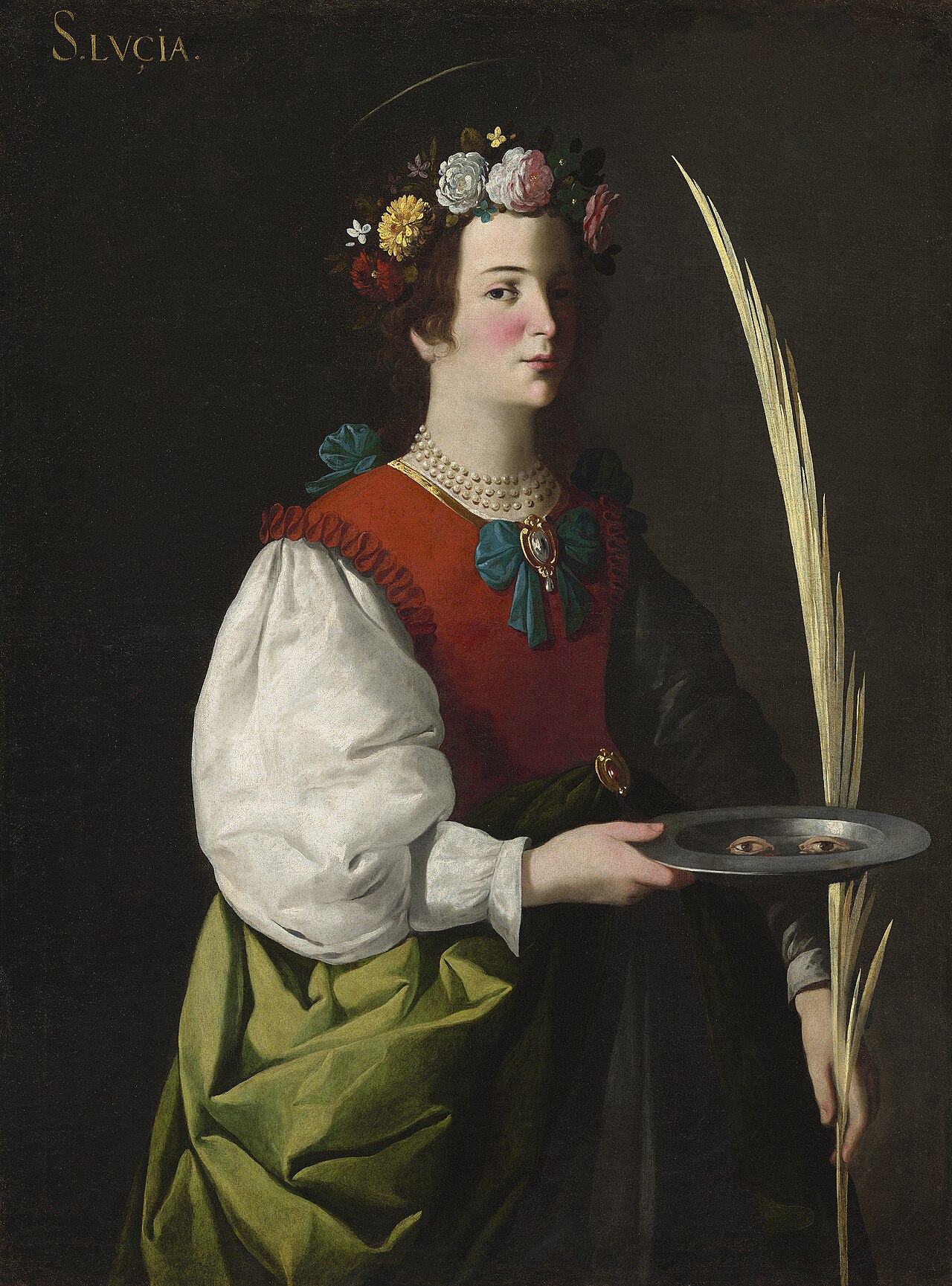
Her familiar eyes-on-a-dish attribute has its own history. The University Complutense’s iconographic study treats the different visual forms through which artists represented Lucy. The eye story is a later addition to her legend, as the Venetian sanctuary itself acknowledges; it should not be presented as an established account of her death. [1][7]
An account involving threatened sexual violence requires care with freedom and dignity. Assault cannot make its victim morally guilty. A saint’s courage should never become a demand that another victim react in a prescribed way.
THROUGH THE LENS OF SCIENCE
The evidence about the remains
The Venetian sanctuary identifies the relic body it holds and explains that a silver mask covers the face. The mask was commissioned in 1955. A viewer is seeing a cared-for devotional display, whose visible face is an artistic covering. [4]
What the silver face conceals
The sanctuary says the present urn and altar date to 1930 and identifies the sculptor Minotto’s silver mask, commissioned by Cardinal Angelo Roncalli in 1955. These details prevent a common mistake: treating the face seen in the shrine as exposed ancient skin. [4]
The sources checked do not supply a complete modern examination, treatment inventory or independently verified chain of physical identification back to Syracuse. The early inscription supports ancient veneration; it cannot authenticate a particular body. The shrine’s custody tradition and its documented modern display should therefore remain separate from a scientific claim of an entirely intact, untreated body. [4][5][6]
READER QUESTIONS
Questions and answers
Were Lucy’s eyes removed as part of her martyrdom?
The familiar eye story is a later addition to her legend. It is important to her art and patronage, but should not be treated as a securely documented event. [1][7]
Is the visible face her preserved skin?
No. The sanctuary identifies a silver mask made by Minotto after Roncalli commissioned it in 1955. [4]
FOLLOW THE SOURCES
Sources and further reading
- Sanctuary of Lucy, Venice: Saint Lucy
current devotional biography
Received life, almsgiving, marriage refusal and later eye legend. Detailed trial attributed to Golden Legend; not contemporary testimony.
- National Gallery of Art: Veronese, Martyrdom and Last Communion of Saint Lucy
museum scholarship
Distinguishes painting’s martyrdom narrative and Golden Legend source; supports reception and art, not eyewitness trial evidence.
- Pope Francis: letter to Syracuse, 13 December 2024
official papal letter
Lucy as virgin and martyr; temporary translation, conscience, women’s voices and contemporary relevance. No technical preservation finding.
- Sanctuary of Lucy, Venice: sanctuary history
current custodian
1204 arrival tradition, 1860 relocation, railway name, 1930 display and 1955 silver mask. No full anatomical report.
- I.Sicily: catalogue entry associated with Euskia epitaph
scholarly epigraphic catalogue
Catalogue lists ISic 001516: Greek funerary marble plaque, AD 401–450, Syracuse. Individual-record access failed; bibliography listing inspected.
- Mariarita Sgarlata: Towards the Publication of ICI Siracusa
archaeological scholarship
Indexed passage on Euskia’s epitaph and Lucy commemoration inspected; author/publication verified through University of Catania repository. No body identification claim.
- Irene González Hernando: Saint Lucy of Syracuse, UCM
university iconographic study
2010 study identifies medieval literary and visual reception. Limited facts paraphrased; no images reused or altered.
Sources checked: 2026-10-27. Suggest a correction or a source.