THE PERSON BEHIND THE ACCOUNT
Werburgh: a royal daughter who took responsibility for other women’s houses
The received life of Werburgh begins with an expected royal marriage and a different choice. A daughter of the Mercian king Wulfhere, she is remembered as choosing religious life at Ely. Later, according to the same tradition, she gave up the seclusion she valued to oversee other women’s monasteries. Her responsibilities grew precisely when she might have preferred a quieter life. [1]
The distance between a princess and her biographer
Werburgh probably died around 700. Much of the familiar narrative survives in much later religious writing. Henry Bradshaw, a monk of Chester, completed a long verse life around 1513; it was printed in 1521. A story written eight centuries after its subject can preserve older traditions, while also revealing the interests of the institution telling it. [2][5]
The choice of Ely and rejection of marriage belong to a received account, rather than recoverable private conversations. Its distance from Werburgh’s lifetime limits what can be said about her motives. [1][5]
An abbess beyond one enclosure
The early biographical tradition places Werburgh at Ely among other royal women who had entered religious life. It then connects her with the direction of women’s houses in Mercia, including Hanbury, Trentham and Weedon. In the Catholic Encyclopedia’s account, she accepted these responsibilities at King Ethelred’s request despite her preference for seclusion. [1]
Chester Cathedral retains Werburgh’s responsibility for Mercian women’s houses as central to its account. Her remembered contribution concerns how communities lived, prayed and were governed together. [4]
IN OUR OWN LIVES
Responsibility across several communities
Werburgh’s royal ancestry is easy to remember. The work attributed to her concerned women who had to live, pray and be governed together in several houses. That gives readers a more useful place to begin than a pedigree alone. [1][4]
Her later memory also belonged to people whose institutions changed around them. A patron could remain familiar after relics were lost and an abbey became a cathedral. A visit to the shrine encounters those later generations as well as the distant saint. [3][4]
THROUGH THE EYES OF FAITH
Faith and daily life
Werburgh belongs to the early English world in which monasteries offered women a form of religious community, education and authority. The tradition presents her leadership as an obligation to her fellow religious, grounded in her own commitment to prayer and communal discipline. [1][4]
The geese and the city
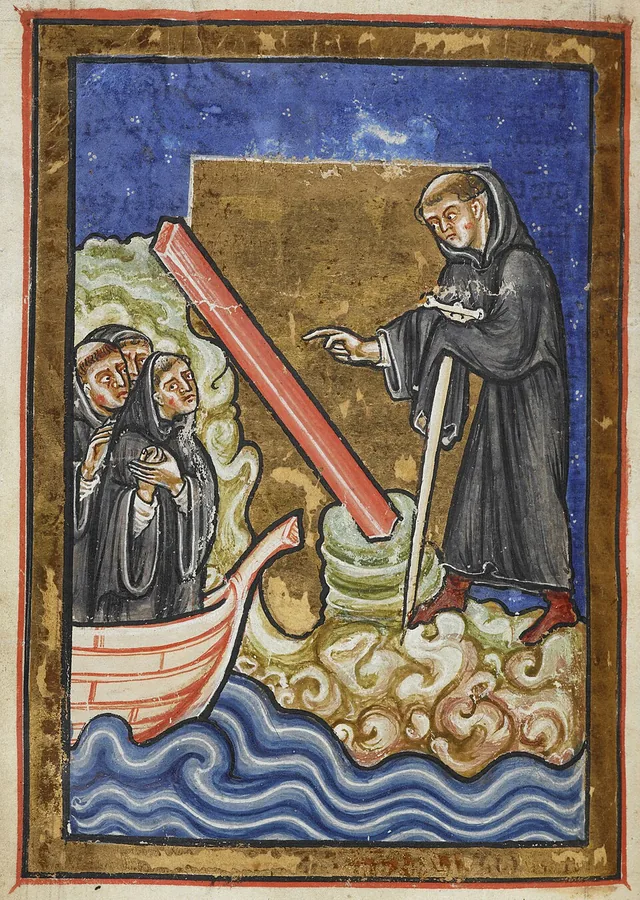
A popular legend tells of Werburgh dealing with geese that damaged crops. Such a story gives a local saint an immediately recognizable presence in the working countryside. It should be introduced as a miracle legend, not reconstructed as an observed event in her biography. [3][5]
Her later importance also changed with the journey of her relics. They were taken from Hanbury to Chester in the late ninth century amid the danger of Viking attacks. Chester came to identify Werburgh as its patron. Bradshaw’s poem entwines her life with the history of the city and its abbey, showing how devotion could shape a community’s account of itself. [2][5]
The saint’s church outlived its medieval institution
The medieval abbey at Chester was Benedictine; the present cathedral became an Anglican cathedral in 1541. Werburgh’s memory remained attached to the building through this institutional change. A visitor now encounters a patron shared across a long local history, rather than an untouched survival of her own seventh-century world. [4]
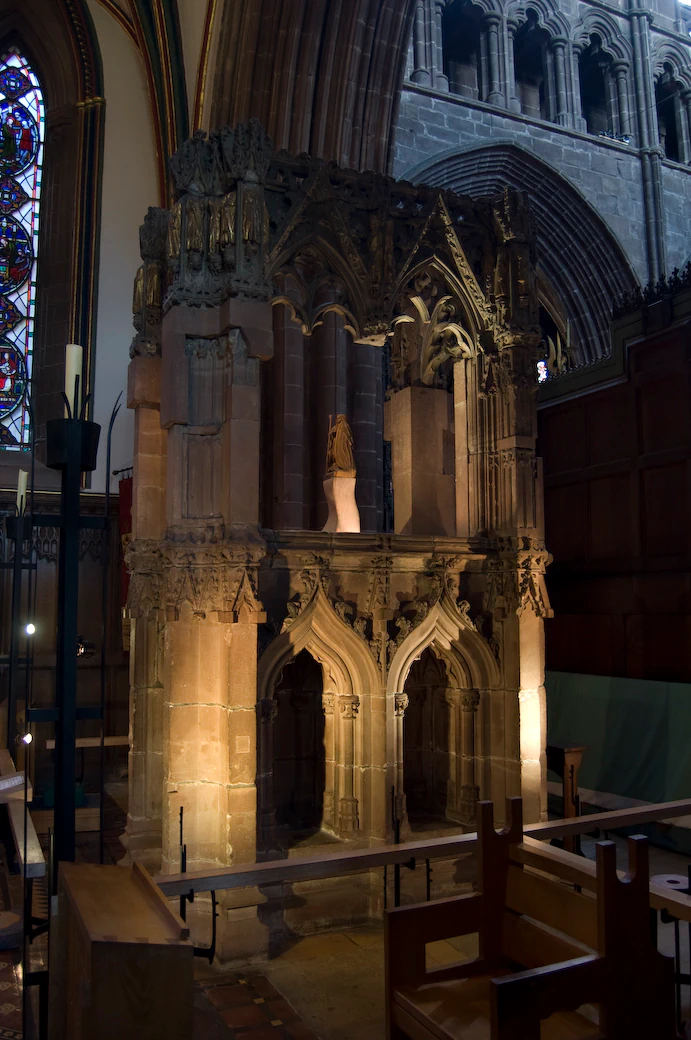
That distinction offers a useful way into the shrine. Its stonework records later generations’ devotion. The monument does not supply the missing details of her childhood or prove every miracle in her medieval life. It shows that people continued to make a place for her in their worship and civic memory. [3][4]
THROUGH THE LENS OF SCIENCE
The evidence about the remains
There is no intact body of Werburgh available for visitors or scientists to examine in Chester. Accounts of an early opening of her grave must be read alongside later accounts of decay and the eventual loss of her relics. [3][5]
An intact grave, powder and a lost collection of relics
The parish’s account dates a reported discovery of her body intact to 708. This is a religious tradition about an early exhumation; no contemporary medical description is supplied. Bradshaw’s much later life also says that, by the late ninth-century translation, the body had turned to powder. The poem gives that decay a protective religious interpretation. [3][5]
The relics themselves were lost after the Dissolution of the Monasteries. Surviving parts of the damaged stone shrine were reassembled in 1876 and are now in the cathedral’s Lady Chapel. The object on view is therefore a reconstructed medieval shrine. Neither its appearance nor the 708 tradition permits a diagnosis of preservation, and the historical record does not support calling Werburgh an intact body on display today. [3]
READER QUESTIONS
Questions and answers
Can I see Werburgh’s preserved body?
No. The parish says her relics were lost after the Dissolution. The cathedral preserves reassembled stonework from her medieval shrine. [3]
FOLLOW THE SOURCES
Sources and further reading
- Catholic Encyclopedia: St. Werburgh
historical reference
1912 historical biography transmitting older royal, Ely and Mercian-house traditions; no contemporary record of private conversations.
- Chester Cathedral: Cloud of Witnesses, dining with royalty
cathedral history
Royal and monastic background, approximate death and translation to Chester under Viking threat; later shrine history.
- St Werburgh’s Catholic Parish: shrine
local ecclesiastical history
Reports 708 intact-body tradition, loss of relics after the Dissolution, 1876 reconstruction and current Lady Chapel position. This is not an examination report.
- Chester Cathedral: our history
current custodian
Mercian houses, Benedictine abbey and 1541 Anglican cathedral history.
- Catherine Clarke: Henry Bradshaw, Life of St Werburge
scholarly textual introduction
Dates and interprets Bradshaw’s late life, civic and abbey interests, marriage/Ely traditions and its report that the body had become powder before translation. No modern forensic evidence.
Sources checked: 2026-10-27. Suggest a correction or a source.