THE PERSON BEHIND THE ACCOUNT
The Roman martyr behind the marble
A young woman lies on her side beneath an altar in Santa Cecilia in Trastevere, her face turned away. The figure is Stefano Maderno’s marble sculpture. It has become one of Rome’s most familiar images of martyrdom, but the woman it represents is harder to recover than the sculpture’s vivid form suggests. [1]
What survives from early Rome
Early liturgical records, a church bearing her name and a burial tradition attest Cecilia’s ancient Roman cult. The Catholic Encyclopedia distinguishes that evidence from the much later story of her life. [3]
There is no agreed year of death in the source tradition reviewed here. A precise date, age, or set of final words would give a false impression of certainty. We can name the saint whom Roman Christians remembered without pretending to possess a contemporary biography. [3]
The courage told in the Passio
The fifth-century Passio describes Cecilia persuading her husband Valerian to respect her commitment to Christ. His conversion follows. The narrative includes care for poor people and burial of persecuted Christians, before Cecilia faces the authorities and refuses to abandon her faith. [3]
These episodes explain the person whom later Christian art presents: resourceful, persuasive, generous, and prepared to suffer for her convictions. They are episodes in a late devotional narrative. The Catholic Encyclopedia calls its dramatic form a religious romance; treating the conversations as verbatim testimony would misuse it. [3]
How music entered the picture
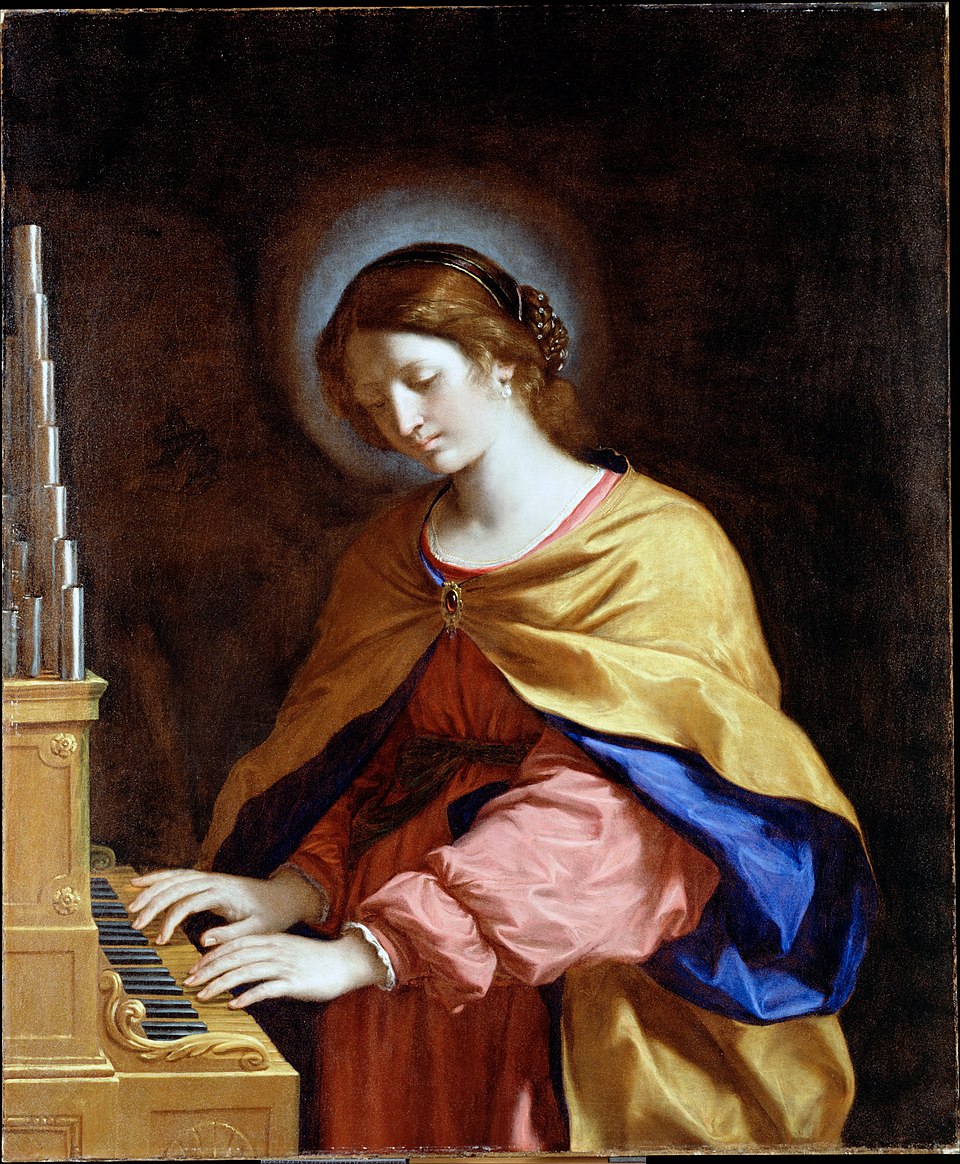
Cecilia’s patronage of musicians grew from a line about singing to God in her heart while instruments sounded. John Paul II explained that connection during his 1984 visit to the basilica, noting the later artistic custom of placing an instrument beside her. There is no need to turn her into a documented professional musician to understand why singers adopted her. The image is of someone whose inward allegiance continues amid the sound around her. [2]
IN OUR OWN LIVES
Courage with a purpose
Cecilia gives musicians an image of attention: a heart directed toward something deeper than the performance itself. For anyone facing pressure to fit in, her received story also raises the harder question of what conviction will cost. Its courage is directed toward fidelity, generosity, and the protection of a community. [3]
The uncertainty surrounding her biography asks something of the storyteller too. We can enjoy a powerful work of art, learn the story it carries, and admit where history grows thin. Careful description gives the next visitor more to discover.
THROUGH THE EYES OF FAITH
Faith and daily life
In his homily at the basilica, John Paul II connected Cecilia with fidelity to Christ and remembered people suffering for their faith in his own time. Martyrdom, in that Catholic reading, is witness carried through suffering. The saint’s place in prayer rests on that fidelity; the appearance of a sculpture is no measure of it. [2]
A household offered to others
The Passio ends with resources given to poor people and a home made available for worship. Within the received story, fidelity changes what Cecilia does with her possessions. [3]
THROUGH THE LENS OF SCIENCE
The evidence about the remains
Maderno’s figure beneath the altar is marble. The shrine separately preserves a tradition about the transfer of Cecilia’s attributed remains. A photograph of the sculpture cannot reveal the condition of those relics. [1]
The journey of the attributed remains
The Vatican’s church guide recounts the transfer under Paschal I of remains identified as Cecilia’s from the cemetery of Callistus. It describes the body as intact. The same guide identifies Maderno’s figure as sculpture. These are two separate things in the shrine: a transmitted account of remains and a later artistic representation. [1]
The Catholic Encyclopedia also recounts the 1599 opening associated with Cardinal Sfondrati and the subsequent sculpture. Its account is historical scholarship based on earlier records, not a new examination. The sources linked here contain no modern anatomical inventory, identification study, or complete conservation history from which to describe the remains’ present condition. [3]
READER QUESTIONS
Questions and answers
Was Cecilia a musician?
Her musical patronage developed from the tradition of singing to God in her heart. The sources here do not document a musical profession. John Paul II explained the later association with instruments in his 1984 homily. [2]
Is the marble figure her preserved body?
It is a sculpture by Stefano Maderno. The Vatican’s guide identifies it as such while separately recounting the transfer of attributed remains. [1]
How can she be a saint without a modern canonization date?
Her veneration belongs to the ancient Roman Church, centuries before today’s formal cause procedures. The early cult and later accounts must be studied on their own historical terms. [3]
FOLLOW THE SOURCES
Sources and further reading
- Pontifical Academy Cultorum Martyrum — Station at Santa Cecilia
Church or shrine source
Official church guide: translation tradition, artworks and Maderno sculpture. No modern examination report.
- John Paul II — homily at Santa Cecilia, 22 November 1984
Church or shrine source
Catholic interpretation of the martyr tradition, music patronage and witness. A homily, not contemporary biographical testimony.
- Johann Peter Kirsch — Saint Cecilia, Catholic Encyclopedia 1913
Scholarly account
Public-domain historical scholarship distinguishing early cult from the later Passio and discussing translation and 1599 records. Its historical judgments are attributed, not presented as a current forensic investigation.
Sources checked: 2026-10-27. Suggest a correction or a source.