THE PERSON BEHIND THE ACCOUNT
He asked a divided city to make mercy public.
In August 1399, prisoners in Pistoia were released during a religious movement for mercy and peace. Bishop Andrew Franchi was helping lead the Bianchi, whose participants wore white and followed a crucifix through the city. The Dominican library's history recounts the episode from the chronicler Luca Dominici. [4]
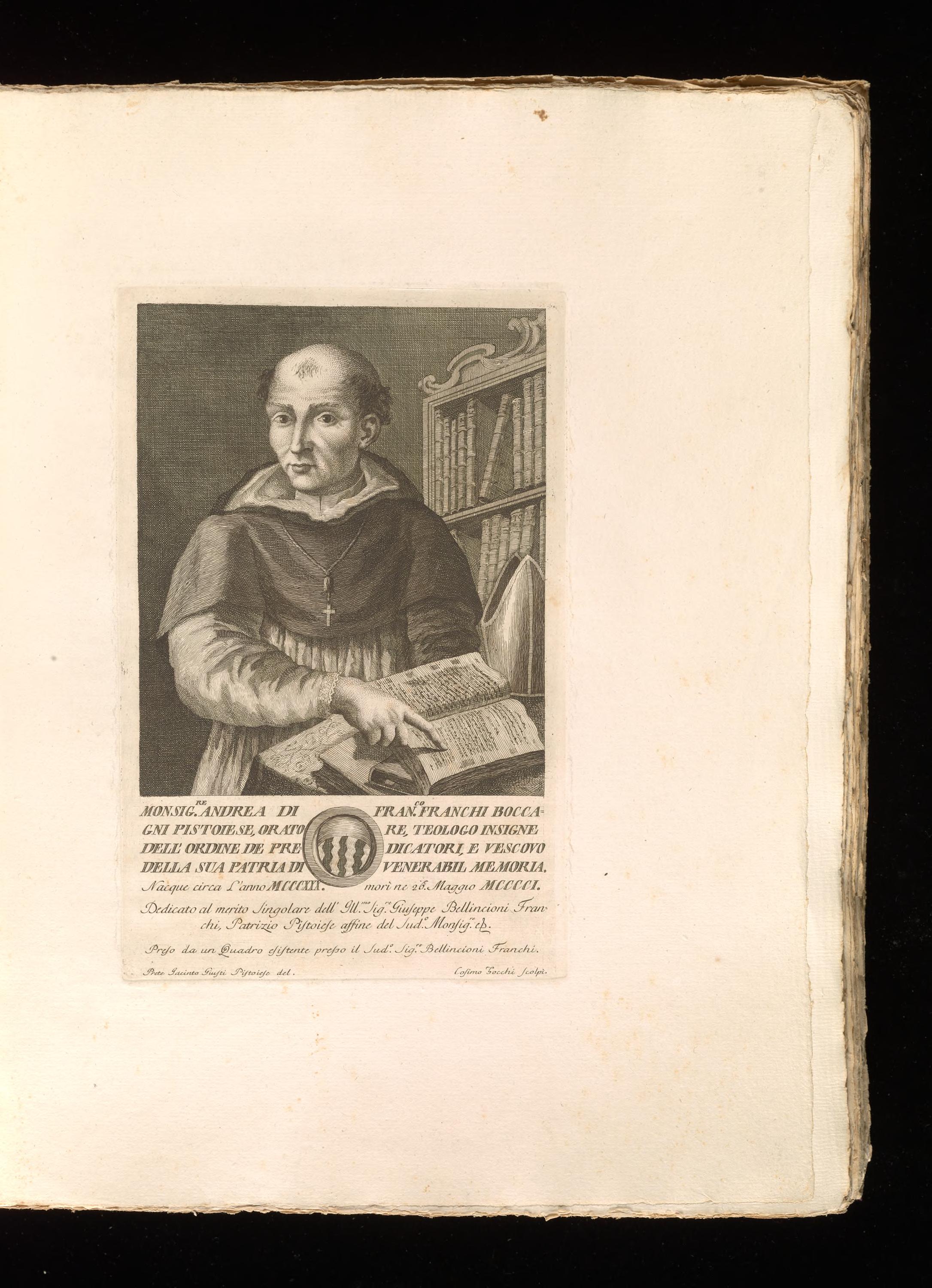
Franchi had spent much of his life inside Dominican communities before becoming bishop of his home city. Born in Pistoia in 1335 to a merchant family, he entered the Order as a young man and trained for a life of study, preaching, and pastoral responsibility. His later public work grew from that formation. [3]
A friar learns to lead
Before his episcopate, Franchi served as prior in Pistoia, Lucca, and Orvieto. He also directed Pistoia's Compagnia dei Magi, an association of artisans engaged in charitable work. Religious leadership already meant organizing other people's efforts and meeting practical needs. The Dominican account also associates him with establishing a pharmacy for those needing assistance. [5]
His appointment as bishop, placed by the diocese in 1382, enlarged those responsibilities. The diocesan biography remembers him as reluctant to take the office. Franzese describes a bishop who retained his Dominican habit and divided his income among church repairs, poor people, and his own support. [1] [3]
A meeting after the procession
The Bianchi took their name from their white clothing. Their processions combined prayer, fasting, and movement through towns and the countryside under the threat of plague. Historian Alexandra Lee's study shows how local clergy shaped the movement. Franchi appears in Dominici's account as a frequent preacher who also explained exemptions for pregnant women and children under twelve from the travelling processions. The devotion required organization as well as enthusiasm. [6]
Franzese's account, also drawing on Dominici, describes what followed Pistoia's great August procession. Franchi urged reconciliation with enemies. The next day he gathered civic authorities in the cathedral sacristy to address hostilities among families of the city and surrounding countryside. Later he publicly urged perseverance and peace. The work involved bringing public authority into the same conversation as religious repentance. [3]
A city still vulnerable
The story also resists a tidy ending. The Bianchi's devotions were associated with hopes of protection from plague, yet disease struck Pistoia. Lee distinguishes the 1399 movement from further plague processions in 1400 and shows how religious activity and civic measures formed the city's response. This history gives no basis for treating the processions as medically protective. Nor does it establish a simple claim that they caused the epidemic. [6]
During the plague, Franchi continued demanding pastoral work despite his age and poor health, according to Franzese. [3]
Franchi's own health eventually limited his work. Gravely ill, he relinquished the bishop's responsibilities in 1400 and returned to San Domenico, where he died in 1401. The Dominican remembrance ends his life with dependence and illness as well as public service. The man remembered for helping others had to accept the limits of his own body. [5]
IN OUR OWN LIVES
Mercy in a divided city
Franchi’s religious movement reached prisons and meetings with civic authorities. Peacemaking meant addressing hostilities among families who would continue living near one another after the procession ended. His other work involved organizing charity and helping people who were ill. These were practical uses of the influence a religious leader could hold. [2][4]
Someone with money or public responsibility has choices about where that influence goes. Franchi’s use of episcopal income and his efforts at reconciliation make those choices visible. His Catholic faith gave them a place in worship: Matthew’s Gospel asks a person to seek reconciliation before bringing an offering to the altar. [3][8]
THROUGH THE EYES OF FAITH
Faith and daily life
The two words carried through Pistoia's streets were a religious demand: mercy and peace. The diocese's history credits Franchi's movement with helping repair relationships among leading families. Its account connects prayer with the difficult task of living together after conflict. [2]
That connection is central to the Gospel. In Matthew 5, Jesus blesses peacemakers and tells a worshipper to seek reconciliation with an estranged brother before presenting an offering. Franchi's public ministry gives a local, imperfect human setting in which to consider that teaching. A prayer for peace can ask something of the person praying it. [8]
Beauty belongs to the story too
San Domenico also holds material traces of his building work. Italy's national cultural-property catalogue identifies a stone Franchi family emblem and connects it with his role in completing the church facade. A visitor can meet this bishop through a place shaped for a community's worship, as well as through its reliquary. [9]
THROUGH THE LENS OF SCIENCE
The evidence about the remains
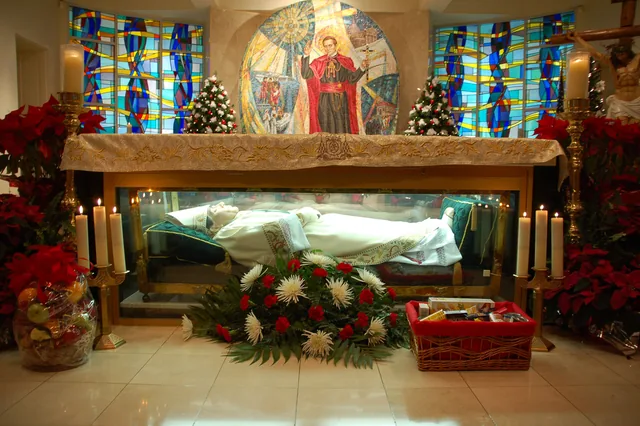
The Diocese of Pistoia describes Franchi's remains as incorrupt and locates them in a glass case at San Domenico. Its history traces a move during church restoration in 1613, a later disappearance and recovery in 1790, and a return to the church following his recognition as Blessed in 1921. This is a history of custody and devotion. The anatomical inventory and full conservation record are absent from the account. [1]
A study announced in 2022
A more recent record opens a different line of inquiry. On 17 March 2022, Fondazione Caript announced support for a University of Pisa project to study the remains using biomedical methods and expertise from the humanities and sciences. The funder's announcement calls the body mummified. It describes research to be undertaken, rather than publishing examination results. [7]
That distinction matters for a visitor standing before the case. The announcement records funding for research; its findings about surviving tissue, treatment, or preservation are not published there. Those physical questions remain open in the records linked here. Franchi's charitable and civic work can be examined historically while the condition of the remains receives its own investigation. [7]
READER QUESTIONS
Questions and answers
Why is he called Blessed rather than Saint?
The Dominican account records that Benedict XV confirmed his cult in 1921 and identifies him as Blessed. That is the title used in this profile. The recognition concerns his religious life and public veneration; the physical condition of the remains is a separate question. [5]
Does the display establish miraculous preservation?
The diocese's description and the 2022 research announcement establish an attributed body, a custody history, and a funded scientific project. They do not publish the findings needed to establish how preservation occurred. A photograph or the appearance of the case cannot answer those questions by itself. [1] [7]
FOLLOW THE SOURCES
Sources and further reading
- Maria Valbonesi, Diocese of Pistoia — Andrea Franchi, the Blessed bishop
Church or shrine source
Institutional biography and custody history; its preservation description is not a scientific examination.
- Diocese of Pistoia — San Domenico: history of the church and convent
Church or shrine source
Institutional account of Dominican community, study, preaching, lay confraternities, and Franchi's promotion of mercy and peace among Pistoia's leading families. A retrospective account, not a contemporary transcript.
- Paolo Franzese — Franchi, Andrea, Dizionario Biografico degli Italiani 50 (1998)
Scholarly account
Scholarly synthesis using archives and Dominici; the appointment date remains uncertain.
- Biblioteca dei Domenicani, Pistoia — Andrew Franchi and the San Domenico monuments
Custodian’s account
Institutional history citing Dominici; checked against scholarship because some dates and papal numerals are erroneous.
- Amici Domenicani — Blessed Andrew Franchi (10 June 2023)
Church or shrine source
Dominican remembrance of charitable work, illness and cult. Its erroneous episcopal year1832 is excluded.
- Alexandra R. A. Lee — Plague and Popular Revival: Ecclesiastical Authorities and the Bianchi Devotions in 1399 (2022)
Scholarly account
Original peer-reviewed historical research on chronicles and civic records; distinguishes devotional aims, disease chronology and causal claims. Does not examine Franchi’s remains.
- Fondazione Caript — Research grant announcement, 17 March 2022
Primary historical record
Funder’s University of Pisa research announcement; it supplies no examination findings or preservation mechanism.
- Gospel of Matthew 5:9 and 5:23–24 — USCCB Bible
Scripture
The Catholic biblical context for peacemaking and reconciliation before worship. Used for the profile's explicit theological reflection, not as evidence of the precise words Franchi preached.
- Italian Ministry of Culture — Franchi family arms at San Domenico, catalogue 0900020959
Primary historical record
Official cultural-property record of a stone family emblem, with historical notes connecting it to Franchi's work on the church facade. Metadata licensed CC BY 4.0. Used as material evidence of building patronage, not a complete reconstruction of his intentions.
Sources checked: 2026-10-27. Suggest a correction or a source.