THE PERSON BEHIND THE ACCOUNT
A young woman in a city that could expel her
Rose’s remembered public life was brief and risky. The Viterbo tradition describes a young woman taking religious devotion into the streets and being exiled with her family. Later writers made her a formidable political preacher. Historical study finds a more restrained early account centred on prayer, example and public acts of faith. [1][2]
The early text and the larger legend
Rose is generally placed in Viterbo around 1233–1251. The historical dictionary identifies two early witnesses: a 1252 papal letter ordering the collection of testimony, and a fragmentary thirteenth-century Life. A later Life amplified the account and became influential in subsequent biographies. [2]
Filippo Sedda and Eleonora Rava’s catalogue of the Lives gives readers the means to distinguish those layers. The first text survives only in a fragment, while the later biography belongs to a fifteenth-century context. A more colourful scene is not necessarily a better-attested event. [3]
Devotion outside the convent
The diocesan account says Rose was refused entry to the local women’s community and instead practiced penance and charity in town. This vocation outside the institution she wanted to enter belongs to the received biography. [1]
The historical dictionary cautions against the later image of a long campaign against Emperor Frederick II. In the earlier Life, the emphasis is religious example and public devotion. Exile remains part of the narrative, but its setting is a divided city in which religious allegiance and civic conflict were closely entangled. [2]
IN OUR OWN LIVES
A voice that grew after a short life
Rose gives readers two connected histories: a young woman whose public faith brought consequences, and a city that continually reshaped her memory. The fragmentary early text, the later legend and the conserved mummy all survive differently. Looking closely at them makes the person more interesting than an unqualified claim that nothing ever changed. [2][3][4]
THROUGH THE EYES OF FAITH
Faith and daily life
Viterbo venerates Rose as its patron. Her memory belongs to a Franciscan world of penance, charitable care and devotion to the crucified Christ. Her continuing cult should not be confused with a modern canonization decree: the historical processes described by local scholarship were not completed. [1][2]
Whose story did Viterbo keep?
The city preserved Rose’s memory through the shrine, religious observance and the annual transport of the Macchina di Santa Rosa. The diocesan account locates the great public event on 3 September. The structure carried through the streets is a devotional construction; it should not be mistaken for a procession carrying the body itself. [1]
An early Life and a later retelling answer different questions. Their dates and surviving manuscripts help reveal how an exemplary young woman became a civic patron. [2][3]
THROUGH THE LENS OF SCIENCE
The evidence about the remains
The local study centre describes natural mummification and a long history of contact, damage and conservation. Her preserved remains have not simply spent eight centuries untouched. [4]
Natural drying and later intervention
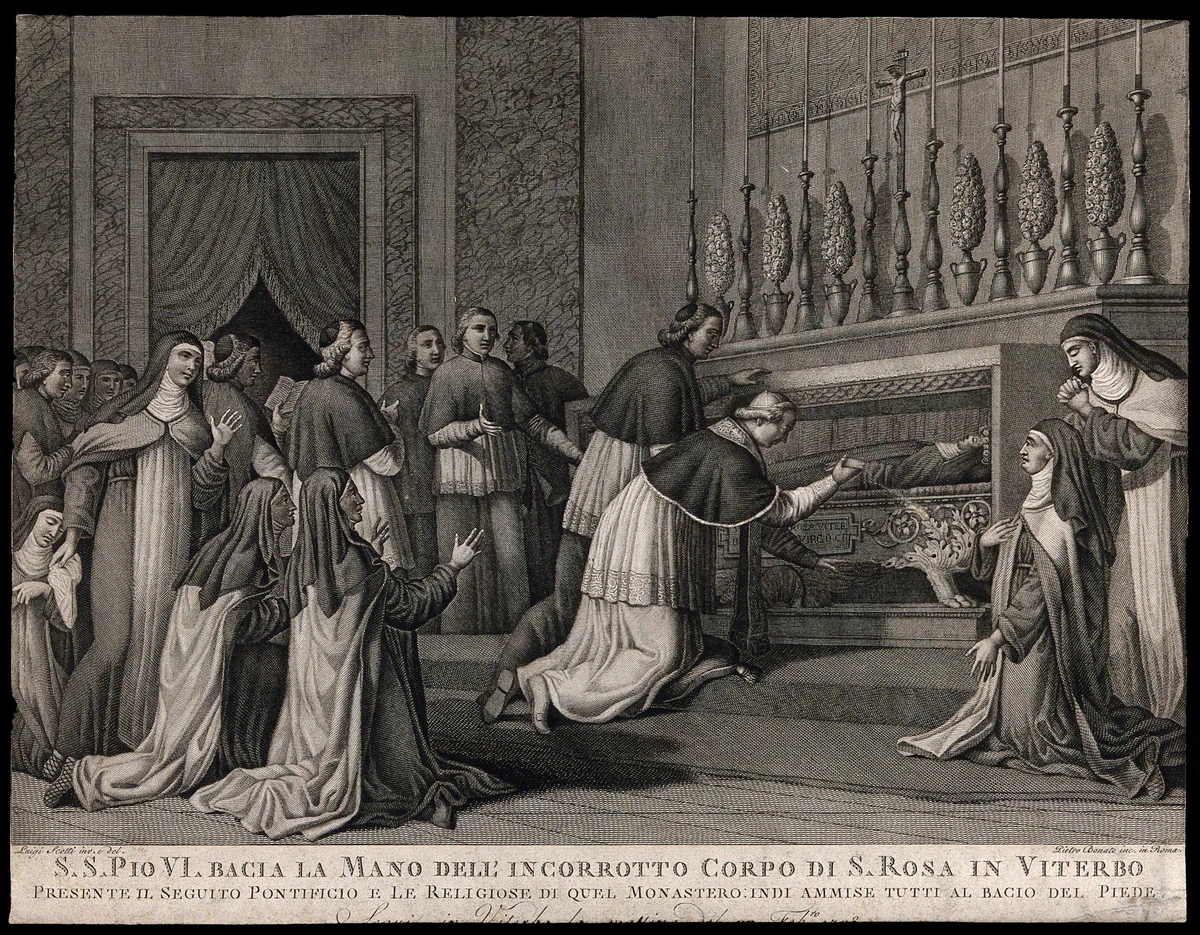
The Santa Rosa study centre’s 2021 archival article describes the remains as a natural mummy, with preservation attributed to rapid drying after burial. It also explains that opening the urn for hand-kissing and washing the skin exposed the remains to repeated handling; a broken arm and tissue loss were among the consequences. [4]
In 1921, physician Pietro Neri carried out conservation after concern about deterioration. The centre characterizes the intervention as invasive and records removal of the heart, which became a separate relic. Its article also discusses the 1998 examination. This is a history of surviving tissue combined with subsequent intervention, not an untouched body. [4]
What a shrine summary can and cannot settle
The diocese describes surviving internal organs, muscle and connected bones and reports a congenital absence of the sternum. Those are attributed institutional descriptions. Its webpage is not the full anatomical report, and no new diagnosis or survival prognosis is made here from the mummy’s appearance. [1]
The study centre’s treatment history is essential when reading an “incorrupt” caption. It gives natural mummification a place in the account while acknowledging human conservation and a separately kept organ. A detailed technical publication would be needed to assess particular anatomical claims beyond these summaries. [1][4]
READER QUESTIONS
Questions and answers
Was she the political campaigner described in every later biography?
The historical dictionary finds that the later Life amplified that image. The earlier fragment places more emphasis on prayer, example and public devotion; the distinction should remain visible. [2]
Have the remains been treated?
Yes. The study centre documents 1921 conservation, removal of the heart and later examination. It describes natural mummification alongside those interventions. [4]
FOLLOW THE SOURCES
Sources and further reading
- Diocese of Viterbo: Santa Rosa shrine
Diocesan account
Received life, patronal observance and physical summary. Its medical descriptions are attributed; no new diagnostic or prognosis claims adopted.
- Dizionario Storico Biografico della Tuscia: Rose
Local historical reference
Distinguishes 1252 letter, early Life and later amplification; dates and public career remain qualified; explains uncompleted canonization processes.
- Sedda and Rava: catalogue of the Lives
Scholarly institution’s account
Dates and locates the early fragment and later Life; source transmission is not treated as direct eyewitness access.
- Santa Rosa study centre: centenary of the 1921 examination
Archival research
Reports natural mummification, handling damage, invasive 1921 conservation, heart removal and 1998 examination. Archival synthesis, not the complete modern analytical dataset.
Sources checked: 2026-10-27. Suggest a correction or a source.