THE PERSON BEHIND THE ACCOUNT
Refusing to pass the feud on
The most consequential choice in Rita’s received biography came after her husband’s murder. The Cascia sanctuary says she refused revenge, even at the cost of resentment from his family. She feared that their sons would inherit the feud. Her story brings a large religious word, forgiveness, into the pressure of family loyalties. [1][3]
What can be known of a medieval woman
Rita left no writings. Historian Lucetta Scaraffia’s Treccani account emphasizes how limited the documentary evidence is, including uncertainty about her birth date. The painted wooden coffin and its inscriptions are important witnesses to her early memory. Precise dialogue and intimate domestic scenes in later biographies cannot be treated as eyewitness reporting. [4]
The familiar outline places her at Roccaporena, near Cascia, before marriage and motherhood. It then follows widowhood, the loss of her sons and entry into the monastery of Santa Maria Maddalena. Details and dates vary, but the movement through family life and religious community is central to how Catholics remember her. [2][4]
A family after a killing
The sanctuary situates the murder within factional conflict. It says her refusal to identify the killers angered her husband’s relatives: reconciliation challenged expectations inside the family. [1]
Later descriptions of her marriage also disagree. The cause profile repeats the image of a violent husband; the sanctuary explicitly disputes that portrayal. The available evidence does not justify presenting a detailed, certain account of abuse or claiming that she “tamed” a husband. Her devotion should never be used to make remaining in danger a religious obligation. [1][2]
Widowhood did not end her capacity to act
The received accounts describe obstacles before Rita entered Santa Maria Maddalena. She eventually joined other women in a shared religious life. Bereavement preceded that new belonging, but it did not exhaust her identity. [2]
Scaraffia reads her place in the city and the imagery on the coffin in terms of reconciliation. The painted name of Jesus links the memorial with a devotion that had itself provoked dispute between religious groups. A saint remembered for peace could become a symbol through which a community expressed its hope for unity. [4]
IN OUR OWN LIVES
When loyalty seems to require retaliation
Rita is compelling because the choice remembered of her was socially costly. She would not hand a feud on to her children. Readers facing family conflict can take that question seriously while leaving uncertain medieval details uncertain. Her later communal life also prevents the biography from ending with bereavement: she continued to belong, pray and act. [3][4]
THROUGH THE EYES OF FAITH
Faith and daily life
Rita’s later life belonged to an Augustinian community and a devotion to Christ’s Passion. John Paul II interpreted her example through love and peacemaking, explicitly rejecting passive resignation as the meaning of accepting suffering. [3]
The thorn and the rose
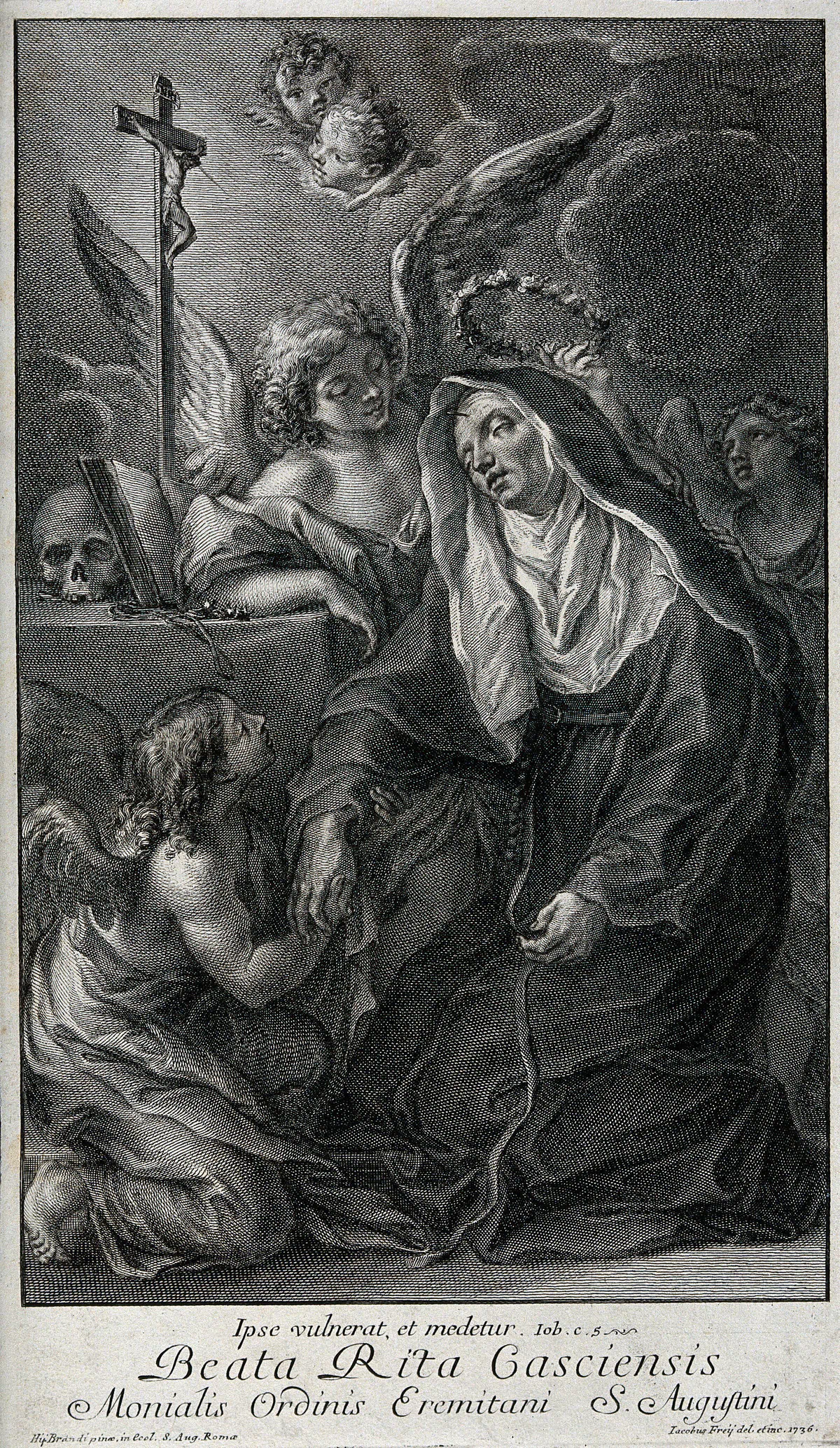
Catholic devotion connects Rita with a wound on her forehead, understood as sharing in Christ’s crown of thorns. It also remembers a winter rose from Roccaporena. John Paul II used these images to speak about responding to suffering with forgiveness and self-giving love. Their religious meaning should be distinguished from a medical account of an injury. [2][3]
That distinction also keeps the focus on action. In the pope’s interpretation, her faith concerns the work of overcoming conflict in daily life. Forgiveness does not erase a killing, make violence acceptable or provide a complete description of grief. It names the refusal to make another generation carry the same retaliation. [3]
THROUGH THE LENS OF SCIENCE
The evidence about the remains
The sanctuary describes partly mummified remains with a skeleton beneath the habit. The whole body’s flesh has not survived. [1]
The body under the habit
The sanctuary says the face, hands and feet are mummified, while the remainder is skeletal, a condition it dates to the early eighteenth century. It locates the remains in the basilica’s silver-and-crystal urn. This partial preservation is more specific than the usual photographs or the blanket term “incorruptible.” [1]
The same page attributes a forehead bone lesion to medical investigation but supplies no methods or differential diagnosis. Its interpretation in relation to the thorn wound should therefore remain a devotional interpretation of an attributed finding. [1]
A painted wound documents religious memory. A lesion requires an examination and diagnosis. Neither supplies a shortcut to the other.
A 2021 review classifies Rita’s remains as artificially mummified; its direct survey concerned Ranieri, not Rita. [5]
READER QUESTIONS
Questions and answers
Is Rita’s whole body preserved with all its flesh?
No. The sanctuary describes mummification of the face, hands and feet and a complete skeleton beneath the habit. [1]
FOLLOW THE SOURCES
Sources and further reading
- Cascia sanctuary: Rita’s life and remains
Custodian’s account
Partial mummification/skeleton, disputed husband, attributed bone lesion; no examination report.
- Dicastery for the Causes of Saints: Rita
Church or shrine source
Supports recognition and received Augustinian/Passion tradition. Its violent-husband wording conflicts with custodian; no certainty asserted between them.
- John Paul II: address to devotees, 20 May 2000
Church or shrine source
Interprets forgiveness, peacemaking and Passion symbolism; explicitly distinguishes acceptance of suffering from passive resignation.
- Lucetta Scaraffia: Rita da Cascia, Dizionario Biografico degli Italiani
Scholarly account
Historical source criticism: scant documents, uncertain birth, coffin imagery and civic reconciliation. No modern anatomical findings.
- Mandarano, Czortek and Ventura (2021), Table 1
Comparative scientific literature
Comparative classification; direct survey of Ranieri.
Sources checked: 2026-10-27. Suggest a correction or a source.