THE PERSON BEHIND THE ACCOUNT
The woman who defended the right to own nothing
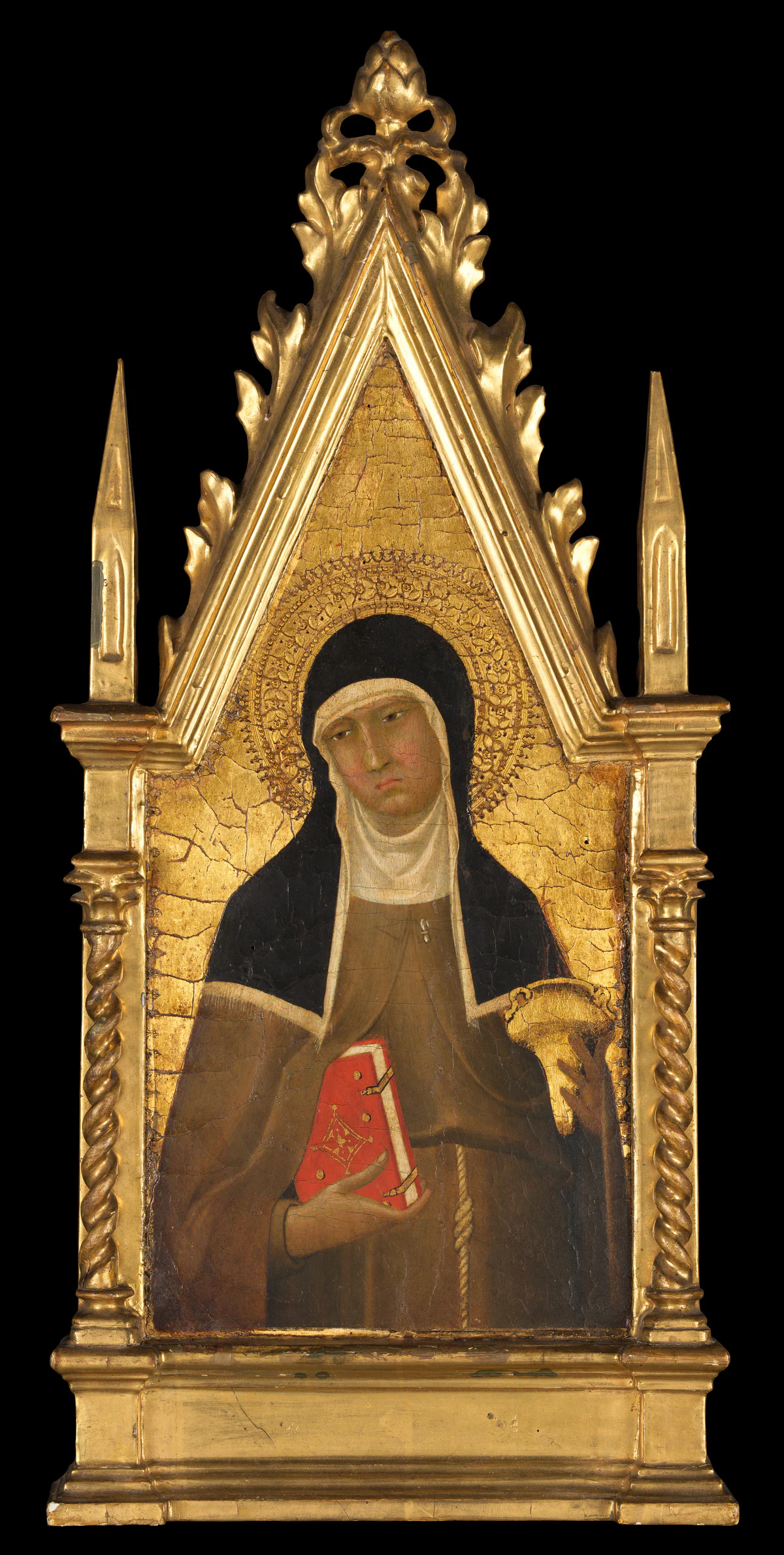
Clare left an aristocratic household to join the religious movement gathering around Francis of Assisi. Her family had expected a prestigious marriage. She chose a rough habit and a community whose poverty would require work, dependence on others and repeated negotiation with Church authorities. [1][2]
A decision her relatives resisted
Her relatives pressed her to abandon the new life. After time in other religious houses, Clare settled with companions at San Damiano, where she remained for more than forty years until her death in 1253. The celebrated act of leaving home became a long commitment to the same place and people. [1]
Keeping the original promise
Historian Joan Mueller places Clare’s struggle for a rule alongside the work of her correspondent Agnes of Prague. They wanted women’s communities to keep the Franciscan commitment to poverty rather than acquire a conventional financial foundation. The issue demanded political judgment as well as conviction. Innocent IV approved Clare’s rule near the end of her life in 1253. [2]
A monastery also had to eat, maintain shelter and look after sick sisters. Refusing a dependable endowment made those responsibilities harder to plan. Clare’s insistence makes sense within her trust in Christ and providence, but its practical cost should remain visible beside its spiritual appeal. [1][2]
IN OUR OWN LIVES
Making a conviction survive its founder
Clare’s insistence on an approved rule addressed a problem that outlives any founder: how does a community keep its commitments when its members and leaders change? She worked on the arrangements as well as the personal promise. [2]
Her dispute about property gives an organization a practical question to ask. Do the terms of its funding support the work it promised to do? Clare’s particular answer belonged to her religious vocation; the need to examine those terms remains familiar.
THROUGH THE EYES OF FAITH
Faith and daily life
The privilege Clare defended allowed her sisters to live without the landed endowments ordinarily expected to support a monastery. Giving away possessions was a beginning; preserving that choice for future women required a rule and papal approval. [2]
The mirror in her letter
In her fourth letter to Agnes, Clare uses Christ as a mirror in which a person can examine their own life. The point is to learn poverty, humility and charity by contemplating him. Her correspondence made a relationship between women in distant communities a vehicle for religious teaching. [3]
The image changes the question one brings to self-examination. Instead of asking whether I look accomplished, I can ask whom my choices resemble. What would another person recognize in my use of money, my treatment of someone dependent on me, or the way I speak when inconvenienced? Those are practical ways to begin with Clare’s teaching. [3]
A leader within the enclosure
The community’s rule put Clare’s religious commitment into terms that other women could continue to live. Her letters also carried teaching beyond the enclosure. Those documents give readers direct work to examine alongside the familiar account of her friendship with Francis. [2][3]
THROUGH THE LENS OF SCIENCE
The evidence about the remains
The figure in Clare’s basilica in Assisi includes a modeled wax head over her remains. A Catholic religious-superiors’ guide describes the underlying remains as bones. The visible face is therefore no evidence of surviving facial tissue. [4]
Bones, coverings and a crypt
The basilica’s Franciscan guide identifies her sarcophagus in the crypt, constructed in the nineteenth century. The Council of Major Superiors of Women Religious gives the more specific distinction between the bones and their exterior presentation, including the modeled face. A body-shaped display can hold bodily relics without being an intact body. [4][5]
What the old preservation story leaves open
The religious-superiors’ guide also recounts an earlier finding of preservation and later deterioration. It supplies no modern laboratory report or complete conservation chronology. That account should be read as a history of how the remains have been described and displayed, rather than a demonstration that soft tissue survives today. [4]
READER QUESTIONS
Questions and answers
Did Clare simply follow Francis’s instructions?
Francis profoundly shaped her vocation, but Clare defended her community’s way of life through her own leadership, correspondence and rule. Her collaboration with Agnes of Prague was part of that work. [1][2]
Is the face in the crypt her preserved face?
The religious-superiors’ guide identifies a modeled wax head and underlying bones. The exterior should not be described as natural facial preservation. [4]
FOLLOW THE SOURCES
Sources and further reading
- Benedict XVI — Clare of Assisi, 15 September 2010
Church or shrine source
Supports departure, family opposition, San Damiano, poverty and institutional teaching; exact departure year varies in modern chronology and is omitted.
- Joan Mueller — The Privilege of Poverty, Penn State University Press
Scholarly account
Publisher’s scholarly synopsis on Clare, Agnes and the struggle for a rule preserving poverty. Only synopsis/excerpt inspected, not the entire book.
- Commission on the Franciscan Intellectual Tradition — Clare’s Words of Wisdom
Church or shrine source
Institutional presentation with excerpts from Clare’s fourth letter and Testament; supports mirror teaching and correspondence. Its precise rule-approval interval is not adopted.
- Council of Major Superiors of Women Religious — Assisi, Part III
Church or shrine source
Catholic institutional pilgrimage guide identifies bones, modeled wax head and earlier preservation narrative. Not a specialist anatomical report.
- Assisi OFM — Basilica di Santa Chiara
Church or shrine source
Franciscan institutional account identifies the sarcophagus and nineteenth-century crypt; does not itself supply an anatomical analysis.
Sources checked: 2026-10-27. Suggest a correction or a source.