THE PERSON BEHIND THE ACCOUNT
Schools, prayer and a history that requires candour
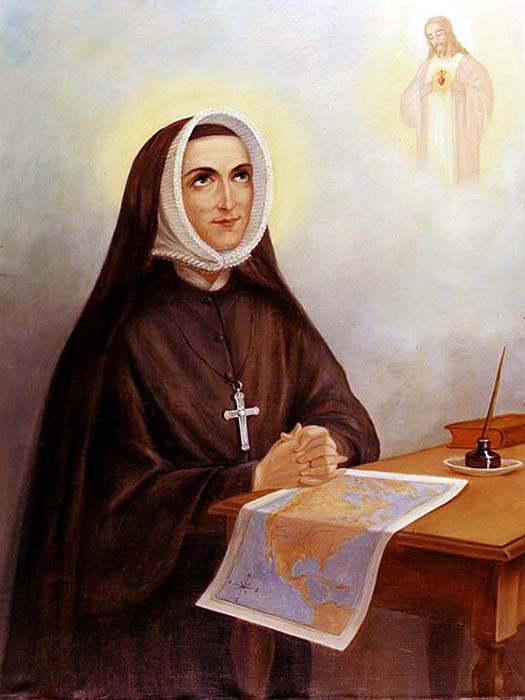
In 1804, after the French Revolution had broken up her earlier religious community, Philippine Duchesne entrusted her former monastery to Madeleine Sophie Barat’s Society of the Sacred Heart and joined it. Years later she crossed the Atlantic to establish schools. Those decisions demanded persistence, but a full account must also include the people whose coerced labour supported the foundations. [1][3]
A religious life interrupted by revolution
Born in Grenoble in 1769, Philippine entered the Visitation community at nineteen against her family’s wishes. The Revolution forced the nuns from their house. The Society’s biography records years spent nursing prisoners, helping priests reach Catholics and teaching and feeding children. She later recovered the monastery and attempted to begin again. [1]
Joining Barat’s Society placed the recovered property within a new undertaking. North American schools grew from this international religious network and the friendship between the two women. [1]
Keeping a school open
Philippine and her companions opened the first Sacred Heart school outside Europe at Saint Charles, Missouri, in 1818. Other foundations followed in Missouri and Louisiana. A historian’s reading of her collected writings finds descriptions of money, rules, teaching and difficult relations with clergy beside her spiritual ambitions. [1][2]
The letters are valuable partly because they resist a smooth commemorative story. They show the daily negotiations involved in keeping a women’s institution functioning. Catherine O’Donnell notes her insistence that admitting a congregation to a diocese did not entitle a bishop to rewrite its rule at will. Religious obedience and institutional judgment could come into tension. [2]
Rachel’s claim and the Society’s answer
The foundations relied on enslaved people. The Society’s own archival account names Rachel, who maintained that she was not in fact enslaved to the community. Philippine rejected that assertion, appealed to a purchase from Bishop Du Bourg and considered obtaining a receipt. Rachel was later sold. Her resistance belongs in this history alongside the founder’s letters. [3]
Other records describe transactions involving people treated as property for domestic and agricultural labour. Calling this merely a feature of the times would conceal the choices people made and the harm done. The Society now acknowledges its complicity in enslavement as sinful and works with descendants. A saint’s biography should tell readers why such work is necessary. [1][3]
The people already at Sugar Creek
At seventy-two, Philippine went to the mission among the Potawatomi at Sugar Creek. She could not learn enough of the language to teach and was too frail for much physical work. Her stay lasted about a year before she was recalled. The familiar title “Woman Who Prays Always” belongs to this late period. [1][2]
The Potawatomi had recently endured forced removal. The Citizen Potawatomi Nation’s Cultural Heritage Center describes the 1838 march from Indiana, leaders restrained and homes destroyed, with more than forty deaths. This was their history before the missionary arrived. They must not appear merely as a grateful audience for her final chapter. [5]
IN OUR OWN LIVES
An honest account can sustain harder questions
Philippine’s life belongs in conversations about women’s education, religious initiative and institutional memory. It also asks what happens when admirable work depends on exploitation. Reading Rachel’s resistance and the Potawatomi history alongside the founder’s letters gives those questions real names and circumstances. Her canonization need not be used to silence them. [2][3][5]
THROUGH THE EYES OF FAITH
Faith and daily life
Prayer and education belonged together in her Sacred Heart vocation. Her correspondence also shows a woman defending her community’s rules and decisions when male clergy pressed for changes. Devotion did not make her passive in governing the work. [2]
What prayer meant at the edge of her abilities
The Society’s later reflection on Sugar Creek asks what Philippine understood of the people’s suffering and how she reconciled political realities with the Gospel. It asks those questions rather than supplying an answer from her mind. Her hours of prayer are remembered; their precise contents and her full understanding of forced displacement are not ours to invent. [4]
The combination makes her legacy demanding. Readers can recognize courage in crossing an ocean and perseverance in difficult work while also facing a failure to recognize other people’s freedom. Catholic remembrance becomes more credible when it leaves both parts visible. [1][3][4]
THROUGH THE LENS OF SCIENCE
The evidence about the remains
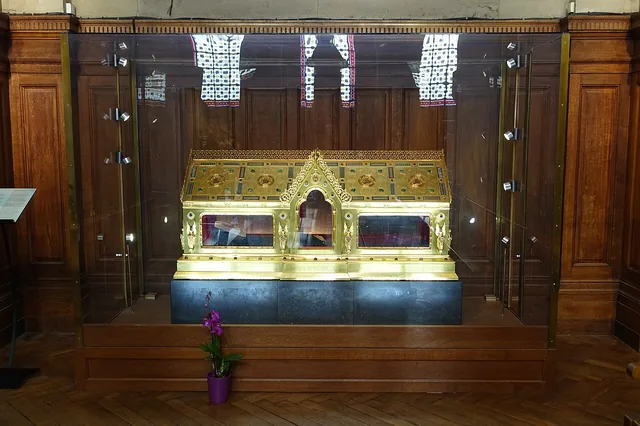
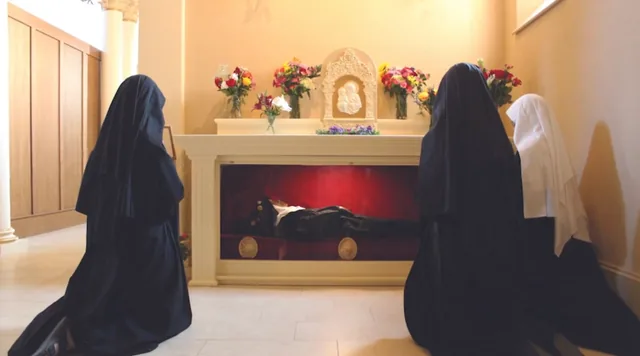
The shrine reports an intact-body observation at an exhumation three years after her 1852 death. It now identifies a marble sarcophagus, not an exposed body available for visual assessment. [6]
A historical observation, a closed sarcophagus
After her death in 1852, Philippine was buried at the school in Saint Charles. The custodian says an exhumation three years later found the body intact. Later moves placed the remains in a marble sarcophagus, transferred into the shrine in 1952. The phrase “miraculously intact” is the shrine’s religious characterization of the earlier observation. [6]
The public history does not reproduce the exhumation record, describe current anatomy or give a complete treatment history. It cannot establish the present survival of soft tissue or a preservation mechanism. Visitors encounter a tomb within a functioning school and religious memorial, whose wider history includes the people educated there and the labour that supported it. [3][6]
READER QUESTIONS
Questions and answers
Did her communities participate in slavery?
Yes. The Society’s own archival history documents buying, selling and relying on enslaved people, including Philippine’s correspondence concerning Rachel. [3]
Can visitors see an uncovered preserved body?
The shrine identifies a marble sarcophagus. Its intact-body statement concerns an earlier exhumation, not a published current anatomical examination. [6]
FOLLOW THE SOURCES
Sources and further reading
- Society of the Sacred Heart: her life
Religious order’s account
Grenoble, Revolution, 1804 decision, 1818 school and Sugar Creek; acknowledges enslavement.
- Catherine O’Donnell: reading Duchesne’s complete writings
Scholarly account
Historian’s reading of letters documents institutional negotiations, limits at Sugar Creek and recall. No invented interior account.
- Society: enslavement in Missouri and Kansas
Institutional archival history
Documents Rachel’s assertion, Philippine’s rejection and sale, plus other enslaved labour transactions. Their agency is retained without reproducing racist language.
- Sheila Smith RSCJ: What drove her to prayer?
Religious reflection
Places Sugar Creek in forced displacement and poses questions about her understanding; questions are not converted into asserted motives.
- Citizen Potawatomi Nation Cultural Heritage Center: Trail of Death
Indigenous community source
Potawatomi institutional history of 1838 forced march, coercion and deaths; supports context independent of missionary commemoration.
- Society: about the shrine
Custodian’s account
Reports intact-body observation three years after 1852 death and subsequent sarcophagus/shrine transfers. No underlying examination or current anatomy file.
Sources checked: 2026-10-27. Suggest a correction or a source.