THE PERSON BEHIND THE ACCOUNT
She began again in her seventies, carrying a lifetime of teaching, music, and prayer into a new community.
In May 1995, after half a century as an Oblate Sister of Providence, Wilhelmina Lancaster arrived in Pennsylvania to help begin another religious community. She was in her seventies. Leaving sisters she loved felt, she recalled, like leaving her family again. [1]
A daughter of segregated St. Louis
Born Mary Elizabeth Lancaster in St. Louis in 1924, she grew up loving books and imagining herself writing fiction. Religious life was a possibility she considered alongside those ambitions. At thirteen she wrote to the Oblate Sisters in Baltimore; their superior advised her to finish high school first. In her later account, her parents helped establish a Catholic high school for Black pupils during segregation. Education was something her family worked to make possible. [2]
At graduation she told two Oblate Sisters that she wanted to join them. She left home for Baltimore at seventeen and made her first vows in 1944. Her memoir also describes experiences she understood as encounters with Christ, beginning at her first Communion. Those are her religious recollections: they help explain the meaning she gave her vocation, without becoming independently verified observations. [2]
A schoolroom filled with music
The Oblates brought her into an established tradition of Black Catholic service. Founded in Baltimore in 1829 by Mary Lange and James Joubert, the congregation joined religious life with education and care for neglected communities. Its own history places service to poor people at the center of that work. Wilhelmina’s long vocation belongs within that wider history of women building and sustaining Catholic institutions. [3]
She was candid about her own difficulties: in her memoir she wrote that she loved study and school but not teaching. [1]
A former pupil at St. Pius V in Baltimore remembered a demanding teacher who conducted school musicals and expected children to sing attentively. When his singing wandered off-key, she told him to lower his voice. His sisters remembered how rehearsals and performances helped them love music. His recollection also includes the less enchanting duty of sweeping stairways after class. Decades later, he remembered her letters as warm and encouraging. The music teacher who asked for precision could still offer encouragement long after her pupils had grown up. [4]
Disappointment and another kind of work
Her own retrospective account does not turn every difficulty into a triumph. She says that excessive strictness toward a pupil, followed by a complaint, ended her classroom work in 1972. Back at the motherhouse, she asked to work on the congregation’s history. She described feeling that she had failed as a teacher. The memoir then recalls the consolation of writing a Eucharistic poem, “We Do Believe,” which Sister Benigna set to music. Archives and musical collaboration became important work. Her account records self-criticism alongside the discovery of another way to serve. [1]
The costly decision to begin again
Wilhelmina wanted a more contemplative form of community life, with a common habit, shared discipline, silence, and the older liturgical forms she loved. Those convictions brought disagreement within her congregation. A 2023 interview with Mother Cecilia, abbess of the community she helped found, describes her persistence and the eventual move to a new foundation associated with the Priestly Fraternity of St. Peter. In that interview, her wordplay on her name preserves some of her formidable humor: “I’ve a HELL of a WILL and I MEAN it!” [5]
The community began in the Diocese of Scranton in 1995, moved to Missouri in 2006, and became an abbey in 2018. Its first daughter house opened the following year. Those developments give her late beginning a visible consequence: a community continued beyond its foundress’s own capacity to lead it. [6]
IN OUR OWN LIVES
A new beginning in her seventies
Wilhelmina left a community she loved and helped establish another at an age when many people are retiring. The school her parents helped create, the music her pupils remembered, and the monastery’s daily work give that decision a history. Her own account of disappointment and excessive strictness deserves a place beside those achievements. Perseverance includes facing the effects of our choices on other people.
THROUGH THE EYES OF FAITH
Faith and daily life
Benedict XVI’s explanation of Saint Benedict’s Rule describes prayer as listening that must lead to action. He stresses humility, service, and a leader’s willingness to hear others, including the youngest. Those demands are a useful way to read Wilhelmina’s vocation, with its strong convictions and admitted mistakes. A Benedictine community has to live its faith through decisions and relationships each day. [11]
What the sisters mean by a hidden life
The Benedictines of Mary describe their vocation as prayer and sacrifice for priests, inspired by Mary’s support of the early Church. Their days include Mass, chanted psalms, reflective Scripture reading, and the work needed to maintain a household. They also make vestments and altar linens and offer hospitality to priests. This explains the practical shape of Wilhelmina’s later vocation: a common life built to sustain worship and the people who serve others. The community’s account is its own explanation of its purpose, rather than an outside measure of its spiritual achievements. [6]
THROUGH THE LENS OF SCIENCE
The evidence about the remains
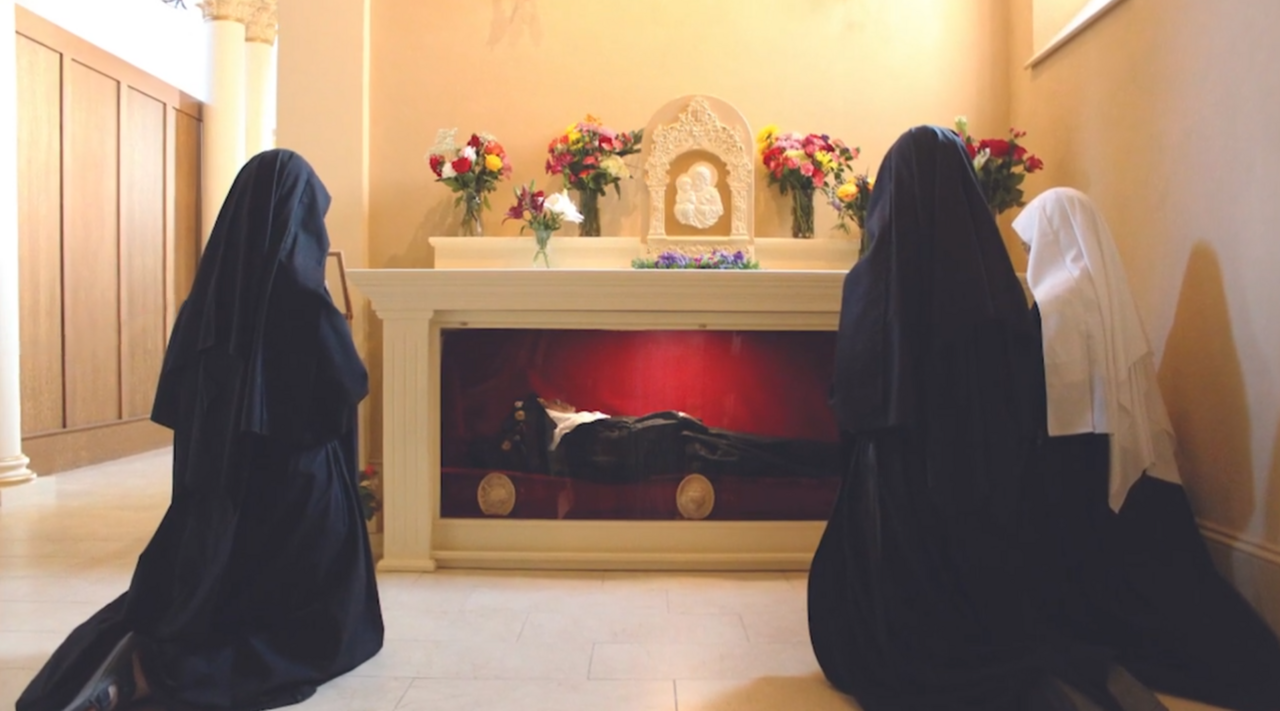
Wilhelmina died in 2019. The sisters opened her grave on April 28, 2023, to move her remains into their church. Their account describes burial without embalming in a simple wooden coffin and the surprise of finding a recognizable body and preserved habit. The discovery occurred during a planned reinterment, and the community’s interpretation of it is devotional. [7]
What the medical inquiry found
Bishop James Johnston’s August 2024 statement describes a team led by a pathologist, assisted by two other physicians and a former county coroner. They examined the remains and coffin and interviewed witnesses. The summary reports no detected features of decomposition during the limited examination, despite deterioration of the coffin lining, and calls the condition highly atypical for the circumstances. Soil analysis found no unusual elements thought to account for it. The public statement summarizes the inquiry; it does not publish the underlying medical report and data. It documents an unusual observation, without establishing its mechanism. [8] Our article on natural laws and miracles examines the further argument involved in interpreting an unexplained event as divine action.
What a soil test can—and cannot—answer
Decomposition involves interacting conditions. Research on cemetery soils considers moisture, temperature, oxygen, chemistry, and the burial environment, and warns against transferring results mechanically between locations. Finding no unusual soil element therefore does not test every natural pathway. This literature did not examine Wilhelmina’s body; it cannot supply a diagnosis of her case or erase the examiners’ judgment that the condition was unusual. It explains why establishing a cause requires more than one negative test. [9]
READER QUESTIONS
Questions and answers
Is Sister Wilhelmina officially a saint or Blessed?
She is presented here as a Catholic religious. The diocese’s August 2024 statement said there was no current plan to open a cause and that incorruptibility is not an indication of sainthood. This review, completed on 27 October 2026, located no later official cause announcement. [8]
Does the soil testing rule out every natural explanation?
No. Soil chemistry is one part of a changing burial environment. General taphonomic research cannot determine this case, and the diocesan public summary does not establish a preservation mechanism. An unresolved explanation also does not prove a supernatural cause. [9]
Can I visit the community?
The abbey’s published schedule welcomes visitors to Mass and the Divine Office. Consult the community’s current information before traveling, especially for groups, and remember that this is a working monastery whose daily prayer and quiet continue around its visitors. [10]
FOLLOW THE SOURCES
Sources and further reading
- Benedictines of Mary — 2019 memorial newsletter and Wilhelmina’s autobiographical account
Primary historical record
Her retrospective account, published by her community; pages 1–4 inform the personal narrative.
- Maria Wiering, OSV News — biography drawing on Wilhelmina’s autobiography
Reported account
Reported biography; childhood spiritual experiences are attributed as recollections.
- Oblate Sisters of Providence — congregational history
Church or shrine source
Historical origins and educational mission; older present-day counts are not used.
- Ralph Moore Jr. — Remembering Mother Wilhelmina, the teacher
Primary historical record
First-person pupil recollections; not used for medical findings or exhumation dates.
- Kelsey Wicks, CNA/ACI — interview with Mother Cecilia and biographical reporting
Reported account
Used for founding convictions and reported humor, not its superseded burial chronology.
- Benedictines of Mary — Our Charism and About Our Founding
Church or shrine source
The community explains its purpose and institutional development.
- Benedictines of Mary — account of the 2023 reinterment
Community’s account
A firsthand custodial account with devotional interpretation.
- Diocese of Kansas City–St. Joseph — medical inquiry update, August 22, 2024
Church or shrine source
Dated public summary; full medical report and data are not published here.
- Silva-Bessa and colleagues — The Importance of Soil on Human Taphonomy
Peer-reviewed research
General burial research; it did not examine Wilhelmina.
- Benedictines of Mary — public prayer and visiting schedule
Church or shrine source
Check current visiting information before travel.
- Benedict XVI — Saint Benedict of Norcia, General Audience, April 9, 2008
Church or shrine source
Catholic interpretation of Benedictine prayer, service, humility, and leadership.
Sources checked: 2026-10-27. Suggest a correction or a source.