THE PERSON BEHIND THE ACCOUNT
Compassion needed a rota
The 1617 rule for the Charity at Châtillon names a familiar problem: people could suffer because help was poorly organized, even when generous neighbours were willing. Vincent de Paul and the women who joined the association gave that help a schedule and shared responsibilities. The rule survives as a record of a practical decision. [1]
A decision recorded on paper
The foundation document of 23 August 1617 states that members would take turns, each responsible for a day’s assistance to the sick people the group had agreed to serve. The later regulations set out bodily and spiritual care and anticipated that an unstructured good intention could soon fade. Organization was part of the charity itself. [1]
A dated rule lets readers see what changed. Responsibility no longer depended only on whoever happened to feel moved that day. The women’s agreement gave the work continuity. The paper also preserves their participation: these were people making a shared undertaking, rather than anonymous helpers appearing around a famous man. [1]
The women who made the work possible
The Daughters of Charity’s own history names Vincent, Louise de Marillac and Marguerite Naseau together. Louise helped form and organize the women. Marguerite came from a rural background and offered the practical service that encouraged others to join. The community formed in 1633 grew from their contributions as well as Vincent’s. [3]
Remembering them changes the picture of a founder. He identified needs and connected people, but the work depended on women’s knowledge, judgment and labour. Their history describes an active vocation that put women alongside people in need, including those who could not come to a religious house for assistance. [3][4]
Rules that could yield to a person
Blandine Delort’s study of the Regulations and later Rules traces Louise’s adaptations to different places and services. These changes grew from observing what the sisters actually did. The rules could direct the day closely, but urgent needs of poor people were to take precedence. [4]
That is a consequential choice about authority. A rule intended to serve people could become an obstacle if treated as an end in itself. The historical study preserves the tension. Good organization would never remove the need for judgment when someone’s circumstances differed from those anticipated on paper. [4]
IN OUR OWN LIVES
Will anyone be there tomorrow?
Vincent’s rules are a useful starting point for anyone involved in volunteering or care. They ask who will come, who is responsible and what happens when the initial enthusiasm ends. Louise and the other women helped give answers that could survive a founder. Religious belief and practical arrangements belonged to the same work. [1][3][4]
THROUGH THE EYES OF FAITH
Faith and daily life
Vincent understood care for poor people as an encounter with Christ. Prayer, preaching and priestly formation belonged beside material assistance. The spiritual claim was meant to change how people were treated and how reliably help arrived. [2]
Preaching and formation
Pope Francis’s 2017 message interprets Vincent’s charism through Luke’s Gospel and good news for the poor. It remembers popular missions and the formation of priests as part of the same commitment. Vincent was concerned with religious instruction and pastoral care as well as material relief. [2]
The Daughters of Charity’s continuing history likewise places their service within trust in Providence and the charity of Christ. Catholic faith supplied the purpose and practices of the community. The daily service gave that faith a form other people could encounter, whether through a visit, food or care during illness. [2][3]
THROUGH THE LENS OF SCIENCE
The evidence about the remains
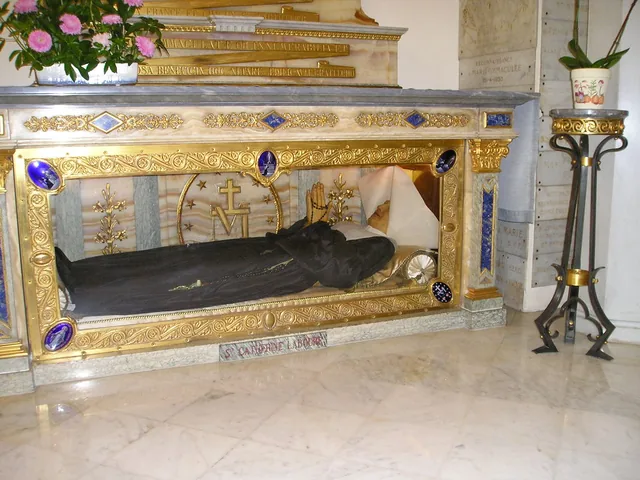
The Congregation of the Mission is explicit about the Paris display: a surviving skeleton with face and hands modelled in wax. The lifelike surfaces are representation, not exposed preserved skin. [5]
The body changed; the representation kept a face
The Paris custodian reports that Vincent’s body was found largely intact in 1712, but that only the skeleton remained in 1737. It then describes the face and hands modelled in wax over the surviving relics. The historical preservation report and the current display therefore refer to different conditions. [5]
The lifelike face cannot be captioned as a naturally preserved face. The custodian also recounts the relics surviving the Revolution and their continuing place in the chapel. That custody history matters, but it cannot change the material of the visible surfaces or restore the tissue its earlier timeline says was gone. [5]
The De Paul University Vincentian image archive also catalogues the wax presentation. A visitor can respect the relic and the artist’s work while knowing which is visible. This allows the person’s life of care to hold attention without a misleading physical claim. [6]
READER QUESTIONS
Questions and answers
Is the face visible in the Paris display his untreated skin?
No. The custodian identifies the wax face and hands and says that skeletal remains survived by 1737. [5]
FOLLOW THE SOURCES
Sources and further reading
- Vincent: Châtillon foundation document and regulations, 1617
Primary translated
Dated foundation and regulations document rotas, bodily/spiritual care and the need for organized assistance. Modern translation budget applies; no invented scene.
- Pope Francis: Vincentian Family message, 2017
Church or shrine source
Interprets charism, Christ in poor people, popular missions and priestly formation. Later papal reading, not Vincent’s autograph.
- Daughters of Charity: our history
Religious community’s account
Names Vincent, Louise and Marguerite as contributors and describes 1633 foundation and active service.
- Blandine Delort: From Regulations to Rules, Vincentian Heritage Journal
Scholarly account
Abstract supports Louise’s adaptations from observation, scheduled work and priority of urgent needs. Full article argument not assumed.
- Congregation of the Mission: Paris chapel
Custodian’s account
Explicit 1712/1737 condition timeline and wax face/hands over preserved skeleton. Current display is not exposed untreated tissue.
- De Paul University: Vincentian image archive
University archive
Catalogues wax on face and hands; corroborates display description without claiming a new examination.
Sources checked: 2026-10-27. Suggest a correction or a source.