THE PERSON BEHIND THE ACCOUNT
The woman behind the Miraculous Medal spent her working life caring for people who were old and poor.
Catherine Labouré’s father tried to change her mind about religious life by sending her to work in her brother’s Paris restaurant. She had already carried heavy responsibilities on the family farm after her mother’s death. Her wish to join the Daughters of Charity survived both the work and the opposition, according to the community’s biography. [4]
Work before she could choose her work
Born in Burgundy in 1806, Catherine lost her mother at nine. Household duties took the place of elementary schooling. When she entered the Daughters of Charity in 1830, at twenty-four, she brought years of domestic work with her. The Dicastery’s biography describes a childhood shaped by family need; vocation required finding a way beyond those immediate demands. [1]
The reports from Rue du Bac
During her novitiate in Paris, Catherine reported encounters with Mary in July and November 1830. The best-known vision supplied the imagery for the medal: Mary, rays from her hands, the cross and letter M, and the hearts of Jesus and Mary. The Dicastery recounts those experiences as the origin of the devotion. Its account is a Catholic retelling of her visions. [1]
The medal eventually reached people who never knew the woman associated with it. Catherine’s community records her transfer in February 1831 to the Enghien hospice in Reuilly, a poor part of Paris. She remained in that work for the rest of her life. [4]
The people at Enghien
The Daughters’ biography remembers her concern for elderly residents who were difficult to care for, her attentiveness to sick and dying people, and her service through the upheaval of the Paris Commune. These were repeated tasks requiring patience with particular people. The community places her at the bedside as well as in the chapel. [4]
In his address after her canonization, Pius XII also remembered her concern for young girls working in factories around Reuilly. Religious instruction and an association under Mary’s patronage offered them support. The pope praised her practical ability, tact, and kindness alongside her prayer. That account gives her more work to do than the familiar picture of a solitary visionary suggests. [5]
Living with a secret
Pius XII emphasized that Catherine’s connection with the visions remained unknown to the wider public during her lifetime. People could see her at work without recognizing the person behind a famous devotion. The long period of anonymity makes her career unusual: she served among people daily while attention gathered around a message she had conveyed. [5]
IN OUR OWN LIVES
Doing good without being noticed
Catherine’s story is close to anyone whose work is necessary and easily overlooked: feeding someone, keeping a room clean, returning to a difficult conversation, sitting beside a dying person.
It is also a story about recognition. Public influence may travel much farther than the name of the person responsible for it. Catherine’s life gives us a reason to notice the people doing useful work near us, and to ask whether our own religious commitments make their work easier.
THROUGH THE EYES OF FAITH
Faith and daily life
John Paul II, marking fifty years since Catherine’s canonization, held up her charity, humility, and simplicity. His 1997 letter urged the Daughters to respect the cultures of the people they served and to make their work answer actual needs. A Catholic reading of Catherine can begin with that demanding practice of attention. [3]
A medal and a way of treating people
The Rue du Bac chapel describes the Daughters’ vocation through humility, simplicity, and charity. Their ministry grew around nursing, teaching, and care for people who had been abandoned. Catherine’s daily responsibilities belonged to that shared way of life. Marian devotion and the care of poor people developed together in the community she entered. [2]
THROUGH THE LENS OF SCIENCE
The evidence about the remains
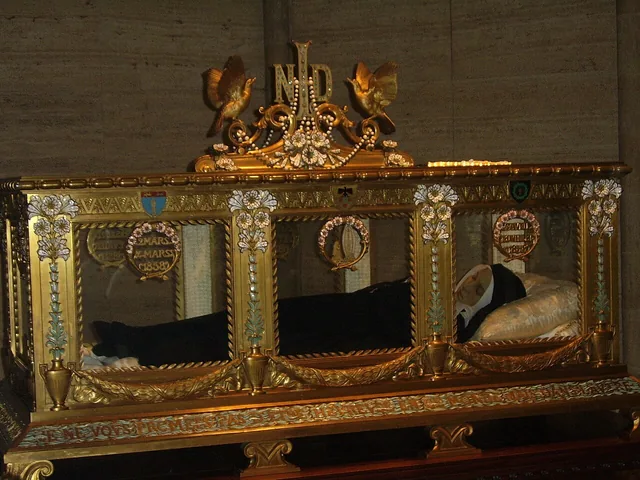
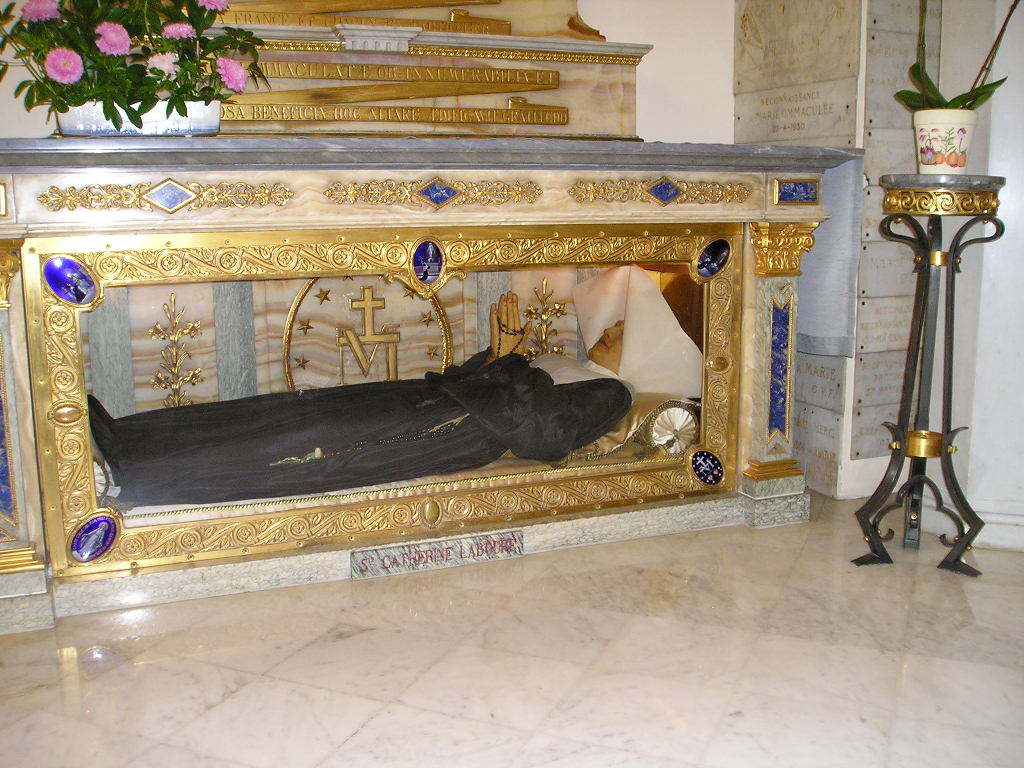
The Daughters of Charity report that Catherine’s body was exhumed in 1933, found preserved, dressed anew and placed in a reliquary at Rue du Bac. Their anniversary account is a history of the opening and presentation, without a full anatomical or conservation dossier. [6]
The 1933 opening
Sister Anne Prévost’s 2022 anniversary history dates the opening at Reuilly to 21 March 1933. It reports a preserved body, redressing in the community’s habit and transfer to the motherhouse chapel. The present account therefore includes preparation and movement after exhumation. [6]
The public history gives no full anatomical inventory or record of preparation and subsequent conservation. We can report the opening and what the chapel says was found; the information available here is insufficient to describe every component of the present display or to determine how preservation occurred.
READER QUESTIONS
Questions and answers
What is the Miraculous Medal meant to express?
Its imagery connects Mary with Christ, grace, and intercession. Catherine’s reported visions supplied its design. The devotion should be read within that Catholic setting, alongside her life of charity. [1][2]
Was Catherine officially canonized?
Pius XII canonized her on 27 July 1947. The Dicastery records the date; John Paul II commemorated its fiftieth anniversary in 1997. [1][3]
What is known about the body?
The Daughters of Charity recount preservation at the 1933 exhumation, redressing and transfer. Their anniversary history gives no full anatomical findings or treatment protocol. [6]
FOLLOW THE SOURCES
Sources and further reading
- Dicastery for the Causes of Saints — Catherine Labouré
Church or shrine source
Childhood, visions, service and formal recognition. Its devotional preservation statement is not a published examination.
- Rue du Bac chapel — Family History
Church or shrine source
Community history of the Daughters, Vincent and Louise; supports shared spirituality and charitable work. The 1933 opening is documented in source 6.
- John Paul II — letter to the Daughters of Charity, 2 May 1997
Church or shrine source
Anniversary of canonization and Catholic interpretation of charity, humility, simplicity and culturally respectful service.
- Daughters of Charity — Saint Catherine Labouré
Church or shrine source
Community biography: paternal opposition, restaurant work, hospice care and Commune. Its timeline’s beatification date conflicts with the Dicastery; the latter is followed.
- Pius XII — address to Catherine’s canonization pilgrims, 28 July 1947
Church or shrine source
Contemporary canonization interpretation of anonymity, practical care and support for working girls. A retrospective religious account.
- Sister Anne Prévost — Echoes of the Company, July–August 2022, pp. 267–268
Church or shrine source
Daughters of Charity anniversary history: 21 March 1933 exhumation, reported preservation, redressing and placement at the motherhouse. Institutional historical narrative, without technical findings or complete preparation protocol.
Sources checked: 2026-10-27. Suggest a correction or a source.