THE PERSON BEHIND THE ACCOUNT
An abbot’s reputation outlasted his body
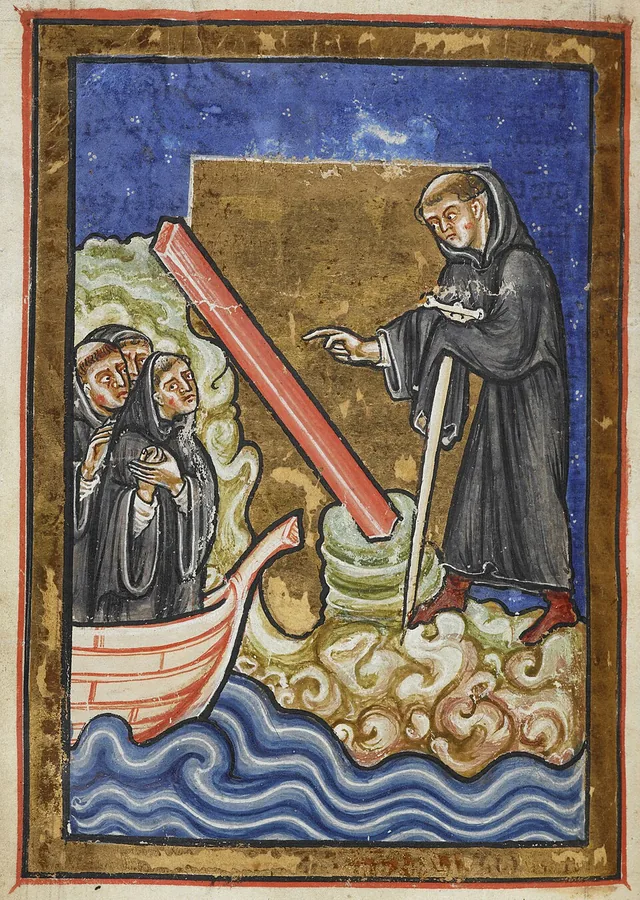
A medieval famine story places Abbot Waltheof beside his cellarer, facing people who needed food and stores that seemed insufficient. The chronicle ends with miraculous abundance. Even as a legend, it preserves a concrete expectation of the abbey: wealth and land brought responsibility towards hungry neighbours. [1]
A royal connection, a monastic choice
Waltheof was the stepson of King David I of Scotland. The historical commentary on Bernard’s Life of Malachy follows him from the Augustinian houses of Nostell and Kirkham to Cistercian communities, eventually Rievaulx. It presents his departure from a prior’s office as a choice of a stricter life. [2]
That change involved giving up one established place and entering another community as a monk. He became abbot of Melrose in 1148. His royal connections mattered to the setting, but they should not be used to turn every monastic decision into a court manoeuvre for which the evidence is missing. [2][3]
The cellarer’s problem
Historic Environment Scotland recounts the famine story from Walter Bower’s Scotichronicon. Thomas, the cellarer, was responsible for provisions. In the story, feeding those gathered around the abbey required confronting the limits of grain and livestock. Waltheof’s miraculous increase of the grain belongs to the chronicler’s religious account. [1]
The narrative is not a surviving audited record of supplies or a reliable count of every person fed. It does show what later memory valued in the abbot: willingness to use the abbey’s resources for those who could not provide for themselves. The miracle is inseparable from a practical concern about food. [1]
IN OUR OWN LIVES
Resources and responsibility
Waltheof’s remembered response to famine gives the life an accessible question: what should an institution do with its resources when need appears at its boundary? The later dispute over his cult adds another: how does a community decide what to remember? Both can be explored without pretending that the medieval body survived intact. [1][3][4]
THROUGH THE EYES OF FAITH
Faith and daily life
Waltheof chose Cistercian life after earlier service among Augustinian canons. His cult developed within the monastery of Melrose after his death in 1159. He is historically venerated as a saint; scholarship finds no credible evidence of a solemn papal canonization. [2][3]
A saint within the house, and an argument
Derek Baker’s study examines the difference between the early record and the later Life written by Jocelin of Furness. It also shows that Waltheof’s cult was not simply accepted in one uncontested movement. Later abbots and supporters played different roles in promoting or resisting it. [3]
This makes the monastic setting more interesting. A religious community could disagree about a predecessor’s reputation while sharing the same tradition. The history of a cult includes decisions about texts, tombs and public memory, rather than only a spontaneous and unanimous response. [3][4]
THROUGH THE LENS OF SCIENCE
The evidence about the remains
Medieval records report preservation at earlier openings of his tomb, but the 1240 account says the body had decayed. The surviving heritage site identifies a shrine fragment, not an intact body. [3][4][5]
What “entire” became in the telling
The early account of the 1171 opening described the body as entire and the vestments intact. Baker distinguishes that wording from a later Life’s stronger formulation. The difference is small on the page but important to a history that asks exactly what a witness or author claimed. [3]
Emilia Jamroziak’s study follows the later openings and the 1240 finding that the body had decayed, with small bones and a tooth taken as relics. The chronology rules out the claim that an intact body remains at Melrose today. Earlier preservation reports are not a permanent physical condition. [4]
What remains at Melrose
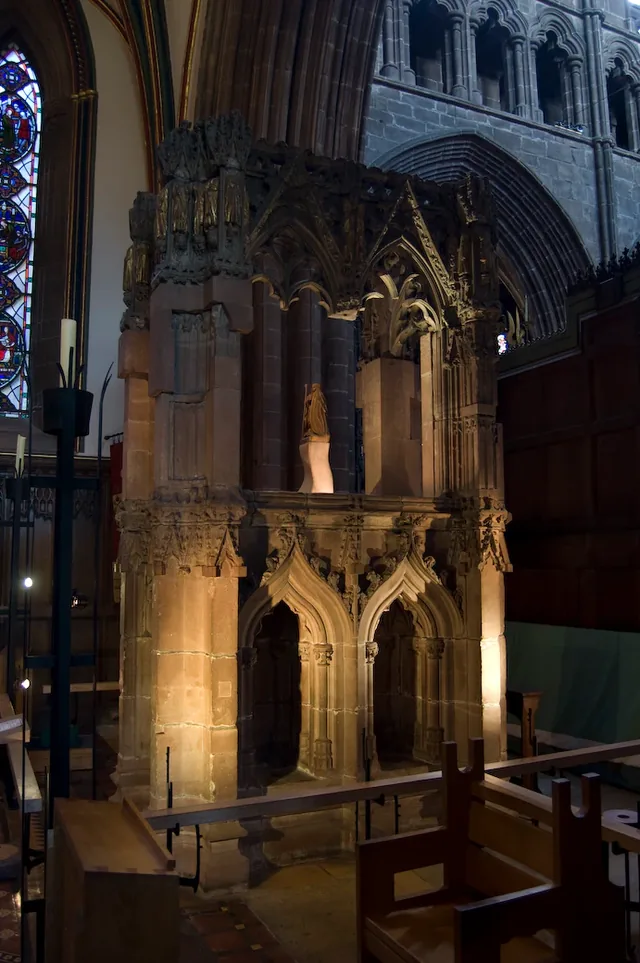
Historic Environment Scotland identifies a fragment of Waltheof’s shrine among the abbey’s surviving material. The stone is evidence of commemoration. It is not the body, nor does its presence authenticate any loose relic claimed elsewhere. [5]
A visitor can therefore approach Melrose with two histories in view: the abbot’s life and cult, and the changing material state of his remains. The latter includes decay. There is no need to preserve an inaccurate incorrupt-body claim in order to explain why the shrine mattered. [3][4][5]
READER QUESTIONS
Questions and answers
FOLLOW THE SOURCES
Sources and further reading
- Historic Environment Scotland: A Melrose miracle
Heritage institution
Retells Bower’s famine legend and Benedictine duty of care; miracle and crowd figure not treated as audited facts.
- H. J. Lawlor: commentary on Bernard’s Life of Malachy
Scholarly historical edition
Supports royal kinship, early houses, Cistercian change and 1148 abbacy; concise scholarly commentary, not a new primary-life transcription.
- Derek Baker: Legend and reality, Waldef of Melrose
Scholarly account
Indexed article/notes distinguish early chronicle from later Life, contested cult and lack of credible solemn papal canonization. Direct fetch rate-limited.
- Emilia Jamroziak: Miracles in Monastic Culture, 2021
Scholarly account
Historical analysis tracks preservation narratives and 1240 decay; not an examination of present remains.
- Historic Environment Scotland: Melrose history
Official heritage
Identifies surviving shrine fragment; does not claim surviving intact body.
Sources checked: 2026-10-27. Suggest a correction or a source.