
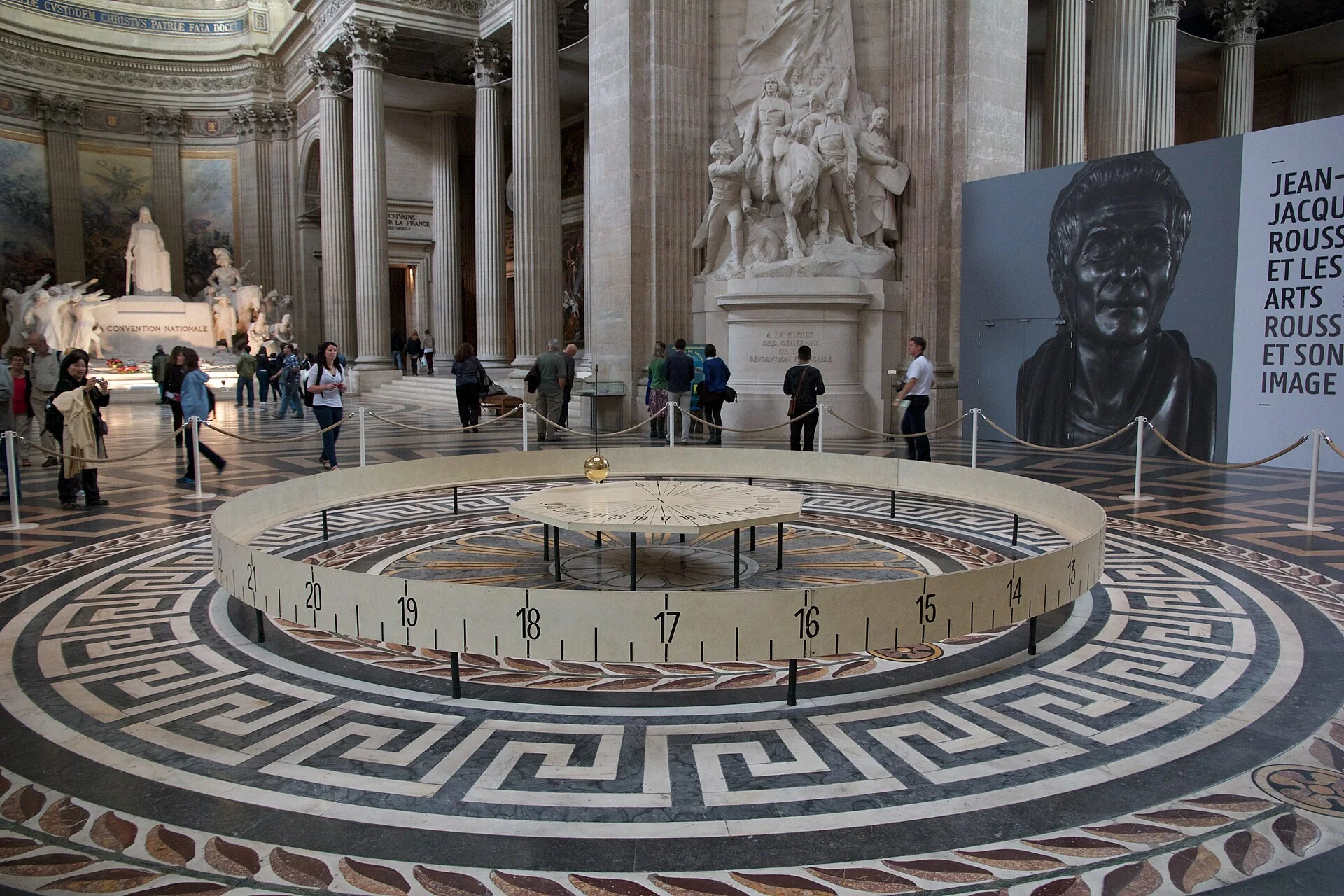

A prediction hanging from a string
Imagine a small weight hanging from a light string. Pull it slightly aside and release it. If we idealize the arrangement as a simple pendulum, its period—the time for one complete swing—depends on its length and the local gravitational acceleration. For small swings, making the pendulum four times as long makes its period roughly twice as long.
The prediction follows from a compact equation: the period is proportional to the square root of length. It does not require timing every possible pendulum first. Once the model and its conditions are established, reasoning about the equation lets us anticipate a new case. OpenStax on simple pendulums
That is an everyday success of mathematical physics. It is also peculiar. Symbols on paper are not lengths of string, weights, or gravity. Yet operations on those symbols can tell us something reliable about an object we have not built.
The practical question is how to calculate correctly. The deeper question is why calculation reaches the world at all.
An equation earns its application
The pendulum example also shows what mathematical success is not. The simple formula assumes small angles and an idealized system. A heavy string, appreciable friction, or a large swing can require a more elaborate description. A calculation may be impeccable while its application is poor.
That distinction separates mathematics from empirical science. A mathematical deduction follows from specified assumptions. A physical model adds a further claim: these assumptions and quantities adequately represent this part of the world. Observation and experiment test that additional claim.
Consider drawing a perfectly circular orbit because circles are elegant. Flawless geometry can describe an orbit that no planet follows. Beauty can suggest a model; measurements determine whether the model describes its target.
Abstraction is powerful because it leaves things out. A useful pendulum model need not describe the color of the string. The difficulty is deciding which omissions leave the predicted behavior intact. Mathematics becomes a scientific instrument through that judgment, supported by repeated comparison with observations.
Wigner's larger surprise
In a 1960 essay, physicist Eugene Wigner argued that the effectiveness of mathematics in natural science is unexpectedly profound. Abstract concepts, sometimes developed without a particular physical application in mind, can become central to accurate descriptions of nature. Wigner's original essay
Wigner’s puzzle concerns the precision and reach of those applications. Physical laws still address selected regularities, rather than every detail of an event. The surprise is that such selective descriptions can travel so far: an abstraction built for one problem becomes useful in another, and a calculation anticipates a measurement.
In September 2015, LIGO’s two detectors recorded a brief signal that climbed from about 35 to 250 cycles per second. Its rising frequency was part of a predicted sequence: two black holes spiral together, merge, and leave a single disturbed black hole that settles down. The discovery paper compared that changing waveform with general relativity’s predictions and tested it against detector noise. Matching a sequence constrained by a physical model is much more demanding than finding a vaguely suggestive shape in a graph. The original LIGO–Virgo discovery paper
This was not Einstein writing down an exact tracing of a future detector output a century earlier. Many researchers developed the theoretical, numerical, and experimental tools required to make the comparison. Yet the achievement remains striking: a mathematical framework constrained what a previously unobserved kind of event should look like, and instruments found the corresponding pattern.
Successful prediction is more demanding than describing a pattern after seeing it. A sufficiently flexible story can accommodate many outcomes. A theory that risks a specific failure and survives the test earns a different kind of confidence.
Why the success might be less mysterious
There are serious reasons not to treat every successful equation as an unexplained miracle.
First, mathematics is partly developed through engagement with quantities, shapes, motion, and change. Some fit with the physical world is therefore built into its history. Second, scientists choose useful mathematical structures and discard unsuccessful models. We mostly teach the survivors. Third, the same abstract relationship can recur in physically different settings, allowing an existing tool to travel.
These considerations explain some of the effectiveness without requiring a supernatural conclusion. They also sharpen the remaining question. Selecting useful tools explains why scientists use the models that work; it does not by itself explain why nature presents regularities with such reach and precision. A naturalistic explanation remains possible; surprise alone gives no argument against one.
The disagreement is partly about what would count as an adequate explanation. One thinker may regard stable structure as a basic feature of reality. Another may ask why such structure exists and is accessible to minds. Both must distinguish an unanswered question from a demonstrated answer.
A Catholic reading of intelligibility
In a 2006 address in Verona, Benedict XVI reflected on the correspondence between mathematical reasoning and the universe's structure. He proposed that this correspondence invites consideration of a common source in divine intelligence. This is a theological and philosophical interpretation of intelligibility, not an extra result extracted from a scientific equation. Benedict XVI's Verona address
The Catechism similarly associates creation with divine wisdom and an ordered world available to human understanding. That belief gives a Catholic reason to regard inquiry as meaningful. It does not supply the answer to an unsolved differential equation or decide between competing physical models. Catechism, paragraphs 295 and 299
The strongest version of this connection leaves the work intact. If nature is intelligible, investigators still have to find out how. If reason is a gift, it is exercised through calculations, criticism, correction, and the willingness to discover that a beautiful proposal is wrong.
The disagreement turns on how far an explanation should go. Does a stable mathematical structure count as a basic fact, or does its existence call for an account beyond physics? Benedict’s proposal takes the second route and identifies that source with divine reason. Accepting it requires philosophical judgment as well as admiration for a successful calculation.
The pendulum offers a small test you can repeat: time it, change the string’s length, and compare the results with the equation. Agreement tests this model. The wider question of mathematics’ success in nature remains open.