
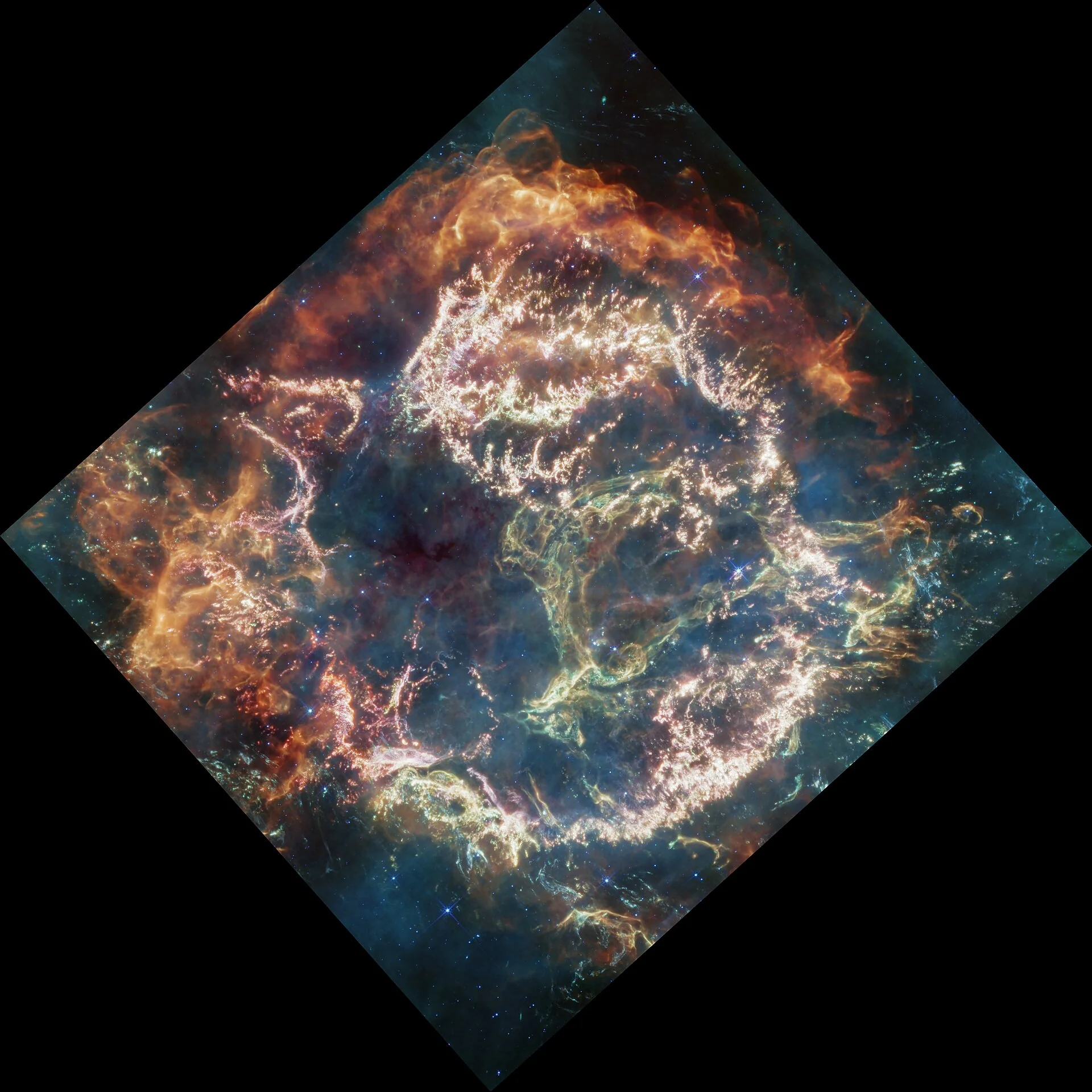
A glass with two histories
Take a glass of water. Every water molecule contains two hydrogen atoms and one oxygen atom. They belong together chemically, but their nuclei do not share the same origin story.
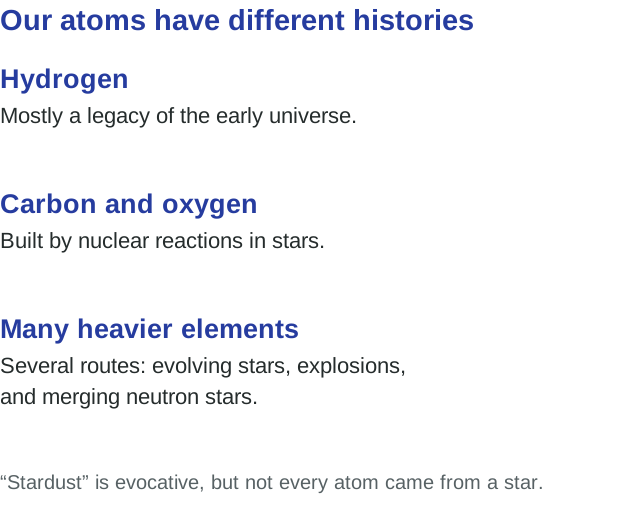
Much of the universe's hydrogen belongs to the primordial inventory: matter present before the first stars. Oxygen came later, through nuclear reactions inside stars. A sip of water therefore joins material from very different chapters of cosmic history. The familiar claim that we are made of stardust captures something real, but it needs an amendment: some of our ingredients are older than stars. NASA's introduction to star stuff
The distinction makes the story more interesting. We are not the residue of one explosion, scattered into human shape. Our bodies are continually assembled from food, water, and air, whose ingredients have passed through many environments. Cosmic history supplies the material; chemistry and biology organize it into living bodies.
Making an element is different from making a molecule
A kitchen can turn flour into bread without creating a new chemical element. Chemical reactions rearrange atoms and their electrons. Making oxygen from lighter nuclei requires changes inside atomic nuclei themselves.
Stars provide environments where that can happen. During the longest stable part of a star's life, fusion converts hydrogen into helium. Later stages depend strongly on the star's mass. Helium burning can produce carbon; massive stars support additional nuclear reactions that produce other elements, including oxygen. The first stars thus began a transformation of the universe's comparatively simple starting inventory. NASA on how stars evolve
This does not mean every element is made by repeating the same fusion recipe. Different nuclei require different production pathways. A periodic table colored by cosmic origin would contain overlapping contributions rather than one tidy sequence of factories.
It also matters that manufacture and delivery are separate problems. Material locked permanently inside a star could never enter a planet. Stars can return enriched material to space through winds, the shedding of outer layers, and supernova explosions. Not every star explodes. Clouds containing material from earlier stellar generations can later form new stars and planetary systems. That is how a distant nuclear history becomes relevant to an ordinary glass.
The universe leaves receipts
This account rests on evidence more specific than the resemblance between a star and a bright furnace.
Tiny grains preserved in meteorites sometimes carry unusual proportions of isotopes: versions of an element with different numbers of neutrons. Some patterns identify material formed before the Solar System, in stellar environments different from the mixture that became our planetary neighborhood. Researchers can examine these grains in laboratories. NASA investigators, for example, have used isotopic measurements and electron microscopy to investigate the histories of presolar silicate grains. NASA's account of the grain research
Here “stardust” can mean an actual surviving microscopic grain. When applied to a person, however, the phrase usually concerns the ancestry of atomic nuclei. It does not mean our tissues are packed with intact grains freshly swept from stellar atmospheres. Nuclear ancestry survives chemical rearrangements that erase the identity of earlier molecules and particles of dust.
There is evidence from distant catastrophes, too. Following the neutron-star merger detected in 2017, astronomers studied the changing spectrum of its luminous aftermath. In a 2019 paper, Darach Watson and colleagues identified strontium in those spectra. Their analysis connected a specific element with material expelled in a neutron-star merger, supporting the role of such events in rapid neutron-capture production. Watson and colleagues' original study
Neutron capture adds neutrons to nuclei; subsequent radioactive changes can produce different elements. These processes expand the story beyond ordinary stellar fusion. The strontium result did not identify every heavy element in the event, nor did it establish the birthplace of a particular atom in your wedding ring. Evidence for a production mechanism and a personal inventory of atomic origins are different achievements.
Shared ingredients, particular people
There is an understandable temptation to turn the chemistry into a verdict about human significance. One person hears “made of common matter” and concludes that a human being is nothing special. Another hears “made in stars” and treats cosmic ancestry as a certificate of spiritual importance.
Neither conclusion follows from nucleosynthesis, the making of atomic nuclei. Learning where an ingredient originated does not settle everything about what an organized living being is, what it can experience, or how it ought to be treated. The same element can occur in a stone, a tree, and a human body without making those things interchangeable.
The Catholic understanding of the person takes bodily existence seriously. The Catechism describes the human person as a unity of body and soul and says that bodily life shares in human dignity. Its discussion of Genesis's dust imagery concerns our embodied creaturehood, not an ancient prediction of nuclear astrophysics. Catechism, paragraphs 362–365
This supplies a more substantial connection than spotting a modern scientific fact in an ancient phrase. Our dependence on material processes is real. So is the moral obligation, within Catholic teaching, to care for bodies: feeding people, tending the sick, and honoring the dead. A body does not become disposable because its ingredients are widely shared.
What the phrase can carry
“We are made of stardust” is useful when it opens a question. Which ingredients? Made by which processes? What observations support that history? It becomes less useful when it closes the conversation with an all-purpose slogan.
The corrected version has room for primordial hydrogen, stellar furnaces, neutron captures, expelled gas, growing planets, and the living exchanges through which a body persists. It also leaves room for questions chemistry cannot answer by cataloging ingredients alone.
Look again at the water. The oxygen and hydrogen are now participants in the same small structure, despite their different histories. Soon they may enter a leaf, a bloodstream, a cloud. A glass of water contains atoms with histories stretching back billions of years.