


Two people take different routes through a city and meet unexpectedly outside a shop. Each journey has an explanation. Their meeting was planned by neither of them. Calling it a chance encounter does not mean that their legs, the roads, or the buses stopped obeying natural laws.
“Chance” often names a relationship between events, a limit of prediction, or a feature of a scientific model. In ordinary conversation it can also suggest that nothing has a purpose. Those meanings are not equivalent.
That distinction matters when someone asks whether an evolutionary history involving chance can also be a world under God's providence. The answer depends partly on which claim the word is making.
Random does not mean structureless
A probability model describes a range of possible outcomes and how probabilities are assigned among them. Some distributions give equal weight to comparable possibilities; many do not. Random events can therefore exhibit reliable patterns without allowing confident prediction of each individual outcome. The NIST statistical handbook's collection of probability distributions provides a useful reminder of how varied such models are.
A tossed coin, an unexpected meeting, and a mutation need not be random in exactly the same sense. A coin may be hard to predict because its motion depends sensitively on circumstances we have not measured. A meeting can be accidental relative to two people's intentions. In biology, an important question is whether a variation arises because it will help the organism meet a particular challenge.
Careful science specifies its model and its evidence. It does not turn the single word “random” into a universal explanation of everything. Nor does a successful probability model automatically tell us whether a process has a purpose beyond what the model describes.
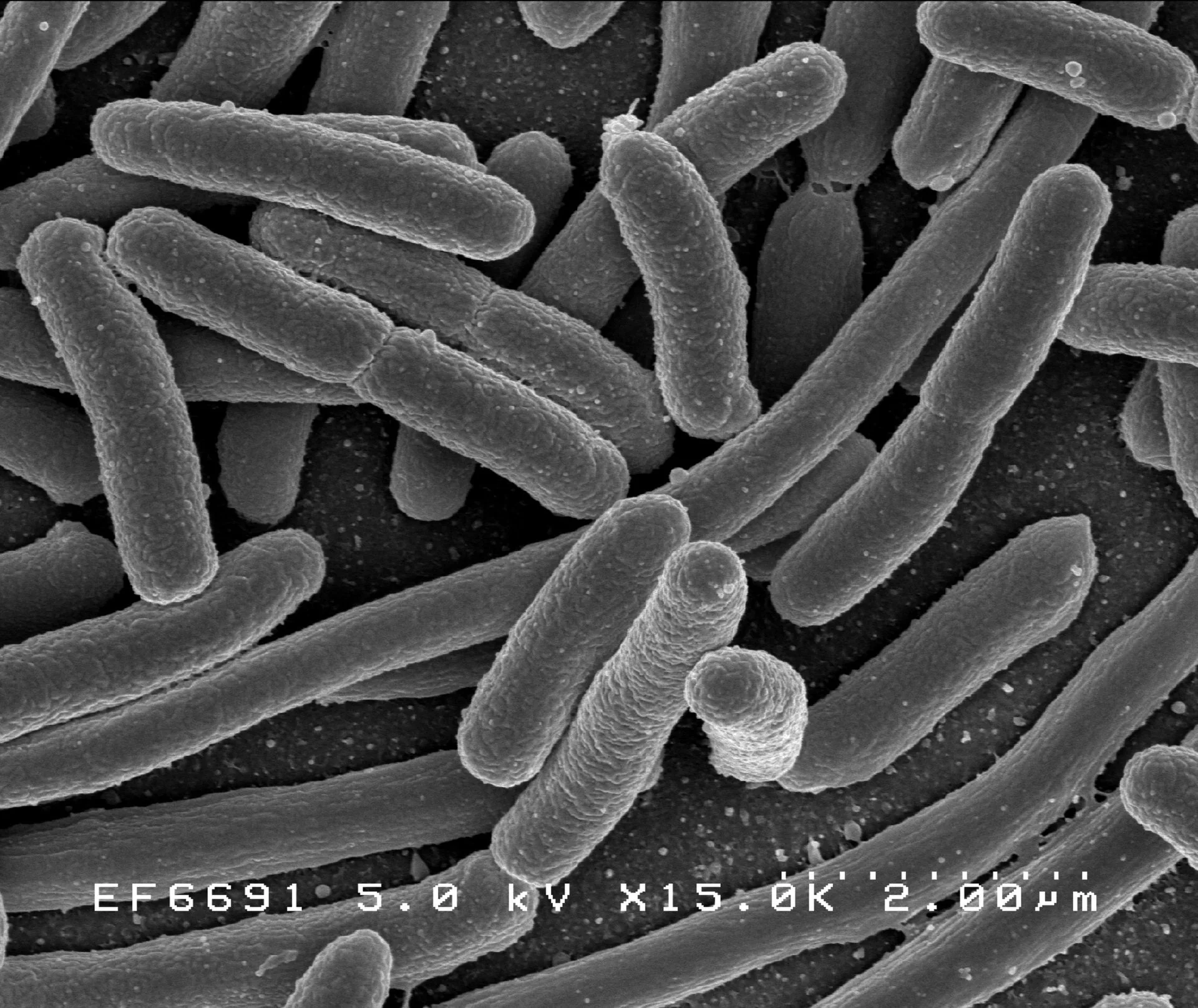
The experiment with the bacterial jackpots
In 1943, Salvador Luria and Max Delbrück studied bacterial resistance to a virus. Did exposure produce resistant bacteria as an adaptive response, or were resistant variants already appearing during growth? The alternatives predicted different patterns across cultures.
If a resistance mutation appeared early in one independently grown culture, its descendants could produce a large resistant population: a jackpot. A late mutation would leave far fewer resistant descendants. Independent cultures should therefore differ much more than repeated samples taken from the same culture.
That large variation was central to the evidence for resistance arising before the viral challenge in the studied system. The experiment inferred an unobserved history from a pattern in the counts. Their original paper, Mutations of Bacteria from Virus Sensitivity to Virus Resistance, remains a remarkable example of experimental reasoning.
It was not a test for divine intention. Nor did it establish that every kind of mutation is equally probable or that environments never affect mutation processes. Its force lay in a specific comparison between biological explanations. It made an enormous difference to that scientific question without measuring the ultimate purpose of life.
Contingency has a place in classical theology
A common picture of providence treats God as a rival to every natural explanation. If a mutation has a mechanism, perhaps God did nothing; if an outcome was unpredictable, perhaps that is where God entered. On this picture, scientific progress continually reallocates work between nature and the Creator.
Classical Catholic thought proposes a different relationship. Created causes can genuinely produce their effects while depending on God for their existence and activity. Aquinas consequently argues that providence need not make every event necessary: contingent effects can arise through contingent causes within the divine ordering of things. His discussion in Summa Theologiae I, question 22 is a philosophical and theological account, not an early scientific theory of mutation.
The International Theological Commission applied a related distinction to evolution in its 2004 document Communion and Stewardship. A process described scientifically as contingent need not thereby lie outside divine providence. Paragraphs 68–70 reject the slide from contingency in a natural process to the claim that it cannot belong to a divine purpose.
An account of what organisms do and an account of their dependence on a Creator need not compete for the same explanatory position. The truth of the theological account still needs an argument. The scientific use of “chance” leaves that question open.
The objection: does providence explain anything?
A skeptic can reasonably ask what evidence would distinguish a providential world from one without providence. If either a predictable or an unpredictable process is compatible with God's action, has theology insulated itself from every possible result?
Compatibility alone would indeed be a weak reason to believe. The claim that providence permits contingent causes does not supply a new laboratory prediction or an extra parameter in a population-genetic model. A Christian defense must draw on broader reasons for belief in God and on its understanding of revelation, rather than presenting a probability distribution as a hidden signature.
At the same time, not every meaningful question is answered by altering a model's predictions. Whether reality is ultimately dependent, whether purposes are reducible to our preferences, and whether God can be trusted are larger philosophical and theological questions. They remain arguable. Identifying their level prevents a biological result from being made to answer a question it was never designed to investigate.
Providence without passivity
There is also a practical danger. Someone may hear that everything falls within providence and conclude that planning, prayer, or action is unnecessary. But a world in which created causes matter is precisely a world in which what we do matters. Feeding a hungry neighbor is an event with real consequences, not interference with a story that must unfold without us.
The Catechism describes prayer as cooperation with providence while challenging the habit of treating God as an instrument for obtaining desired results. Its discussion of trust in prayer, paragraphs 2734–2741, gives this belief a relational rather than mechanical character.
That trust does not entitle us to announce the particular divine reason for someone else's loss. Discovering that an event has natural causes does not reveal its full significance; calling it providential does not give us access to God's intentions. A consoling explanation invented too quickly can become another burden for a grieving person.
Chance can describe something true about a world Catholics believe God creates and sustains. The unfinished work is learning how to live responsibly in it: studying causes, making careful decisions, responding to need, and praying without pretending to possess the whole design.