

Start with the detector
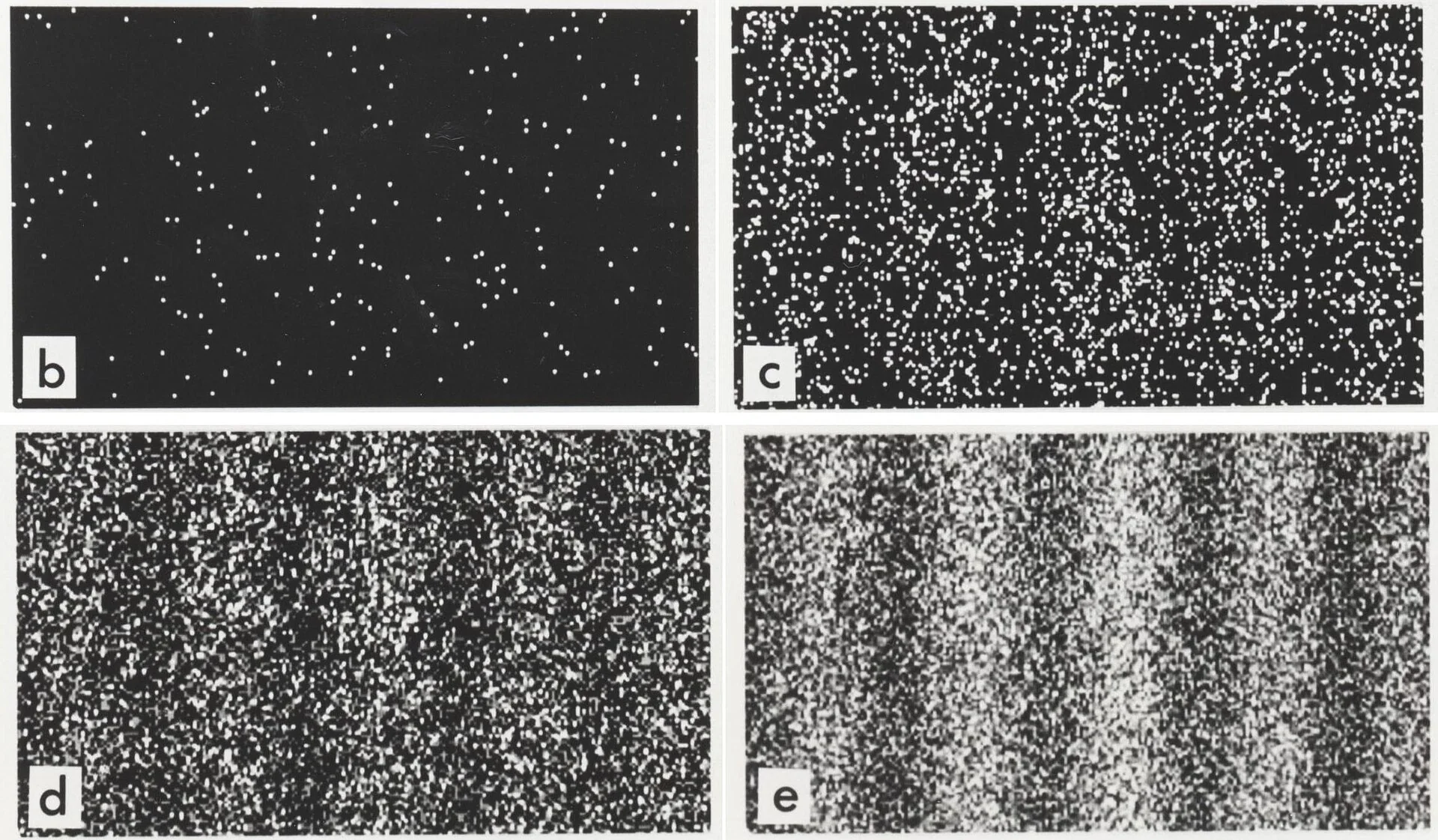
An electron reaches a detector and registers at one location. Repeat the experiment many times, sending electrons toward a barrier with two openings, and the accumulated arrivals can form an interference pattern. Some regions receive many electrons, while others receive few.
The pattern is not what we would expect from ordinary pellets independently passing through one opening or the other. Quantum theory calculates it by combining probability amplitudes—mathematical quantities whose combination can reinforce or cancel—before obtaining detection probabilities. If the apparatus obtains information that distinguishes the paths, the interference pattern can disappear. The Feynman Lectures on quantum behavior
To see the difficulty, compare three arrangements: only the first opening available, only the second available, and both available without path information. For ordinary pellets, adding the first two distributions predicts the third. For electrons, it can fail. At some detector positions, opening a second route can reduce the arrival rate. The calculation combines amplitudes before converting them into probabilities. Feynman’s comparison of the arrangements
That gives us a precise puzzle to investigate. Claims that thought creates matter or consciousness controls an outcome add a different proposition. We can ask what physical interaction changed and whether the experiment actually varied conscious awareness independently of the apparatus.
Observation does not automatically mean consciousness
In ordinary speech, an observer is a person looking. In quantum experiments, measurement involves physical interactions that correlate a system with an apparatus and produce a record. A detector can register an event without a scientist staring at it at that moment.
Adding a means of determining the path changes the physical arrangement. It does not isolate a person's silent awareness as the cause of the changed distribution. The experiment therefore cannot, on its own, demonstrate that a conscious mind is necessary to make events happen.
There are interpretations of quantum mechanics that give consciousness a special role, alongside many that do not. NIST physicist Scott Glancy describes this diversity and distinguishes the reliability of quantum predictions from disagreement about how to understand them. His discussion is useful precisely because it refuses to turn one favored interpretation into the experimental result. Glancy's account of quantum interpretation
There remains a real measurement problem: how should we understand the relation between quantum evolution, the measurement process, and definite outcomes? Pointing out a misleading consciousness claim does not solve that problem. Nor does the existence of the problem make every proposed solution equally supported.
Entanglement is stronger than matching envelopes
Suppose two envelopes contain opposite-colored cards. Open one and you can infer the other. Nothing particularly quantum has happened; the colors were assigned beforehand.
Entanglement involves a joint quantum state whose measurement correlations can exceed limits available to local hidden-variable explanations. “Hidden variables” here refers to additional underlying information proposed to account for outcomes; “local” constrains how separated events can influence one another. Bell inequalities express limits on correlations under a specified set of assumptions, including independence between measurement choices and the hidden variables.
In a major 2015 experiment, Lynden Shalm and colleagues used entangled photons, fast measurement choices, and efficient detectors to violate a Bell inequality while closing important experimental loopholes. Their paper lays out the apparatus and statistical test. Shalm and colleagues' original research
This result rules out the relevant class of local explanations under the test's assumptions. It does not prove that nothing exists until humans look, or eliminate every possible hidden-variable theory. Dropping the word “local” changes the claim materially. A headline about “reality being disproved” loses the structure that makes the experimental conclusion meaningful.
Correlation is not a message
Entanglement also does not hand us an instant communication channel. A sender cannot simply select the desired random measurement result and make it appear as a chosen message at a distant receiver. Comparing the records can reveal extraordinary correlations, but comparison itself requires communication.
Quantum teleportation provides a particularly useful example. It transfers a quantum state using shared entanglement together with ordinary classical information. The recipient needs that information to complete the protocol; it cannot be used to send information faster than light. IBM's teaching material works through those steps explicitly. IBM Quantum on teleportation
In this protocol, the state is the information being transferred; a person or object does not travel between laboratories. The classical message tells the recipient which operation completes the transfer. Shared entanglement alone leaves that step unfinished.
A similar discipline applies to “energy,” “frequency,” and “uncertainty.” These words have defined roles in physics. Moving them into a claim about health, personal destiny, or spiritual experience requires additional evidence connecting the quantities to that claim. A shared word is not a demonstrated mechanism.
Mystery calls for care
For Christians, quantum physics can challenge the assumption that ordinary mechanical pictures exhaust physical reality. It cannot by itself establish the Trinity, explain sacramental presence, or identify a mechanism by which prayer acts. Those conclusions would require premises that an interference pattern or Bell test does not provide.
John Paul II's 1988 letter to the director of the Vatican Observatory offers a demanding approach to such encounters. It encourages engagement between theology and science while respecting each field's integrity. It also warns against using science uncritically for apologetic purposes and against drawing unjustified conclusions beyond what scientific findings establish. John Paul II's letter to George Coyne
For a Catholic reader considering a quantum explanation of a sacrament, this sets a concrete task. The proposal needs to identify which physical result supports which part of the theological claim, and explain the connecting argument. An unexplained measurement outcome cannot carry that connection on its own.
Skeptics need the same discipline. A misleading spiritual use of physics does not show that the underlying philosophical question is meaningless. It shows that this particular route has not answered it.
At the detector, researchers compare individual events and the pattern accumulated over many trials with mathematical predictions. A philosophical interpretation must respect those results and explain what additional argument it contributes.