
The short version
In 1927, Belgian priest and physicist Georges Lemaître connected an expanding model of the universe with astronomical observations. His later proposal about a cosmic beginning helped open the way to Big Bang cosmology. The modern theory grew through other researchers’ work and new evidence. Lemaître’s life brings scientific curiosity and Catholic faith into the same story, while preserving the questions each can answer.
The story
In 1927, Georges Lemaître gave a changing universe a mathematical and observational account. Einstein’s equations allowed him to model expansion; measurements of galaxies let him estimate its rate. Lemaître was also a Belgian Catholic priest, ordained in 1923 and later a professor at the Catholic University of Louvain. His place in this history rests on the calculation and the evidence he brought together. UCLouvain biography
A universe with a history
In his 1927 paper, Lemaître connected solutions of Einstein's equations with astronomical observations. His model predicted that recession speed would increase with distance. He used published galaxy measurements to estimate an expansion rate, drawing on velocities measured by Vesto Slipher and distances estimated by Edwin Hubble. The available distances were uncertain; he recognized that limitation. Mario Livio's archival investigation, Space Telescope Science Institute
The underlying relationship is approachable: for galaxies participating in the overall expansion, greater separation means greater recession speed. Imagine comparing two widely separated pairs of galaxies. If one pair has twice the separation of the other, the simple expansion relationship gives it twice the recession speed. That is a pattern in the changing scale of the universe. IAU explanation of the Hubble–Lemaître law
This was a shared scientific achievement, with observations and mathematical work contributing different pieces. In 2018, the International Astronomical Union recommended the name Hubble–Lemaître law, recognizing the foundational contributions of both men. Honoring Lemaître need not diminish the people whose work helped make the discovery possible. IAU announcement
Run that expanding model backward and the galaxies were closer together. The question of the universe’s earlier state followed from the account of its present motion.
In 1931, Lemaître proposed what became known as the “primeval atom” hypothesis. It imagined a beginning very unlike the cosmos we observe today. This was a pioneering step toward Big Bang cosmology, although its original physical details were not the modern theory. UCLouvain's account of his scientific work
The evidence kept growing
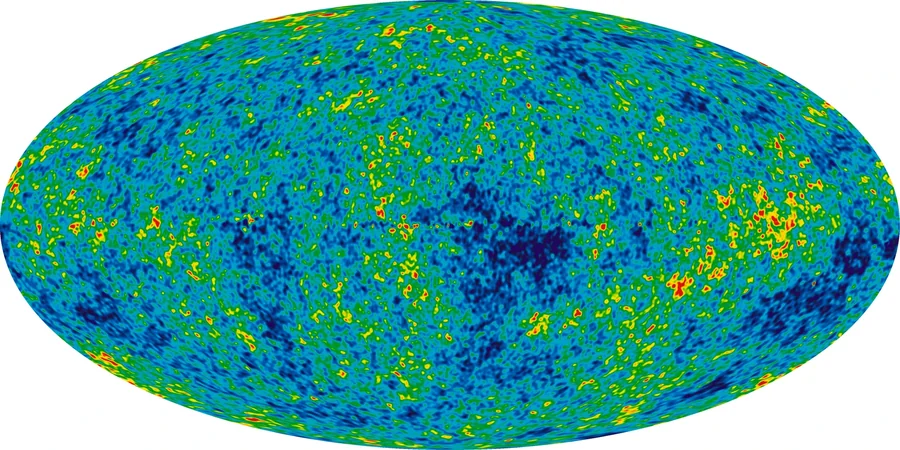
Expansion alone and the later hot Big Bang model are related, but they are not identical claims. Other researchers developed the physics of an early, extremely hot universe and predicted a surviving radiation background. That background was subsequently detected, and NASA's COBE mission measured its spectrum with extraordinary precision. Its close match to the expected thermal pattern provided strong evidence for a hot cosmic past. NASA: COBE's discoveries
The cosmic microwave background carries information from roughly 380,000 years after the early expansion began. It is not a photograph of an absolute first instant. And the Big Bang should not be pictured as a firework exploding from a central point into surrounding darkness: the expansion concerns space itself. NASA's Webb and Big Bang explanation
The background radiation gives cosmology something to measure beyond the present motions of galaxies. Models of an early hot universe must account for its spectrum as well as for expansion. These different observations constrain the same history.
Faith without a shortcut
A priest's contribution to cosmology offers a concrete example of faith and scientific work flourishing together. Belief in the Resurrection, the sacraments, or the authority of the Church requires further investigation and reasons of its own.
Lemaître himself resisted turning his hypothesis into a religious argument. In a surviving 1964 television interview, he explicitly denied defending it for a religious ulterior purpose. When discussing God and the galaxies, he distinguished God's sustaining activity from a physical force inserted into an astronomical explanation. Lemaître's interview, French transcript and English translation
That distinction has a deeply Catholic foundation. The Catechism describes creation as dependence on God for existence, including God's sustaining activity at every moment. The theological claim reaches beyond identifying an unexplained event at the earliest point of a scientific timeline. Discovering a natural process therefore need not displace the Creator from Catholic belief. Catechism, paragraphs 290 and 300–301
There is room here for a fruitful conversation. In 1988, John Paul II encouraged science and theology to learn from one another while preserving their distinct methods. He specifically warned against hasty religious use of Big Bang theory, while also resisting the assumption that cosmology could offer theology nothing worth considering. Letter to the director of the Vatican Observatory
Lemaître’s life can make the prospect of a scientific career within Catholic faith less remote. His argument about creation asks something harder of a believer: let the physical account succeed on its own terms, then examine what it means for anything to exist at all.
The linked 1964 interview is a useful place to continue. Read his answer to the religious question alongside his account of cosmic evolution. He is willing to discuss both, and careful about the kind of explanation each supplies.
Sources & evidenceOptional · 2 min extra
The historical record, the observations, and the limits of the argument.
Follow the sources
- UCLouvain, “Who was Georges Lemaître?” — biography and distinction between his original hypothesis and later cosmology.
- Mario Livio, “The Expanding Universe: Lost (in Translation) and Found” — institutional copy of archival historical research; the observations used in 1927 and their limitations.
- International Astronomical Union, naming announcement, 29 October 2018 — relationship and recommendation to recognize both Hubble and Lemaître.
- NASA, “COBE's Top Discoveries” — development and tests of the hot Big Bang account.
- NASA, “Webb Telescope & The Big Bang” — background radiation and explanation of expansion.
- Gontcho A Gontcho, Kikwaya Eluo, and Gabor, “Resurfaced 1964 VRT video interview of Georges Lemaître” — translated primary testimony, especially the final religious questions.
- Catechism of the Catholic Church, “The Creator” — paragraphs 290, 300–301.
- John Paul II, letter to George V. Coyne, 1 June 1988 — scientific autonomy and constructive theological dialogue.
What this article establishes
Lemaître’s scientific contribution and priesthood are historical claims. The evidence for a hot early universe comes from observations and the models tested against them. The connection to Catholic belief is an interpretation that requires philosophical and theological reasoning beyond those measurements.
Editorial note: AI-assisted research and drafting, based on the linked public sources. No external scientific, historical, or theological review has been commissioned.
For a class, reading group, or quiet moment
Three questions to carry with you.
- What did Lemaître connect in 1927? Which observations would you inspect to assess his explanation?
- Why does it matter to distinguish his 1931 proposal from the later hot Big Bang model?
- What does this history establish about science? What further reasoning would a claim about God require?
Read the story together, then follow the sources. Agreement is not a condition of joining the conversation.