
The short version
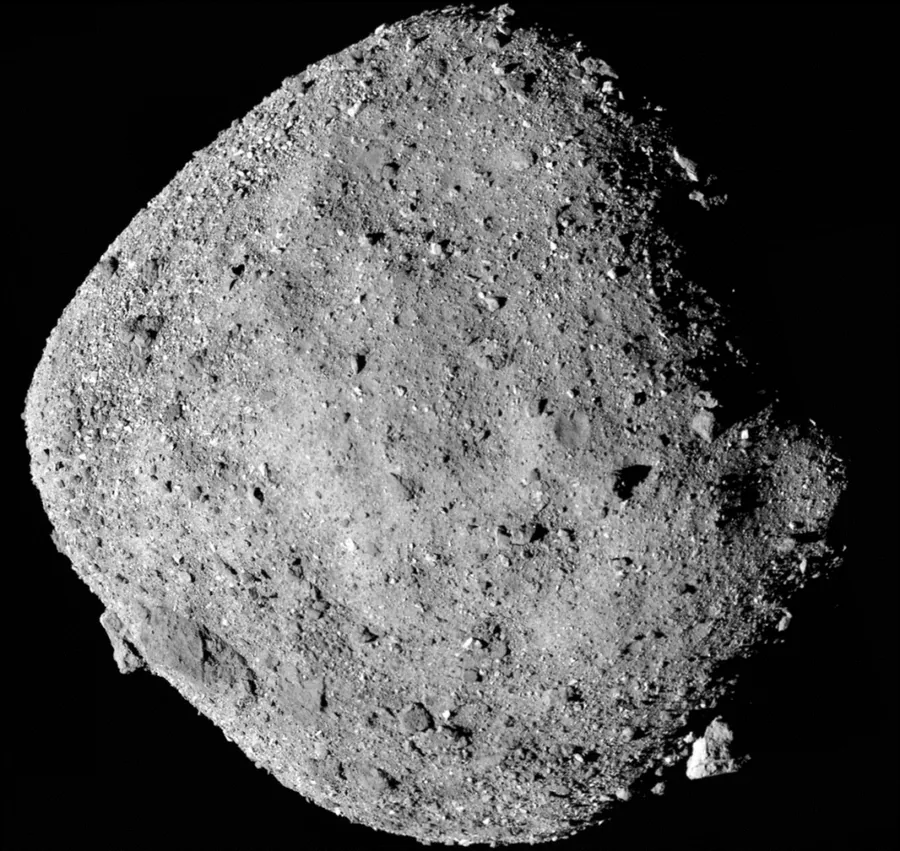
Brother Robert Macke, a Jesuit at the Vatican Observatory, helped develop an instrument to study the density of samples returned from asteroid Bennu. A later study reported implausibly high grain-density readings made with nitrogen gas; the authors said those readings needed further investigation. The work gives a close view of what a Vatican scientist contributes: an instrument, measurements and questions to pursue with colleagues.
A sample from another world
In September 2023, a capsule carrying fragments of asteroid Bennu landed in the Utah desert. NASA's OSIRIS-REx mission had brought home 121.6 grams of material: a small collection with the potential to illuminate the history of our solar system. Scientists would study it using instruments and techniques unavailable aboard a spacecraft. NASA's sample announcement
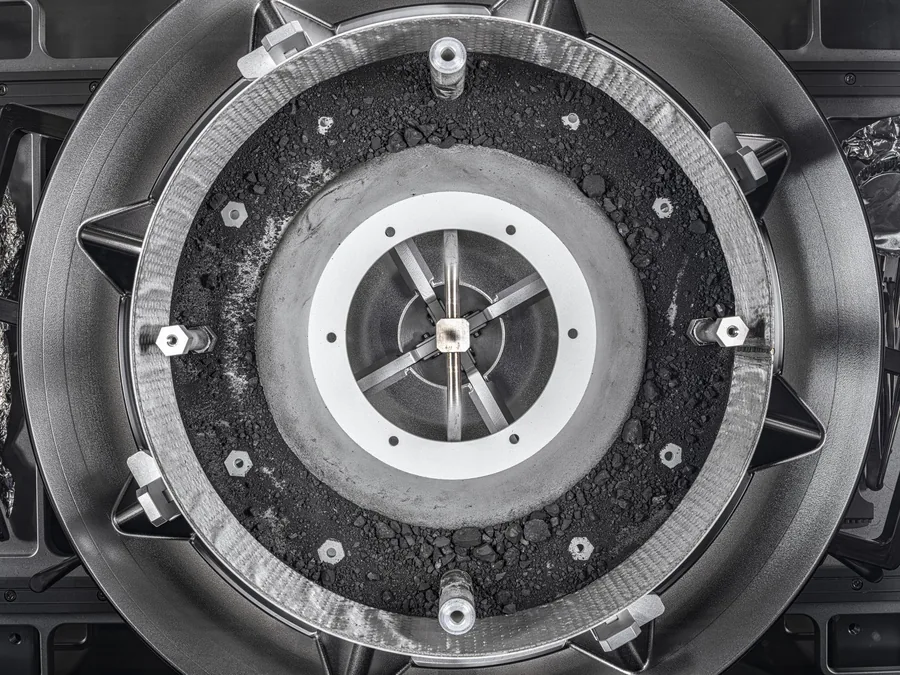
One researcher involved was Brother Robert Macke, a Jesuit at the Vatican Observatory. Before the samples arrived, he spent five weeks at the University of Arizona's Lunar and Planetary Laboratory working on an instrument designed to investigate their density. The instrument was an ideal-gas pycnometer. Macke's account of the instrument
This is an institutional contribution: a scientist at the Holy See's Observatory working alongside colleagues from many other institutions. OSIRIS-REx was a NASA mission, managed by NASA Goddard, with the University of Arizona leading its science team. Mission and science-team credits
What counts as a rock’s volume?
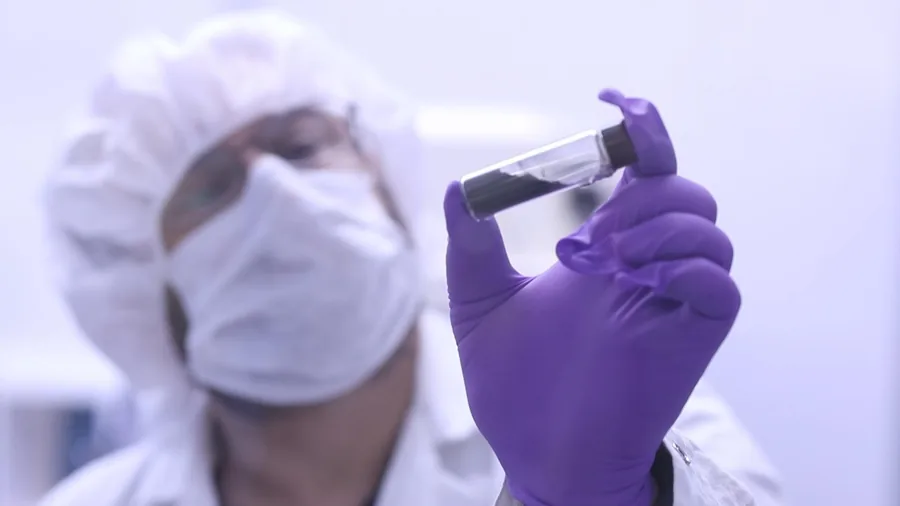
Density is mass divided by volume—but what counts as a rock's volume? Bulk density includes cavities inside the specimen's outer shape. Gas-measured grain density excludes pore spaces that the gas can enter; inaccessible cavities need separate consideration. Comparing compatible measurements helps estimate porosity, the fraction occupied by voids. In simplified form: estimated porosity = 1 − bulk density ÷ grain density. Macke and colleagues' methods abstract
A gas pycnometer uses pressure to determine volume. A specimen occupies part of a chamber, and gas fills the remaining space. Letting the gas expand into another chamber produces a measurable pressure change. With calibrated chamber volumes and gas-law assumptions, researchers calculate the volume displaced by the specimen. This description comes from an earlier instrument in the same research program; its exact specifications should not be assumed for the Bennu device. Instrument principles
When a measurement raises another question
A March 2026 paper, coauthored by Macke, investigated a puzzle that began before the spacecraft reached Bennu. Its low thermal inertia, a measure of resistance to temperature change, had suggested a surface of small fragments. The cameras instead found boulders. How could large rocks respond to heating and cooling like that? The team examined returned particles with laser-based thermal measurements and X-ray imaging, then modeled heat flow through their cracks. Fine pores and branching cracks impede heat flow within the rough-surfaced material. A boulder can therefore have a low thermal inertia because of its internal structure; a surface temperature measurement alone cannot reliably tell you its size.
The paper also reported a complication. Measurements using nitrogen gas produced implausibly high density results. The authors proposed that nitrogen was adhering to internal surfaces in the exceptionally clean samples, undermining an assumption of the technique. Those results required further investigation before they could be interpreted. Original research and methods
A measurement is a chain of questions.
Mass and volume give a density estimate.
Calibration and gas behavior affect what that estimate means.
An unexpected result needs an explanation that can be tested.
The exceptionally clean material may have exposed a problem that calibration objects did not. For their porosity estimates in this paper, the researchers used grain density calculated from mineral proportions instead. They reported the problematic gas results so the next investigation could address them.
Why the Vatican supports this work
The Vatican’s modern Observatory was formally reestablished in 1891, partly to demonstrate support for science. As artificial light made observing increasingly difficult near Rome, its researchers eventually established a presence in Arizona and developed a telescope in collaboration with the University of Arizona. Observatory history
There is also a theological reason to respect scientific independence. In a 1988 letter to the Observatory's director, John Paul II argued that science and religion should engage each other while preserving their distinct methods and integrity. He resisted turning scientific research into an extension of religion or treating science as Christianity's primary justification. John Paul II's letter
The religious commitment behind this work is visible in the choice to support inquiry whose outcome remains open. Catholic teaching holds that God sustains creation and works through created causes; explaining a natural process need not exclude divine providence. Catechism §§301, 306–308 Macke’s contribution can be assessed in the same way as his collaborators’: by what the instrument measures and what they do when a result needs another look.
Examine the methods & evidenceOptional · 2 min extra
Measurements, calibration, and uncertainty
The table scrolls horizontally on small screens.
| Question | What the sources establish |
|---|---|
| Who led the mission? | NASA led OSIRIS-REx; the Observatory's participation concerns research within a wider collaboration. |
| Is this documented research? | The linked research paper identifies its authors and affiliations and provides methods and supporting information. |
| What remains uncertain? | The paper identifies gas-measurement results needing further investigation. Its proposed explanation should retain that qualification. |
| Does the research establish Catholic belief? | That would require additional philosophical and theological arguments. The scientific paper does not undertake that task. |
The Observatory's pages are institutional accounts and a researcher's firsthand description. NASA documents its mission. The research paper is the source for the scientific findings and their limits. The papal letter explains a Catholic approach to science; it does not validate an individual experiment.
Calibration and sample protection
The 2024 Bennu instrument report describes high-purity nitrogen compatible with the protective glovebox atmosphere and strict materials requirements near the samples. An optical scanner measured exterior shape through the glovebox window. Checks included precision steel spheres and simulated asteroid material. Witness foils were examined for possible contamination by particles, organic material, and amino acids. Design and testing report
These checks establish what was tested. They cannot guarantee that unfamiliar material will behave like a calibration object.
The unexpected density reading
The 2026 study reports that nitrogen-based grain-density measurements were unrealistically high. The authors suggest that nitrogen probably adhered to the material’s extensive internal surfaces, violating assumptions used in the measurement. They state that further investigation was needed before those readings could be interpreted. For the study’s porosity estimates, they instead calculated grain density from the samples’ mineral proportions. Research methods
The 2026 study combined laser-based thermal measurements at selected locations on four particles, X-ray imaging, density measurements, and heat-flow modeling. Its estimated grain density came from mineral proportions. The laser measurements sampled small regions and generally missed the thermal effects of larger cracks. The heat-flow models also omitted some cracks that the X-ray images could not resolve. Both limitations matter when relating laboratory results to whole boulders. Research methods
Why return samples to Earth?
Returning samples lets researchers examine the same material with complementary laboratory techniques. NASA reported that analysis of Bennu’s samples revealed magnesium-sodium phosphate that had not been detected in the spacecraft’s remote-sensing data. The finding illustrates why measurements on Earth can add information to observations made at an asteroid. NASA’s explanation of the Bennu samples
Source quality: The linked conference abstracts provide firsthand technical reports, including preliminary hypotheses. The 2026 journal paper reports the later analysis and its methods. We have not independently repeated either the measurements or the calculations.
Source note: based on the linked public sources. No external scientific or theological review has been commissioned.
Editorial update · 27 October 2026
Brought the density measurement into the main story, explained the boulder-temperature puzzle and the proposed role of pores and cracks, and clarified how the researchers handled the problematic gas readings. Original publication: 28 September 2026.