
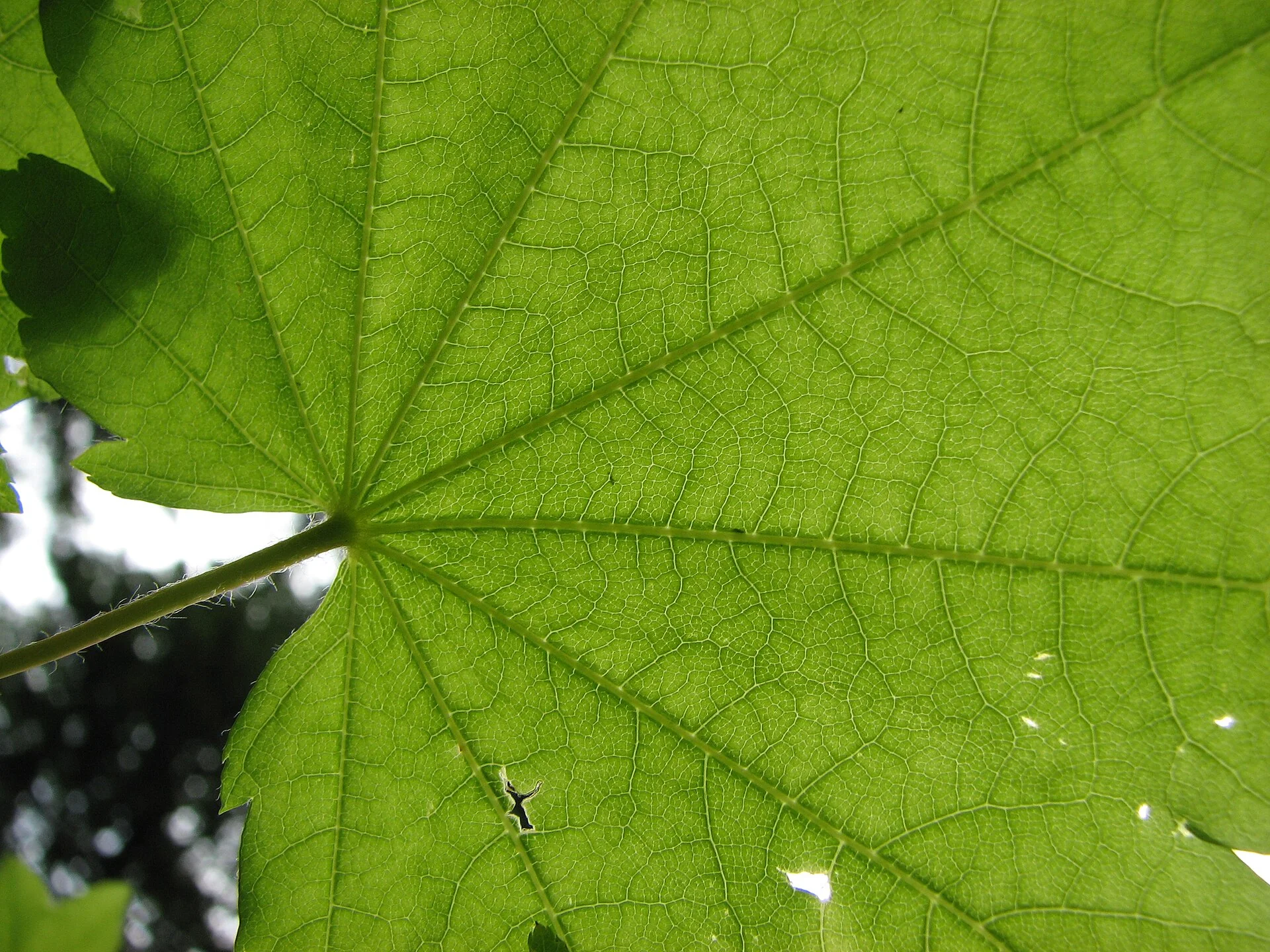

The tree that takes carbon from air
A sapling becomes a tree. Its trunk thickens, its branches spread, and each year it produces more leaves. Looking at the roots, it is easy to imagine that most of this new substance was simply pulled out of the soil.
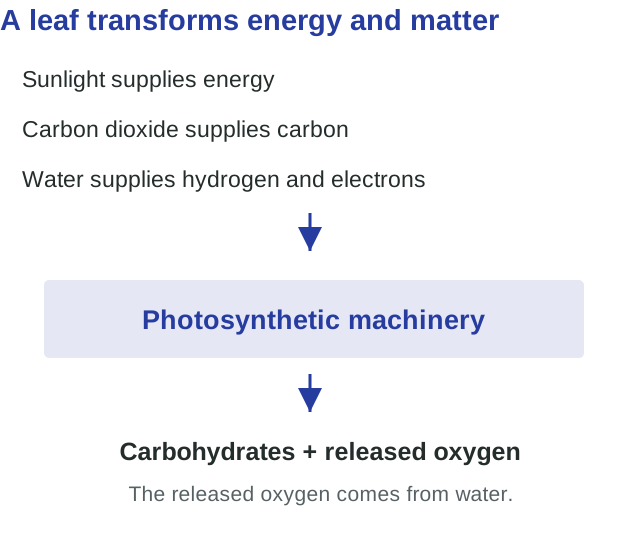
Roots do supply essential water and minerals. But the carbon framework of the tree's organic matter comes from carbon dioxide in the air. Sunlight supplies energy for the work of incorporating that carbon into biological molecules. Light is not a load of tiny pieces of wood: energy and building material have different jobs. OpenStax's overview of photosynthesis
That is the first surprising thing about a leaf. It is an exposed surface where a gas that seems insubstantial becomes part of a living structure. Understanding how requires looking below the green surface, into cells and their chloroplasts, the compartments where photosynthesis takes place.
Catching light and transferring energy
Inside a chloroplast are membranes arranged into structures called thylakoids. Pigments, including chlorophyll, absorb selected wavelengths of light. Organized molecular systems use the absorbed energy to drive the transfer of electrons.
This is a controlled chain of reactions, not a leaf simply getting warm. Water supplies replacement electrons, and oxygen is released in the process. The oxygen produced by photosynthesis comes from water, a detail obscured by the tempting image of a leaf taking carbon dioxide apart and returning its oxygen directly to the air.
Electron transport helps create a difference in proton concentration across a membrane. As protons flow through an enzyme called ATP synthase, that enzyme makes ATP, a molecule cells use in energy transfers. The light-dependent reactions also produce NADPH, which supplies electrons for subsequent chemistry. These products connect captured light with the construction of organic molecules. OpenStax on the light-dependent reactions
One useful way to follow the story is to keep three accounts: where the carbon goes, where the electrons go, and where the energy goes. A one-line equation is convenient, but it can hide the separate transfers that make the whole process possible.
Building with carbon dioxide
The Calvin–Benson cycle incorporates carbon dioxide into organic compounds. ATP and NADPH produced by the light-dependent reactions help power the transformations. Some of the resulting three-carbon molecules, called G3P, can leave the cycle and contribute to the production of carbohydrates and other cellular material. Much of the chemistry regenerates the starting compound so that the cycle can continue. OpenStax on carbon fixation
The word “cycle” matters. A leaf does not possess an inexhaustible pile of a starting ingredient that disappears every time carbon enters. Its reactions repeatedly rebuild the machinery's chemical starting point, while a portion of newly fixed carbon becomes available for growth.
These reactions are sometimes called light-independent, but that does not mean they are a special nighttime operation. Their dependence on products of the light reactions ties them closely to illumination. “Does not absorb the photon in this step” and “works independently of sunlight” are different claims.
How did researchers discover an invisible pathway? They followed labeled carbon. In work described in Melvin Calvin's 1961 Nobel lecture, researchers exposed algae to radioactive carbon dioxide, stopped the reactions after selected intervals, and separated the resulting compounds. Radioactivity revealed where carbon had traveled. Comparing very short exposures with longer ones helped reconstruct the sequence. The work involved Calvin, Andrew Benson, and other collaborators. Calvin's original lecture
That method turns a static list of chemicals into evidence about movement. It resembles placing a traceable marker into a busy distribution system and checking which destinations receive it first. The marker does not explain the pathway by itself; experimental timing and chemical identification make the tracing informative.
A leaf also breathes and loses water
A green plant does more than photosynthesize. It also carries out cellular respiration, using organic molecules to support the work of its living cells. Aerobic respiration consumes oxygen and releases carbon dioxide. It continues during both day and night. Photosynthesis and respiration are therefore concurrent processes in an illuminated plant, not alternating identities in which a plant changes from one kind of organism into another. Oregon State University Extension on plant growth and respiration
The balance of processes determines the net exchange. A leaf can release oxygen overall while some of its cells are consuming oxygen. Thinking in terms of totals prevents the misconception that plants never need the gas they help supply.
The leaf also faces a physical tradeoff. Carbon dioxide enters through small openings called stomata, but water vapor can escape through those openings. Restricting water loss can therefore restrict carbon intake. A leaf's performance depends on its surroundings: light, temperature, water availability, and gas exchange interact. More of one input does not guarantee unlimited growth.
The result is an organism managing constraints. Photosynthesis is remarkable without being an endlessly efficient machine. Understanding its limits helps explain why heat, drought, shading, and other changes can matter to a living plant.
Gratitude with a mechanism
For a Catholic reader, an account of photosynthesis can deepen the idea that food is a gift without bypassing the processes that produce it. Gratitude need not begin where a mechanism stops. Knowing how carbon enters a leaf makes the dependence involved in eating more concrete.
In Laudato Si', Pope Francis asks readers to recognize the value and interdependence of creatures, including organisms that receive little attention. A leaf offers a small, inspectable example of that dependence: living tissue whose work participates in a wider community of life. Laudato Si', paragraphs 32–36
Calling this a gift does not erase agricultural labor, water management, or the need to care for the conditions that allow plants to grow. It can instead sharpen attention to them. The bread on a table connects biological processes with human work and responsibilities.
Hold a leaf up to the light. Across its membranes, electrons move and carbon enters new compounds. Gases pass between the leaf and the air. The tree uses these processes to make sugars that support its growth.