
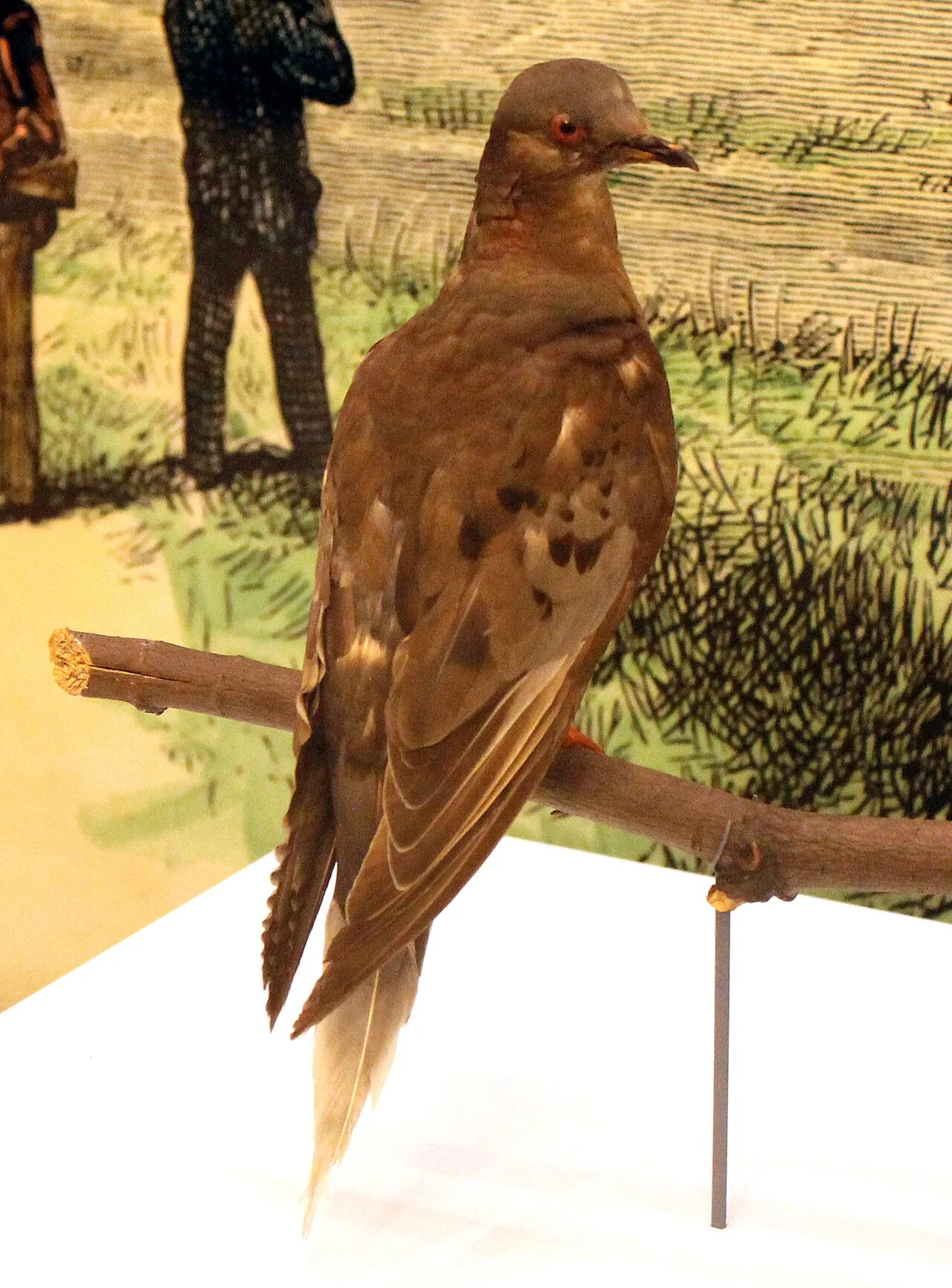

The last bird had a name
On September 1, 1914, a passenger pigeon named Martha died at the Cincinnati Zoo. Her death marked the end of a species that had once gathered in immense North American flocks. Billions of birds had become one captive bird, and then none. Her preserved body entered the Smithsonian's collections. U.S. Fish and Wildlife Service on the extinction; Smithsonian collection record
Martha is easy to remember because a named individual gives an overwhelming loss a human scale. But the extinction was larger than her death. It ended a continuing population: birds breeding, migrating, feeding, and interacting with forests. A museum specimen can preserve evidence of a body. It cannot preserve those living relationships.
A species can disappear before most people have encountered it. Its extinction ends a distinct way of living and reproducing, including the part it might have played in future ecosystems.
Abundance did not mean safety
The passenger pigeon's story challenges the assumption that a familiar, plentiful species must be secure. Commercial hunting killed birds on an enormous scale, while deforestation reduced and altered their habitat. The combination brought a once vast population to collapse. The Fish and Wildlife Service identifies both exploitation and habitat destruction in its account. The documented decline
Scientists have also tested whether the pigeon's numbers were naturally prone to catastrophic swings. In a 2017 study, Gemma Murray and colleagues analyzed passenger-pigeon genomes. They argued that natural selection, rather than repeated enormous population crashes, explained important features of the species' low genetic diversity. Their results did not support the idea that the final extinction simply continued a pattern of extreme natural fluctuations. Murray and colleagues' original paper
This is not a claim that one genetic study reconstructs every cause of extinction. The authors also considered how adaptations advantageous in a very large population could become disadvantages after severe decline. The important distinction is between identifying a species' vulnerabilities and treating its loss as inevitable. A vulnerability can make human pressure more consequential.
For conservation, the lesson is uncomfortable. Waiting until only a handful of individuals remain may leave little room to repair the damage. A species can appear abundant while the conditions supporting its abundance are being dismantled.
A species is part of a working world
An animal does not occupy a sealed box. Its activities affect other organisms and the physical environment. Historical passenger-pigeon flocks were large enough that roosting birds could break branches. Their disappearance therefore removed a particular pattern of disturbance as well as a population of consumers.
We should resist embellishing that observation into a fully solved account of every forest change since 1914. Reconstructing the effects of an extinct animal is difficult. Other species, land use, and climate also change. An attractive story about one missing species causing every later ecological problem can be as misleading as assuming its absence made no difference.
The broader ecological point is well established: biodiversity includes relationships that contribute to ecosystem functioning and human life. The 2019 IPBES global assessment examined interacting pressures including land and sea use, exploitation, climate change, pollution, and invasive species. It presented biodiversity loss as a problem with multiple causes and consequences, rather than one universal mechanism. IPBES assessment summary
This gives practical reasons to care. Food systems, livelihoods, and functioning habitats depend on living communities. Yet a purely useful-species argument has a weakness: it can imply that creatures without a demonstrated human service are expendable. Our knowledge of their roles is incomplete, and usefulness is not the only possible basis for responsibility.
What Catholic teaching adds
In Laudato Si', Pope Francis insists that other creatures have value beyond their usefulness to us. He grounds that value in God’s love for creation. His discussion includes fungi, algae, worms, and microorganisms, which rarely become conservation symbols. Laudato Si', paragraphs 32–36
That claim does not require treating every organism as a human person. The same encyclical recognizes distinctive human worth and responsibility. It also rejects reading biblical dominion as permission for unlimited exploitation. In this account, human capacities increase our obligations toward other creatures rather than making their existence morally irrelevant.
There is a serious objection: extinction occurred long before human beings, so why regard it as a moral problem now? The answer requires identifying an agent and an action. A natural process can cause harm without being morally blameworthy. People who foresee and can reduce the consequences of their choices are in a different position. Calling extinction natural does not determine whether a particular instance was preventable, reckless, or justified.
Nor does concern for a species automatically settle every conflict over land. People need homes, food, and livelihoods. Catholic environmental concern must include affected communities, especially those with little power. The challenge is to examine alternatives and burdens honestly, rather than assuming either that every development is justified or that human needs are an intrusion into nature.
Remembering without stopping at regret
Martha cannot be brought back by a moving paragraph. A useful response to her story begins with attention to living places: what species occur there, what they require, which pressures are documented, and whose decisions shape those pressures.
For a parish, school, or household, that may begin with learning the ecology of land already under its care and asking qualified local conservation workers which changes would help. The appropriate action depends on the habitat. A gesture that photographs well is not necessarily one that supports a local species.
The passenger pigeon also changes what “ordinary” can mean. An animal does not need to be rare before its continued existence deserves attention. Martha's specimen records a last individual. The harder responsibility belongs to us earlier, while the woods still contain enough living creatures for their disappearance to seem impossible.