
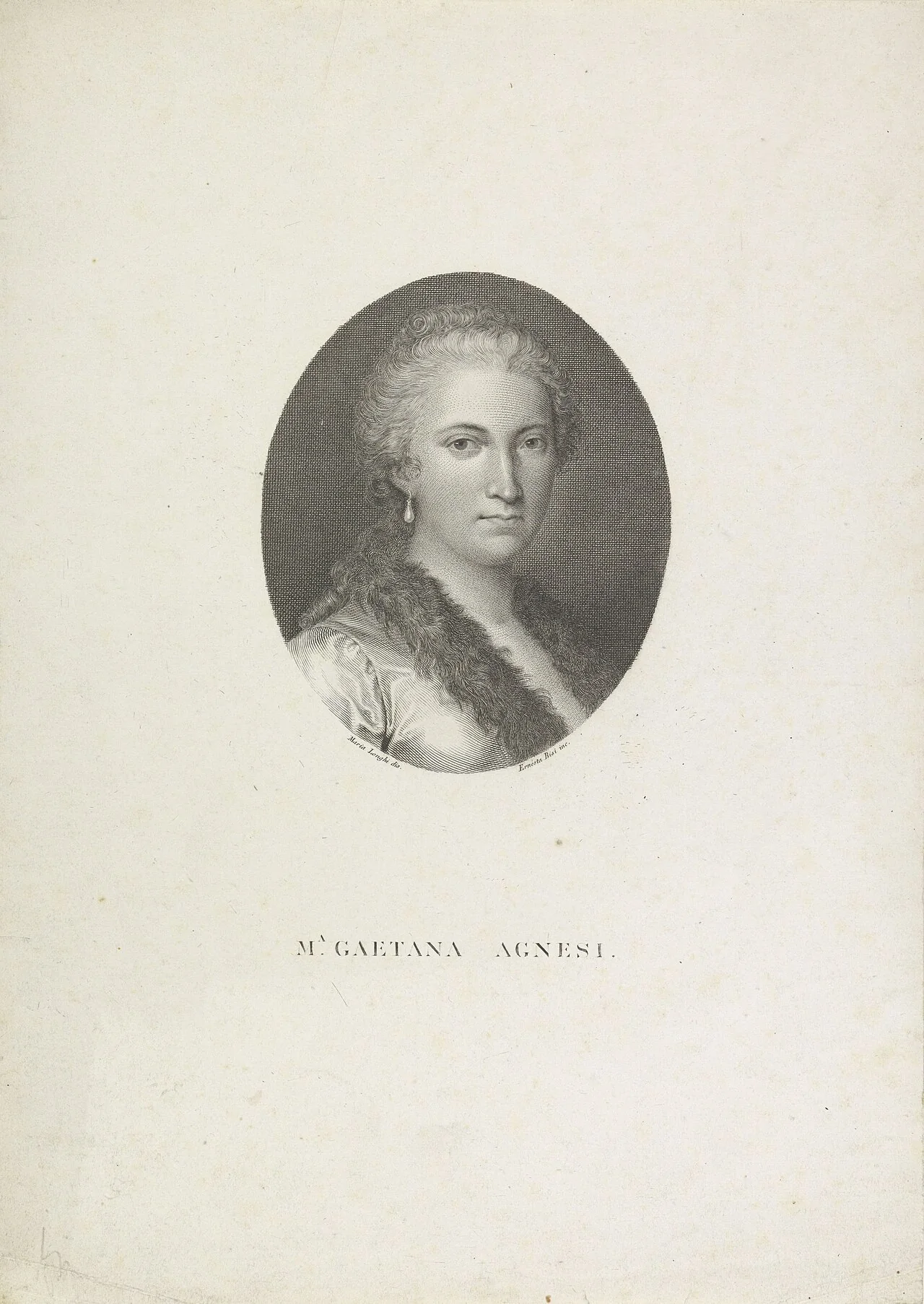

Maria Gaetana Agnesi had a printer working in her family’s Milanese home. As the early parts of her mathematics textbook went to press, she was still sending later sections to the mathematician Jacopo Riccati for comment. His replies had to arrive in time to keep the printing moving. The correspondence gives us an author managing a difficult book, seeking criticism and pressing to finish it. MacTutor’s account of the letters and printing.
The result, the two-volume Instituzioni analitiche ad uso della gioventù italiana, appeared in Milan in 1748. Written in Italian, it brought algebra and calculus into a teaching sequence. Contemporary reviewers praised the order and clarity with which Agnesi presented work scattered among other mathematicians’ publications. MacTutor on the textbook and its reception.
Agnesi would later spend decades caring for poor and ill women. Her life asks us to take both kinds of work seriously: making knowledge available to a learner, and making room for a person who needs care.
An education with unusual opportunities
Born in Milan in 1718, Agnesi grew up in a wealthy household that supplied exceptional opportunities for study. Her learning included languages, philosophy, and mathematics. The mathematician and monk Ramiro Rampinelli helped guide her advanced studies, and her work benefited from contact with other scholars. She did not acquire a major mathematical education in complete isolation. The University of St Andrews' MacTutor biography.
The household that paid for her education expected her to display it before learned visitors. Family wealth gave Agnesi access; family authority limited her freedom. MacTutor on her circumstances.
What clarity contributes to mathematics
Calculus studies change and accumulation. A derivative expresses a rate of change; an integral can describe an accumulated quantity. These ideas become usable through notation, definitions, examples, and arguments that connect a procedure to why it works. A teacher must choose an order of explanation and show how the answer follows.
Take a modern example: the area of a square with side length x is x squared. Increase the side by a small amount h. The added area is 2xh plus h squared. Dividing by h gives 2x plus h; as h approaches zero, the rate of change of area with respect to side length approaches 2x. A compact rule has become intelligible through a geometric comparison.
This is an illustration for the present reader, not a quotation from Agnesi's text. Someone who memorizes “the derivative of x squared is 2x” has acquired a rule. Someone who understands the limiting argument has begun to see how a mathematical claim is justified.
Agnesi's textbook was valued for synthesizing and clarifying existing work. It should not be credited with inventing calculus. MacTutor on the work's mathematical contribution. The original Italian and later English editions also illustrate how notation and translation shape access to mathematical ideas. The Linda Hall Library's discussion of its historical editions.
The strange name attached to a curve
Agnesi is often remembered through the “witch of Agnesi,” a curve discussed in her book. The English name arose through a linguistic confusion involving the Italian name versiera. It does not indicate that Agnesi practiced witchcraft, and the curve's earlier history means its familiar name is not a secure guide to who first investigated it. The Linda Hall Library's account and historical editions.
The nickname has survived more readily than the teaching that made the curve familiar to generations of readers. It is a poor summary of a book that required years of selection, calculation, explanation and production.
For a glimpse of that teaching, compare the library’s Italian and English editions. The translator changed Agnesi’s Leibniz-style calculus notation to Newtonian notation. A mathematical idea can remain the same while its written form becomes familiar to a different readership. The Linda Hall Library’s comparison of the editions.
An appointment is not a teaching career
In 1750 Pope Benedict XIV supported Agnesi's appointment at the University of Bologna. Accounts differ in how they describe the offer, formal appointment, and acceptance. What matters for an accurate public biography is that she did not take up a teaching career there. St Andrews discusses the documentary complications, while Bologna's Agnesi project records the chair offered to her and her turn toward charitable work. MacTutor's account and the Bologna project.
The appointment recognized an author whose book already taught beyond the university. It did not lead to her teaching classes in Bologna. Keeping both facts in view lets us recognize her achievement without supplying a career she never pursued.
A Catholic life beyond a conventional career
After her father's death in 1752, Agnesi concentrated on charitable activity, including care for poor and ill women. Her religious commitment shaped a life outside marriage and outside a convent: she did not become a nun. A University of Michigan Library discussion of historian Massimo Mazzotti's biography emphasizes this unusual position and places her mathematics and piety in the setting of the Catholic Enlightenment. The library's discussion of Mazzotti's historical study.
Her charitable work acquired a durable institutional home. When Milan’s Pio Albergo Trivulzio opened in 1771, she became director of its women, especially those who were ill. The University of Florence’s historical exhibition records that responsibility. “Charity” here meant an ongoing commitment to people and to the organization of their care. Florence’s account of Agnesi.
A modern reader may wish she had written more mathematics. That wish needn’t decide the value of the years she gave to these women. Her Catholic commitments directed her attention toward people whose needs would never confer the prestige of an academic appointment. Teaching and care each required time she could have spent elsewhere.
Agnesi’s textbook remains a record of what she could explain. Her service at the Trivulzio records another use of her abilities: taking responsibility for care over many years.