

One volunteer in a sleep laboratory described being lifted and floating above the bed after a lucid dream. The researchers had an electrical recording to examine alongside that account: they classified the episode as REM sleep. Other volunteers described sinking, spinning or losing their usual sense of where their body ended. [1]
These reports appear in a study published in February 2026 by Teresa Campillo-Ferrer and colleagues. It offers a close view of experiences that are often discussed through stories told long afterward. A second paper, published online in August, asked whether people attempting an out-of-body experience could describe a concealed image. The two investigations address different parts of a familiar question: what happens when someone feels located outside their physical body? [1] [2]
An out-of-body experience concerns that apparent change of location or perspective. A near-death experience is a broader category, sometimes including such a sensation alongside other reported events. The volunteers in these two studies were not being resuscitated after cardiac arrest. Their results should not be presented as a test of everything reported near death. [1] [2]
A signal from the sleeper
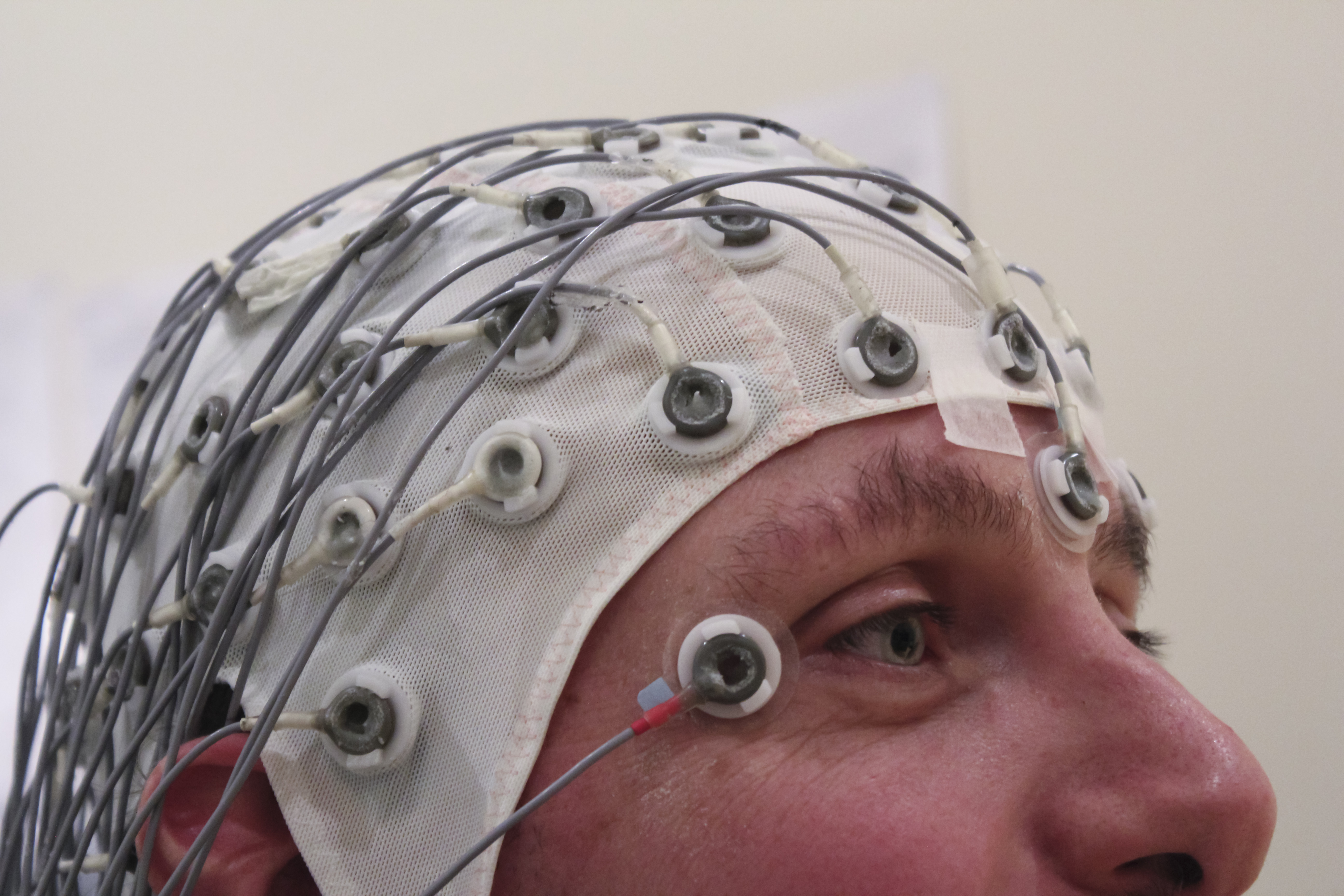
Campillo-Ferrer’s team recruited 35 healthy volunteers with lucid-dream or meditation experience. Data collection ran from June 2023 to May 2024. Participants arrived after a shortened night’s sleep, practiced meditation and then had an opportunity to sleep while wearing a dense array of EEG electrodes. The equipment recorded electrical activity at the scalp; additional sensors tracked eye movements and muscle activity. [1]
The volunteers learned a deliberate left-right eye signal to mark an unusual experience. Researchers used those signals, interviews and other recorded events to work out when each episode occurred. Of 47 reported unusual bodily experiences, 36 from 20 people remained after checks for timing, usable signals and consistency. These included ten episodes classified as out-of-body experiences or a sense of elevated self-location. Most in that subgroup lacked visual content: feeling displaced did not necessarily mean seeing the room from above. [1]
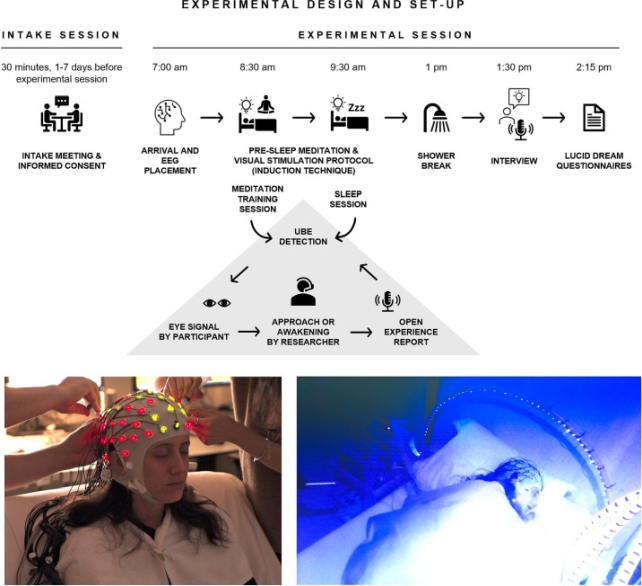
The eye signals helped connect a report to a recording; they did not independently verify the scene a participant described. [1]
The team had predicted that one EEG rhythm, alpha activity, would fall between ordinary waking and sleeping levels during sleep-related episodes. That prediction was not supported as expected: the alpha measurements looked more like sleep. Further, exploratory analyses found changes in faster and slower activity that the authors interpreted as a mixture of waking and sleeping features. These associations give researchers patterns to investigate, rather than a demonstrated cause of every out-of-body experience. [1]
Timing remains difficult. A brief experience may not fall entirely within the five-second segment selected for analysis, and a supposedly ordinary comparison period could contain an experience that went unreported. Light cues may also have contributed to fragmented sleep. Those details matter when deciding which electrical changes belong to the experience itself. [1]
Where the body seems to be
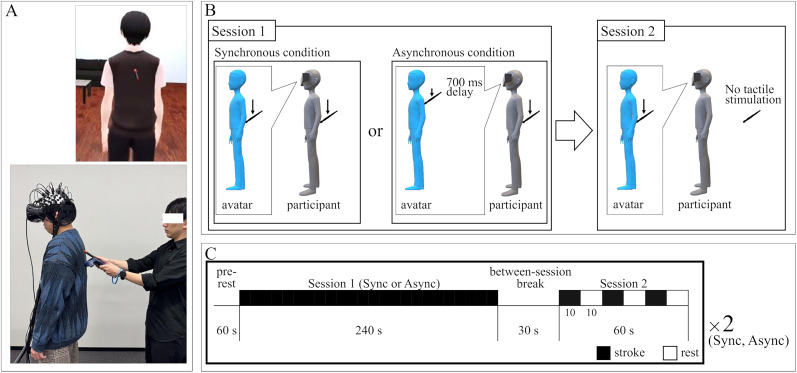
A different experiment, published in September 2025 by Katsuki Higo and colleagues, manipulated body ownership while 18 male volunteers viewed a virtual body being stroked. The strokes they saw and felt were either synchronized or separated by a delay. The researchers collected experience ratings and used near-infrared light to measure changes in blood oxygenation over selected brain regions. This was an experiment in the feeling that a viewed body belongs to oneself. It did not test whether anyone could see a hidden object. [3]
The image in another room
Marina Weiler and colleagues tackled that latter question in their 2026 EXPLORE paper. Twenty-one people affiliated with an out-of-body training institute attempted to describe randomly selected visual targets in an inaccessible room. Participants and researchers were blinded to target identity. A language model compared the meanings of descriptions and image captions, ranking the target among 100 candidates. [2]
Across the 13 descriptions analyzed, neither individual trials nor the combined rank-based test performed significantly above chance. The authors also reported two spontaneous descriptions of experimenters’ activities. Those observations were separate from the controlled target test. The small, selected sample limits generalization, and the scoring controls did not establish how sensitive the method was to natural human descriptions. [2]
The accessible abstract reports these outcomes; the full methods were unavailable for inspection. That leaves questions about exclusions, timing and the analysis plan unresolved. The result offers no controlled support for seeing those targets under this procedure, while leaving broader claims about consciousness unsettled. [2]
Paul’s unanswered question
Catholic readers may hear an echo in Paul’s Second Letter to the Corinthians. He describes a person in Christ caught up to Paradise and adds: “whether in the body or out of the body I do not know, God knows.” The US bishops’ biblical notes identify the third-person account as Paul speaking indirectly about himself. The passage belongs to his discussion of visions, boasting and weakness; it supplies no clinical record from which to diagnose a modern condition. [4]
The Catechism describes the human person as a unity of body and soul and teaches that the soul survives death, awaiting reunion with the body in the resurrection. These are theological teachings, not classifications of laboratory participants. A vivid sensation and an EEG trace cannot, by themselves, decide whether a soul has left a body. [5]
Paul introduces the episode among revelations of the Lord, then turns to his weakness and dependence on Christ. His account leaves the bodily question unanswered. [4]