
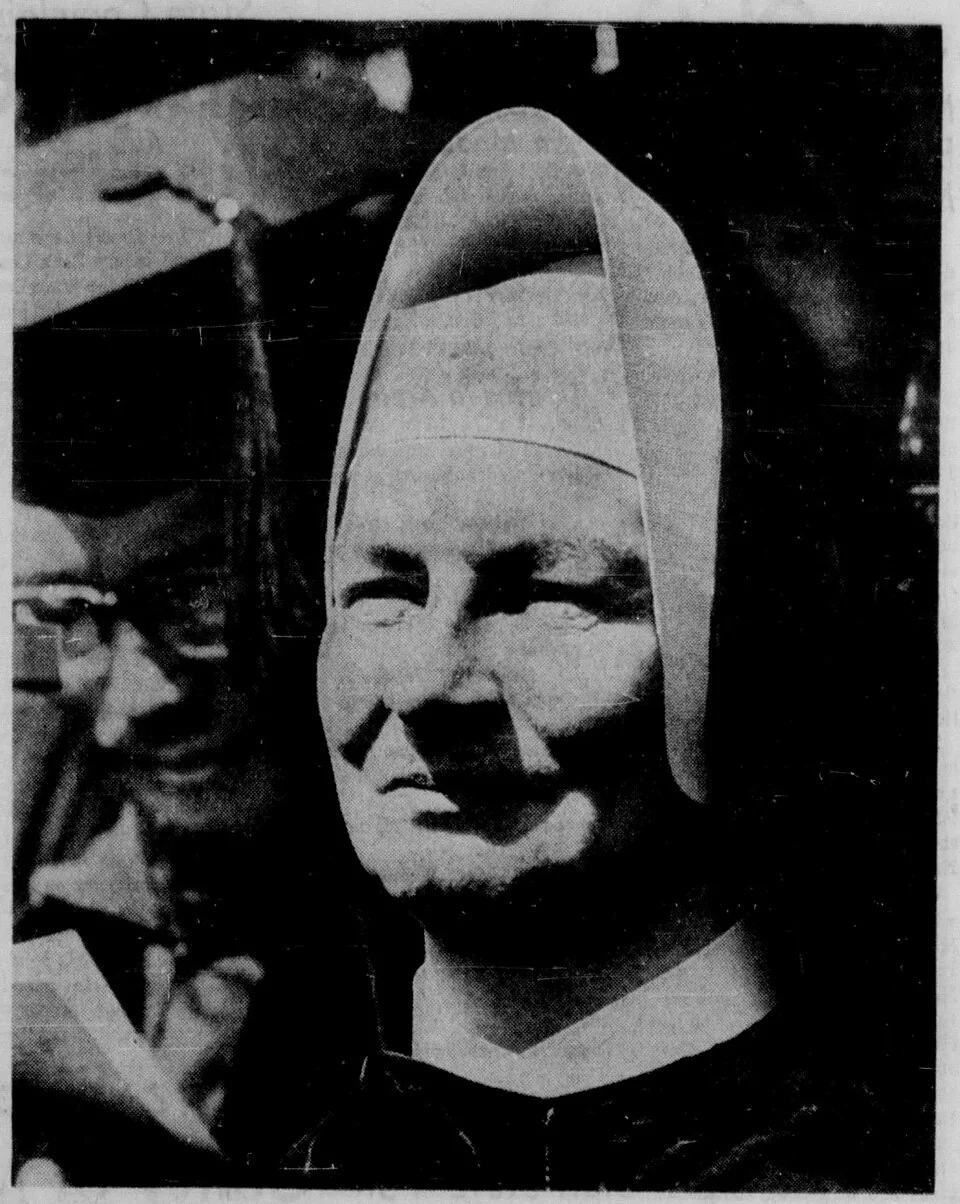

A computer can follow a list of instructions. Can it also find a pattern in examples and extend that pattern to a case it has not been shown? That question sits near the heart of modern debates about artificial intelligence. It also sits in a 1965 doctoral dissertation written by a Catholic sister, Mary Kenneth Keller.
The title was Inductive Inference on Computer Generated Patterns. Keller investigated how a program might generalize from mathematical expressions. She earned her doctorate at the University of Wisconsin–Madison and then built a computing program at Clarke College in Iowa. Her story joins a technical question about machines to a social question about who would be able to use them. Wisconsin's account of her research and career.
An accomplishment that needs no exaggeration
Keller is often described as the first woman to earn a doctorate in computer science in the United States. The more precise story is especially striking. On 7 June 1965 she received her PhD, while Irving C. Tang received a D.Sc. from Washington University's department of applied mathematics and computer science on the same date. A historical study by archivist Jennifer Head and computer scientist Dianne O'Leary distinguishes those degree titles and documents Keller's place among the first American doctoral graduates in the field. Their archival study.
Keller belonged to the Sisters of Charity of the Blessed Virgin Mary. She entered the congregation in 1932, and her route through higher education accompanied years of school teaching. The doctorate did not mark a young graduate's first encounter with a classroom. It equipped an experienced educator to work in an emerging discipline. Wisconsin's biographical account.
After the doctorate came educational work: obtaining equipment, teaching people to program and deciding how a small college could afford access.
What it means to learn from examples
Here is a simple illustration, not a reconstruction of Keller's experiment. Suppose a machine is shown the numbers 2, 4, 6, and 8. It might propose that the next number is 10. But infinitely many rules can fit four examples and produce a different fifth. Successful prediction requires assumptions about which patterns count as plausible and which kinds of examples the program will encounter.
Keller's dissertation considered a more structured mathematical problem: generating an expression for a later derivative from earlier examples. A derivative describes how a mathematical function changes. Repeated differentiation often produces regular patterns. Her implementation used FORTRAN, a programming language suited to scientific calculation. The archival study explains both her aim and the constraints of the program. The dissertation analysis.
The distinction between following a supplied rule and inferring one is useful. A rule-based differentiation program is told how to transform an expression. A program investigating inductive inference tries to infer a pattern from instances. Neither success automatically establishes human understanding. It establishes a capability within a specified task, with specified representations and tests.
Input expressions had to be written consistently: expanding a factored polynomial could hide its pattern. Keller also built a differentiating module to generate examples and check inferred answers. Representation and testing were part of the experiment. Head and O’Leary’s dissertation analysis.
A familiar claim that should be retired
Another story regularly attaches Keller to the invention of BASIC. She did attend a Dartmouth computing workshop. But Head and O'Leary report direct testimony from BASIC co-creator Thomas Kurtz rejecting the claim that she helped create the language. Her documented achievements should not be decorated with someone else's invention. The historical correction.
Dartmouth's own records identify John Kemeny and Thomas Kurtz as the faculty leaders behind BASIC and the Dartmouth Time-Sharing System, working with students. The system became operational in 1964. Time-sharing allowed multiple users to interact with a central computer through terminals, making access less dependent on handing a job to a specialist and waiting for its return. Dartmouth's computing chronology.
This broader movement helps explain the educational opportunity Keller recognized. A computer might become something a student could explore directly. The machine's importance lay partly in the questions people could learn to ask with it.
Bringing the opportunity to a women's college
At Clarke, Keller established one of the early computer science programs at a small college. Clarke's institutional history places that work within its identity as a women's college and remembers its effect on access to a field in which women faced substantial barriers. Clarke's account of its computing history.
Her teaching materials show what opening access involved. In a textbook she coauthored, Keller began with a system of two linear equations, turned the solution into an algorithm and flow chart, then implemented it in BASIC. An appendix led students through using a teletype, from signing on to signing off. The archival study’s examination of her textbook.
Clarke’s IBM 1130 arrived in 1966. Limited funds made keeping equipment current difficult. Keller’s later concerns about a shared computing center included its support and documentation. Access cost more than the purchase price. The computer center’s records.
Education as a form of service
The Catholic connection in Keller's life was institutional and vocational. A religious sister worked through an educational community to expand students' capacities. The Second Vatican Council's 1965 declaration Gravissimum educationis describes education as formation of the whole person and calls Catholic higher education to pursue subjects through their proper methods. Its language also emphasizes access for capable students of limited means. The declaration on Christian education.
This provides a Catholic framework for the service her career performed, rather than evidence of her private thoughts. A student who understands a program can inspect its assumptions and challenge its answer. A student merely handed a result has less power. Teaching the method shares some of the authority that technology otherwise concentrates in specialists.
Keller’s teletype instructions suggest a test for schools adopting a powerful tool: can a beginner find enough explanation to attempt something, recognize an error and try again? Teaching makes the investment usable.