THE PERSON BEHIND THE ACCOUNT
Imelda Lambertini’s story grew around a child’s longing for Communion.
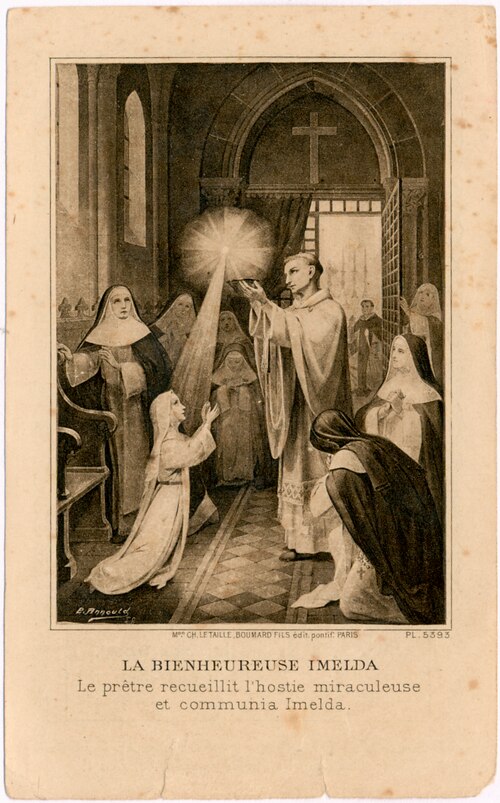
The familiar story places a young girl in a Dominican monastery near Bologna, longing to receive Communion before the customary age. Imelda Lambertini became a patron for children approaching the Eucharist. The Order still tells her story in that devotional setting. [2]
The story the sisters handed down
The tradition associates Imelda with Valdipietra and a host coming to her when she longed for Communion. Surviving versions postdate the child they describe. [1]
Where the documents begin
The diocesan historical contribution traces the account through copied inscriptions, a lost martyrology and a narrative attached to a sixteenth-century breviary. It notes embellishments and absent contemporary testimony. [1]
IN OUR OWN LIVES
Taking children’s faith seriously
A child can ask a serious religious question before adults expect it. Imelda’s devotion gives that possibility a memorable face. Parents and teachers can draw on its Eucharistic focus while telling the historical story carefully. Calling the image a manufactured figure and acknowledging late evidence need not make the conversation colder; it gives children an example of affection and accuracy sharing the same room. [1] [2]
THROUGH THE EYES OF FAITH
Faith and daily life
The Dominican confraternity bearing her name emphasizes friendship with Christ, prayer and a continuing sacramental life after First Communion. Its focus is a child’s capacity for religious attention, with parents and catechists sharing responsibility for formation. [2]
A child’s place in Catholic prayer
The Dominican account presents Imelda as eager for prayer and the Eucharist. Its present confraternity encourages gratitude after Communion, regular Mass and acts of charity. That gives the devotion a life beyond reproducing a miraculous image: a child’s religious formation is meant to continue after a single ceremony. [2]
Blessed in Bologna
The Archdiocese of Bologna lists Imelda among its blesseds. Her local liturgical remembrance and the Dominican confraternity establish a continuing Catholic devotion; they do not remove the difficulties raised by historians about the early narrative. [3] [2]
THROUGH THE LENS OF SCIENCE
The evidence about the remains
At San Sigismondo, the figure associated with Imelda is made of plaster and wax. Bologna’s diocesan newspaper distinguishes that figure from the few incomplete bones attributed to her. Visitors are not looking at an exposed, intact preserved body. [1]
An image made for a shrine
The diocesan article identifies Cesare Bettini’s plaster-and-wax figure, added in 1880 beside three glass cases of attributed bones. Figure and relics are different components. [1]
READER QUESTIONS
Questions and answers
Did she die immediately after a miraculous Communion?
That belongs to the received narrative, supported by late surviving evidence rather than contemporary testimony. [1]
Is the figure her preserved body?
No. Bologna’s diocesan account identifies plaster and wax alongside a small, incomplete collection of attributed bones. [1]
FOLLOW THE SOURCES
Sources and further reading
- Bologna Sette — Imelda Lambertini, 9 July 2017, page 8
Church or shrine source
Late-source history and Bettini’s plaster/wax figure with incomplete bones; not a medieval eyewitness account.
- Dominican Order — Confraternity of Blessed Imelda
Church or shrine source
Present devotional narrative and Eucharistic practices. It is not a contemporary medieval biography.
- Archdiocese of Bologna — Saints and blesseds
Church or shrine source
Lists Imelda among the blesseds and supplies local liturgical context.
Sources checked: 2026-10-27. Suggest a correction or a source.