THE PERSON BEHIND THE ACCOUNT
The artist who wrote for women afraid of failing
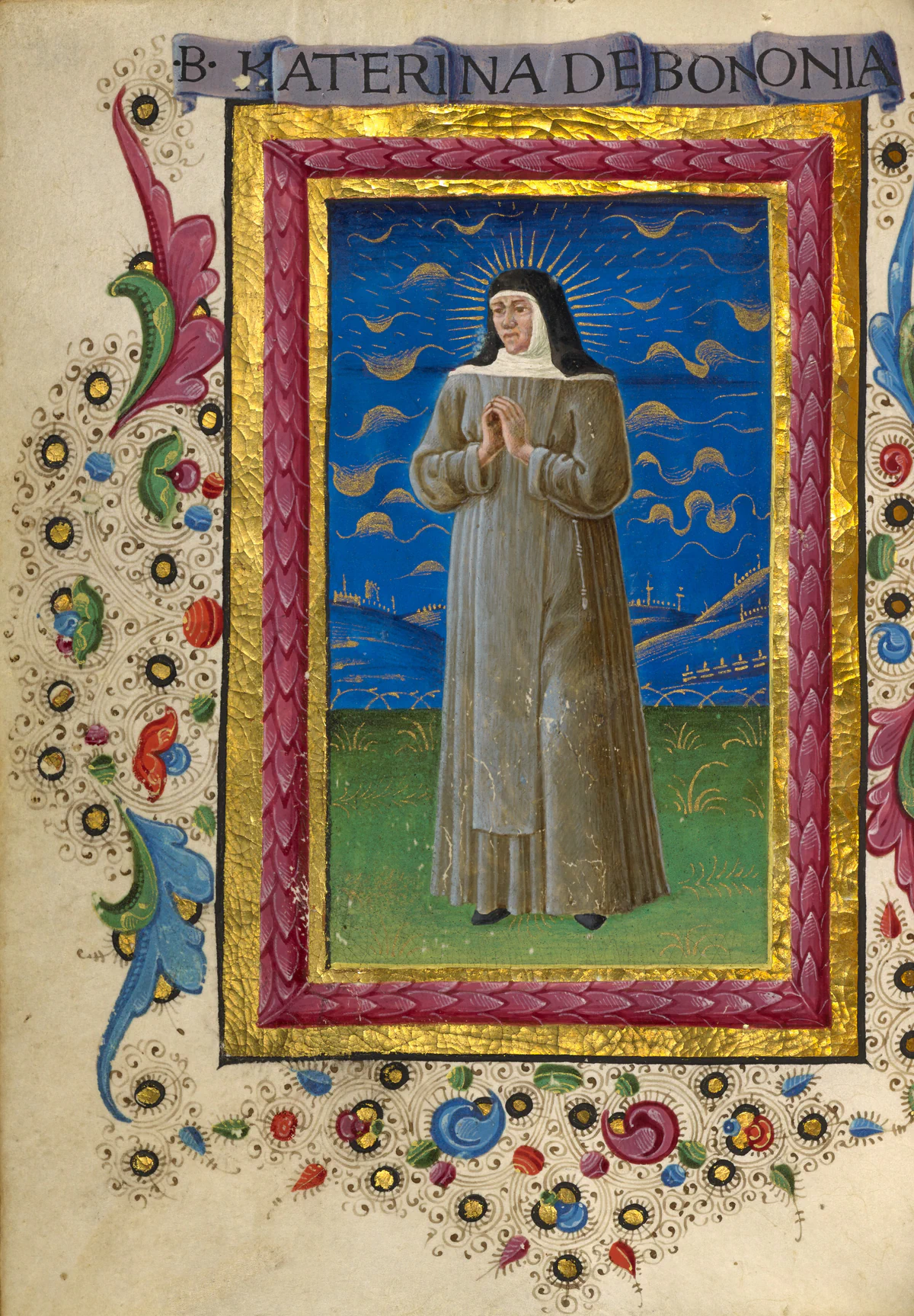
Catherine learned Latin, music and manuscript illumination at the Este court in Ferrara. In 1427 she joined a community of religious women instead. Leaving court did not settle her future: the women disagreed sharply over which religious rule to follow. [3]
A community that could not agree
The women divided over Augustinian and Franciscan observance. The source-based parish biography records temporary dissolution, profession as Poor Clares in 1432 and later permission for Colette’s reform. The community’s future required decisions beyond an individual desire to enter. [3]
Interruptions at the monastery door
The former court attendant worked at washing, sewing and baking. Later, answering visitors at the monastery grille repeatedly interrupted her prayer, a task she found difficult. In 1456 she accepted responsibility for a new foundation in Bologna, although she wanted to remain in Ferrara. These were concrete demands on her time and preferences. [1]
IN OUR OWN LIVES
When prayer keeps getting interrupted
Interruptions make a practical demand on anyone trying to find quiet. Another person’s need may require attention at exactly the wrong moment. A religious account of prayer has room for that collision.
Her writing also gives a place to the believer who feels ashamed of doubt. The teacher remembered what uncertainty felt like. A reader need not reproduce her visions to learn from the patience of her instruction. [1][3]
THROUGH THE EYES OF FAITH
Faith and daily life
Her best-known book, The Seven Spiritual Weapons, grew out of teaching novices. Its subject is perseverance when religious life becomes confusing, frightening or disappointing. Catherine wrote as someone who had known those conditions herself. [1][3]
A book that admits the struggle
Catherine described severe spiritual distress, including doubts concerning the Eucharist. Her teaching directs a struggling reader toward Scripture, remembrance of Christ’s life and Passion, confidence in God, and steady effort at doing good. Distrust of self-sufficiency sits beside trust in divine help. The combination leaves room for effort without requiring the believer to feel spiritually successful. [1][2]
The book moves between practical instruction and Catherine’s accounts of visions and interior conflict. She placed her manuscript in the community’s hands before dying; the nuns printed it in 1475. They helped turn a novice mistress’s counsel into something women elsewhere could read. [3]
More than one woman’s achievement
Historian Gabriella Zarri’s 2026 study follows Catherine’s teaching into later generations at Corpus Domini. Rules, letters and other writings helped the nuns develop and transmit their own intellectual and devotional tradition. Catherine’s legacy includes that sustained work by women who learned, interpreted and taught after her. [4]
THROUGH THE LENS OF SCIENCE
The evidence about the remains
At Corpus Domini in Bologna, visitors encounter Catherine seated in a religious habit. The shrine identifies the remains as her incorrupt body. Its account combines a present-day display with extraordinary stories transmitted by her community after her death in 1463. [2]
The body and its early witnesses
The shrine recounts an exhumation eighteen days after burial, reporting preservation, fragrance and subsequent changes in the body. These are devotional accounts associated with the sisters and with Illuminata Bembo, Catherine’s contemporary biographer. The shrine also preserves objects connected with her artistic life, including illuminated pages and a small viola. [2]
What the display can tell us
The cited custodial description supplies no anatomical inventory, treatment history or modern laboratory report. It therefore leaves unanswered how much tissue survives and how centuries of handling and conservation have affected it. The seated figure is a real focus of devotion; a scientific explanation of its preservation needs evidence beyond the traditional exhumation narrative. [2]
READER QUESTIONS
Questions and answers
Was Catherine an artist as well as a nun?
Yes. The shrine identifies artistic work and objects, including illuminated material and a painting attributed to her. [2]
FOLLOW THE SOURCES
Sources and further reading
- Benedict XVI — Catherine of Bologna, 29 December 2010
Church or shrine source
Supports domestic duties, struggle with doubt, spiritual teaching and the Bologna appointment; a papal catechesis, not an anatomical report.
- Corpus Domini sanctuary — Saint Catherine of Bologna
Church or shrine source
Current custodian’s display description and traditional exhumation account; no modern laboratory findings or complete conservation history.
- Saint Catherine of Bologna parish — source-based biography
Church or shrine source
Biographical synthesis with references to scholarly editions: education, community dispute, novice instruction, writings and printing. Uses received dates where institutional accounts differ.
- Gabriella Zarri — A School of Holiness, Religions 17(6), 667 (2026)
Scholarly account
Scholarly abstract and indexed publisher excerpts support the continuity of women’s literary and spiritual teaching at Corpus Domini; full article unavailable during this check.
Sources checked: 2026-10-27. Suggest a correction or a source.