THE PERSON BEHIND THE ACCOUNT
The parish priest whose decisions reached every parish
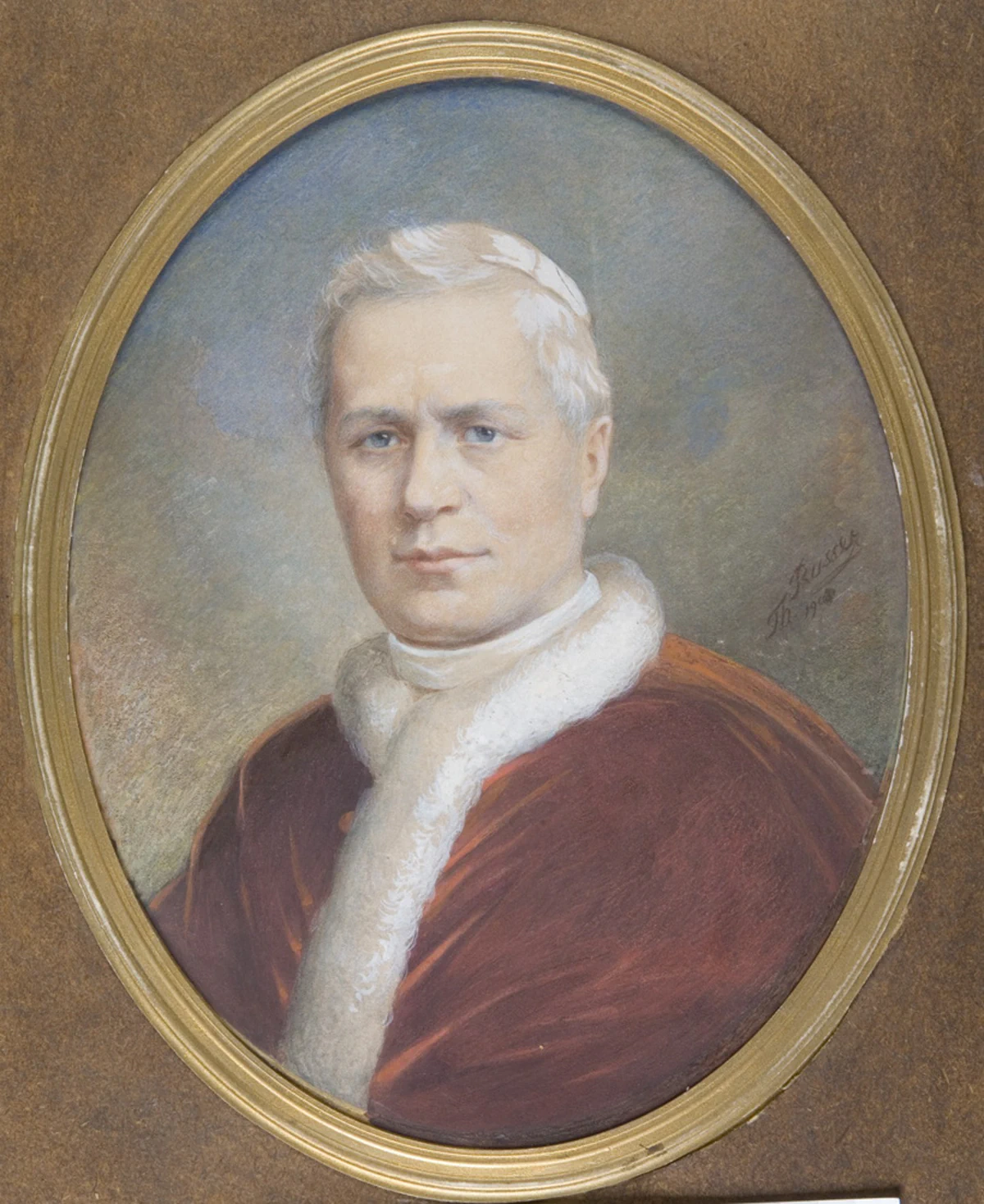
Giuseppe Sarto had worked as a curate, parish priest, seminary director, bishop and patriarch before becoming Pope Pius X in 1903. His papal decisions reached the ordinary places he knew: classrooms, choirs, confessionals and children preparing for Communion. They also reached scholars whose work he considered a threat to the faith. [1][3]
From Riese to Rome
Sarto was born in Riese in 1835 into a family of modest means. Seminary at Padua led to ordination at twenty-three. Pastoral appointments in Tombolo and Salzano preceded responsibilities at Treviso, Mantua and Venice. This was a long preparation in local church work, rather than a career spent only in Vatican administration. [1]
His sister Maria’s later testimony recalls the cholera outbreak at Salzano. She described visits to sick people, encouragement to take medicines and distributions of flour, wood and broth. The testimony, quoted by the prefect of the Dicastery for Causes of Saints, gives a practical example of the parish ministry behind his later policies. It is family remembrance, rather than an independent record of every visit. [5]
Reform meant organization as well as teaching
Pius began the project that became the 1917 Code of Canon Law under his successor. He reorganized the Roman Curia and promoted regional seminaries with libraries and qualified teachers. He also sought accessible catechetical instruction. Benedict’s account connects that concern with people moving between places who needed a dependable way to learn the faith. [1]
His birthplace parish’s itinerary follows the places where he served. It helps connect the pope’s far-reaching policies with his earlier local church work. [4]
IN OUR OWN LIVES
Decisions close to ordinary life
Anyone who has prepared a child for Communion or used a concise catechism has encountered questions Pius took seriously: what must someone understand, who should be welcomed and how should learning continue? His disciplinary campaign raises a harder question about the means used to protect belief. Reading both parts makes him more historically intelligible. [1][2][3]
THROUGH THE EYES OF FAITH
Faith and daily life
He wanted Catholics to learn their faith clearly and participate in the sacraments frequently. The Eucharist stood at the centre of that programme. His insistence on doctrinal protection was equally part of it, and a fair account needs room for both. [1][3]
Children at the Communion rail
The 1910 decree Quam singulari addressed the age at which children should first receive Communion. It tied preparation to the use of reason, commonly around seven, rather than requiring a later age or exhaustive knowledge. It maintained a real need for instruction while opposing barriers that kept children waiting unnecessarily. [2]
This was a consequential choice about how formation happens. Communion was understood as nourishment for growth in Christian life, not simply a reward after education had been completed. Parents, confessors and pastors were given responsibilities for preparation and continued participation. The policy affected family and parish routines across the Church. [2]
The force of the anti-Modernist campaign
Pascendi dominici gregis, issued in 1907, attacked a group of positions Pius gathered under the name Modernism. The encyclical’s own argument shows his concern that revelation and doctrine were being reduced to changing religious experience. Its diagnosis should be read as the pope’s polemical judgment, not a neutral description of every scholar labelled Modernist. [3]
The measures were disciplinary as well as intellectual. The text directed vigilance over teaching, publications and appointments, including exclusion of those judged influenced by Modernism from leadership and teaching roles. These were restrictions with real consequences for Catholic scholarship. Canonization does not make that history disappear or require treating every administrative judgment as beyond criticism. [3]
THROUGH THE LENS OF SCIENCE
The evidence about the remains
The parish at his birthplace identifies a silver facial mask in a 1959 photograph of his remains. That dated image documents a covered face; the page supplies no current anatomical or treatment record. [4]
A mask and a question of evidence
Pius died in 1914. The Riese parish records his beatification in 1951 and canonization in 1954 and identifies a 1959 photograph of his remains with a silver facial mask before a visit to Venice. It also locates his burial at Saint Peter’s. These are specific institutional descriptions of custody and presentation. [4]
The mask matters because appearance cannot tell a visitor the condition of the face beneath it. The parish source provides no current tissue inventory or complete record of treatment. Claims about the natural condition of the whole body need that missing documentation; a covered display cannot supply it. [4]
READER QUESTIONS
Questions and answers
What changed about First Communion?
Quam singulari opposed delaying Communion beyond the age of reason when a child could meet the necessary conditions. It also required continuing instruction and assigned responsibilities to families and clergy. [2]
What does the photograph establish about his face?
The parish identifies a silver mask in its 1959 photograph. It supplies no current record of the face beneath the covering. [4]
FOLLOW THE SOURCES
Sources and further reading
- Benedict XVI: audience on Pius X, 2010
Church or shrine source
Supports pastoral career, hesitant election, sacramental priorities and institutional reforms. Papal appreciative assessment is distinguished from neutral historical judgment.
- Catholic Encyclopedia: Quam singulari, 1911
Historical legal commentary
Contemporary commentary explains age of reason, conditions and responsibilities in the 1910 decree. No claim that instruction became unnecessary.
- Pius X: Pascendi dominici gregis, 1907
Papal text
Supports the pope’s stated diagnosis and disciplinary programme; its description of opponents is treated as polemical, not neutral scholarly consensus.
- Riese Pio X parish: places of his life
Parish account
Documents places, death/recognition dates, Rome burial and silver facial mask in 1959 photograph. No current anatomy or treatment file.
- Dicastery prefect: presentation of Omaggio a Pio X, 2024
Official primary testimony transcription
Quotes sisters Maria and Anna from the Positio: care during Salzano cholera, medicines and material relief. Family retrospective testimony, not a clinical report.
Sources checked: 2026-10-27. Suggest a correction or a source.