THE PERSON BEHIND THE ACCOUNT
She chose a demanding Christian life with the help of Indigenous friends and teachers.
At the Saint-François-Xavier mission, Kateri Tekakwitha found a spiritual guide who had known her mother: Anastasie Tegonhatsiongo. The relationship gives her story a person too often missing from simplified retellings. Kateri’s Catholic life developed through Indigenous friendship and instruction as well as her dealings with Jesuit priests. [2]
A child in a disrupted world
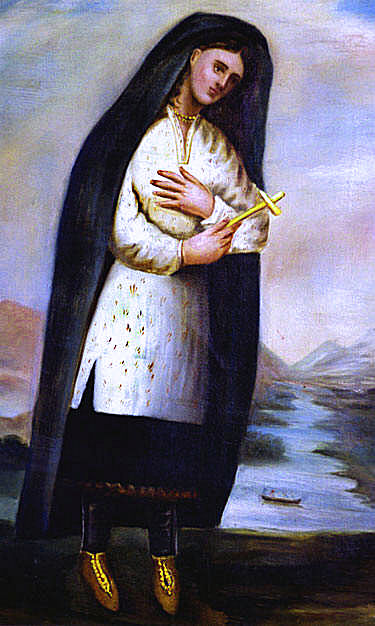
Kateri was born in 1656 to a Mohawk father and an Algonquin mother. Smallpox killed close members of her family and left her with scars and impaired vision. The Canadian bishops’ biography also records French military attacks in 1666 and a winter spent in hiding with her community. Disease, family care, and colonial warfare belong to the setting of her childhood. [6]
Choosing baptism and leaving home
Kateri received baptism at Easter 1676. Opposition to her Catholic practice and refusal of marriage created conflict. In 1677 Indigenous companions helped her leave for the mission near Montreal. Her departure depended on relationships as well as her own decision. [2]
Women forming a religious life
At the mission she received Communion at Christmas 1677 and hoped to establish an Indigenous women’s community. A priest discouraged the plan. In 1679 she made a private vow of chastity. Those choices belong to her short adult life. [2]
The bishops’ account names her friend Marie-Thérèse Tegaiaguenta and the Huron woman Skarikions in the plan for a convent. Remembering their names changes the picture. There were women discussing a future together, with their own aspirations and with clerical authority limiting what they could undertake. [6]
IN OUR OWN LIVES
The friends a short biography leaves out
Who teaches, offers shelter, argues or helps someone imagine a future? Reading Kateri through those relationships gives space to women too often left outside a brief saint’s life. Their ambitions and disagreements deserve attention alongside the well-known image.
For Catholics, reading Indigenous accounts alongside Church sources can deepen devotion by improving the listening that accompanies it. For other readers, the same sources open a history of women, community, illness, and contested religious memory. Nobody needs a flawless face to deserve that attention.
THROUGH THE EYES OF FAITH
Faith and daily life
Kateri’s desire for prayer and consecrated life sometimes put her at odds with people close to her. Her canonization honors the religious commitment Catholics recognize in that life. It does not make scars, disability, complexion, or conformity to another culture a measure of someone’s dignity. [4]
Hearing the story from more than one community
Benedict XVI canonized Kateri in 2012 and emphasized her love of Christ, prayer, and daily Mass. His homily urged readers to love Jesus without denying who they are. That is the Catholic meaning he drew from her life; it should be heard alongside questions about how Indigenous people’s conversion stories have been told. [4]
Randi Rourke Barreiro’s Smithsonian feature includes Mohawk historian Darren Bonaparte’s criticism of biographers who exalted Kateri by disparaging her kin. It also follows Catholic Louise Cook’s work translating the canonization liturgy into Mohawk. Such responses preserve both Indigenous Catholic participation and disagreement over inherited portrayals. [5]
THROUGH THE LENS OF SCIENCE
The evidence about the remains
The early accounts use language of beauty and fairness to describe the reported change. Such words carry the observers’ judgments as well as an attempt to describe what they saw. A present-day reader can ask what happened without adopting the assumption that an unscarred or lighter face would make a person more worthy. [1][5]
The witnesses at her death
Kateri died on 17 April 1680. Two Jesuit accounts, reproduced in Ellen Walworth’s 1891 book, describe a change in her face soon after death. Claude Chauchetière describes it unfolding gradually in less than a quarter of an hour. Pierre Cholenec describes a sudden transformation about fifteen minutes after death, followed by calling others to look. The difference in wording should remain visible. [1]
Cholenec also records his own religious interpretation: he thought the appearance might reflect her entrance into heaven. We have a reported perception and the meaning a witness gave it. The text provides no measured before-and-after comparison, clinical description of changing tissue, or test of a physical mechanism. [1]
Reading a translated recollection
Walworth wrote more than two centuries after the event and reproduced earlier testimony in English. The passages can be studied as transmitted historical accounts. Original manuscripts and every stage of revision and translation have not been compared for this page. Nor is the claim one of an intact body surviving for centuries: it concerns an appearance in the period immediately after death. [1]
READER QUESTIONS
Questions and answers
Is this a claim about a permanently incorrupt body?
The claim examined here concerns a reported facial change shortly after Kateri’s death. It is not a finding that her whole body survived intact indefinitely. [1]
Did both witnesses describe the change in the same way?
The reproduced English accounts differ: Chauchetière describes a gradual change within a short interval; Cholenec a sudden one about fifteen minutes after death. Neither supplies modern clinical observations. [1]
Was her religious life entirely solitary?
No. Indigenous friends and a spiritual guide appear beside Jesuit priests in the biographies. [2]
FOLLOW THE SOURCES
Sources and further reading
- Ellen Walworth — The Life and Times of Kateri Tekakwitha, 1891, chapter XXIV
Primary historical record
Public-domain English reproduction of Chauchetière and Cholenec testimony, printed pages 276–278. Later transmission, not an inspected 1680 autograph; the surrounding dramatic reconstructions are not adopted.
- Henri Béchard — Tekakwitha, Dictionary of Canadian Biography
Scholarly account
Scholarly biography of baptism, departure, Anastasie and religious aspirations. Indexed text consulted after direct retrieval was rate-limited.
- Benedict XVI — canonization homily, 21 October 2012
Church or shrine source
Canonization and Catholic interpretation of faith and identity. No forensic explanation of facial change.
- Randi Rourke Barreiro — Complexity of Ecstasy, Smithsonian NMAI Magazine, 2013
Reported account
Original reporting of Indigenous Catholic participation and Mohawk criticism of colonial portrayals. Full text retrieved directly after the web opener failed.
- Canadian Conference of Catholic Bishops — Saint Kateri Tekakwitha
Church or shrine source
Institutional biography with epidemic, military attack, female friendships, religious community plan and recognition dates.
Sources checked: 2026-10-27. Suggest a correction or a source.