THE PERSON BEHIND THE ACCOUNT
The hospital administrator who changed how people imagined purgatory
In March 1473 Catherine went to confession in Genoa after years of unhappiness. The received Life describes her being overwhelmed by the contrast between her own failings and God’s love. She left before completing the confession and returned later. Her conversion began awkwardly, in an unfinished encounter. [4]
A marriage and a change of direction
Born in 1447, Catherine married Giuliano Adorno at sixteen. The Church biography describes his gambling and a difficult marriage. After her conversion she devoted herself to Pammatone Hospital, where she eventually held responsibility for its direction. Giuliano also changed his life, became a Franciscan tertiary and joined the hospital’s work. [2][6]
Within Pammatone’s walls
At Pammatone, Catherine’s responsibilities included accounts, staffing and the care of patients. Historian Mirella Pasini points to the budget, wills and personnel as part of the work remembered by her biographer. The hospital administrator had to keep track of practical matters while attending to people in distress. [5]
Her story resists the assumption that a powerful religious experience will immediately produce an easier life. The change of direction led into sustained responsibility for people whose needs would recur tomorrow. The cost lay in making room for those needs, rather than treating conversion as a private achievement. [5]
IN OUR OWN LIVES
A change of life that lasted beyond the first emotion
A change of life has to last beyond its first emotion. A painful recognition may lead to responsibilities that recur tomorrow, rather than permanent relief from difficulty. That is a useful standard for stories of beginning again.
Care needs organization, attention and other people willing to help. A person’s administrative work deserves room beside the spiritual language for which she becomes remembered.
THROUGH THE EYES OF FAITH
Faith and daily life
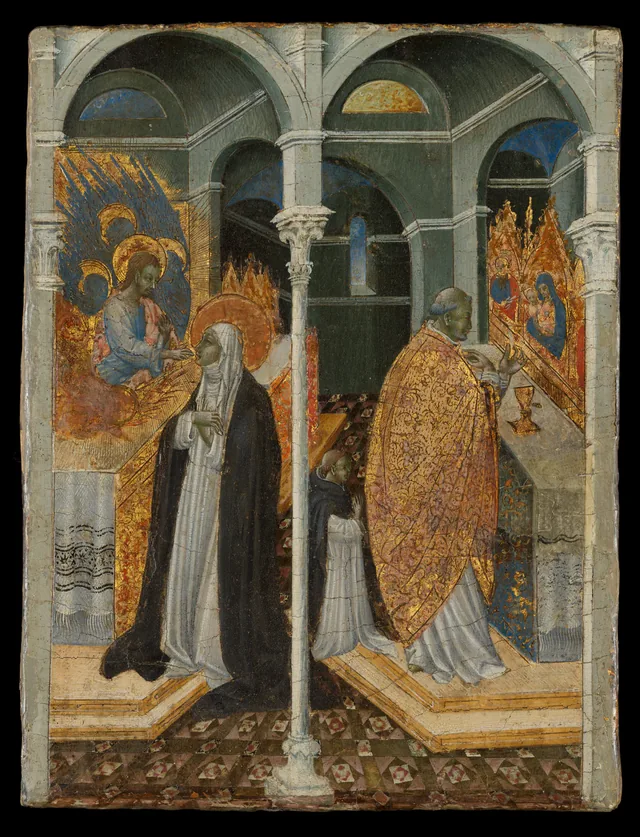
The teaching associated with Catherine describes purification through an image of love burning away what obstructs communion with God. It has made her a major voice in Catholic reflection on purgatory. The writings reached readers through a compilation prepared by followers, not an autobiography in her own handwriting. [1]
Gold in a furnace
In chapter X of the Treatise on Purgatory, gold provides the comparison: fire removes impurities, and purified gold has nothing further for the fire to consume. Catherine’s text applies the image to a soul being freed for union with God. The soul’s desire for God and the pain of its remaining obstacles belong to the same movement. [4]
That teaching can sound severe, yet the Treatise also describes peace and willing agreement with God. Purgatory is portrayed as a merciful preparation for the communion the soul longs for. The image asks a living reader what habits prevent love from becoming generous and unguarded. [4]
The people who preserved her voice
The Life, Treatise and Spiritual Dialogue appeared together in Genoa in 1551, forty-one years after Catherine died. They drew on followers’ records, with Marabotto among the people who preserved her teaching. Scholar Angela Tagliafico describes a composite text shaped through several contributors. Benedict XVI emphasizes its account of interior purification rather than a tour of an underground place. [1][6]
THROUGH THE LENS OF SCIENCE
The evidence about the remains
Genoa’s archdiocese identifies the remains kept at the church of the Santissima Annunziata and Saint Catherine as her incorrupt body. That custodial description does not include measurements, tissue analysis or a conservation record. [3]
A Genoese relic
The archdiocesan guide places her body in the church near the former Pammatone hospital. This connects the shrine to the neighborhood where she worked. Its language records the Church’s continuing identification and veneration of the remains; it is not a technical description of which tissues survive. [3]
Two kinds of fire
The purifying fire of the Treatise is a theological image. It says nothing about the chemistry of Catherine’s remains. With no examination report supplied by the cited church guide, the biological history of the relic remains unresolved here. Neither the spiritual metaphor nor a visitor’s impression of the body can supply the missing physical data. [3][4]
READER QUESTIONS
Questions and answers
Did Catherine write the Treatise herself?
The surviving literary form came through followers. Catherine’s teaching was gathered, copied and edited into the collection published in 1551; it should not be treated as her autograph manuscript. [6]
Did she visit purgatory in a vision?
Benedict XVI distinguishes her teaching from reports of seeing a physical location in the afterlife. Its central images grow from her experience of repentance and divine love. [1]
FOLLOW THE SOURCES
Sources and further reading
- Benedict XVI — Catherine of Genoa, 12 January 2011
Church or shrine source
Hospital service, compilation history and interior-purification theology; not a medical investigation.
- Dicastery for the Causes of Saints — Catherine of Genoa
Church or shrine source
Received biography substantially repeats source 1; counted as the same work for derivation.
- Archdiocese of Genoa — SS. Annunziata e S. Caterina
Church or shrine source
Identifies the church, venerated body and proximity to Pammatone; offers no anatomical or conservation data.
- Life and Doctrine of Saint Catherine of Genoa — received early texts, CCEL
Primary historical record
Early devotional Life and teaching transmitted by followers; Life chapter II and Treatise chapters V and X read in the linked CCEL HTML edition. A primary witness to the received narrative and theology, not independent access to private experiences.
- Mirella Pasini — Pietà e filosofia, Storia della cultura ligure (2004)
Scholarly account
Pages 445–446 discuss the received hospital biography, practical administrative duties and the mediated textual tradition; only the relevant opening section inspected. The printed claim that 1551 was thirty years after 1510 is an error and is not repeated.
- Angela Tagliafico — Itinerario teologico-spirituale di S. Caterina da Genova, Alpha Omega 20/2 (2017)
Scholarly account
Pages 283–290 review the composite textual tradition, marriage, conversion and hospital work with references to critical editions. Biographical chronology differs in small details from the papal summary; no retrospective diagnosis adopted.
Sources checked: 2026-10-27. Suggest a correction or a source.