THE PERSON BEHIND THE ACCOUNT
Repeated arrests did not end his work among Westminster’s sick and poor.
Southworth was first sentenced to death in 1626 and reprieved. He continued ministering, including to people affected by plague in Westminster during the 1630s. Later arrests kept the danger present. His final trial in 1654 ended in execution after he would not deny that he was a priest. [1]
Training away from England
Born into a Catholic family in Lancashire, Southworth trained at the English College in Douai and was ordained in 1618. He returned to work in England and also spent a short period as chaplain to Benedictine women in Brussels. His formation and ministry depended on the networks that allowed English Catholics to train abroad and return despite legal risk. [1]
The parish priest remembered by Westminster
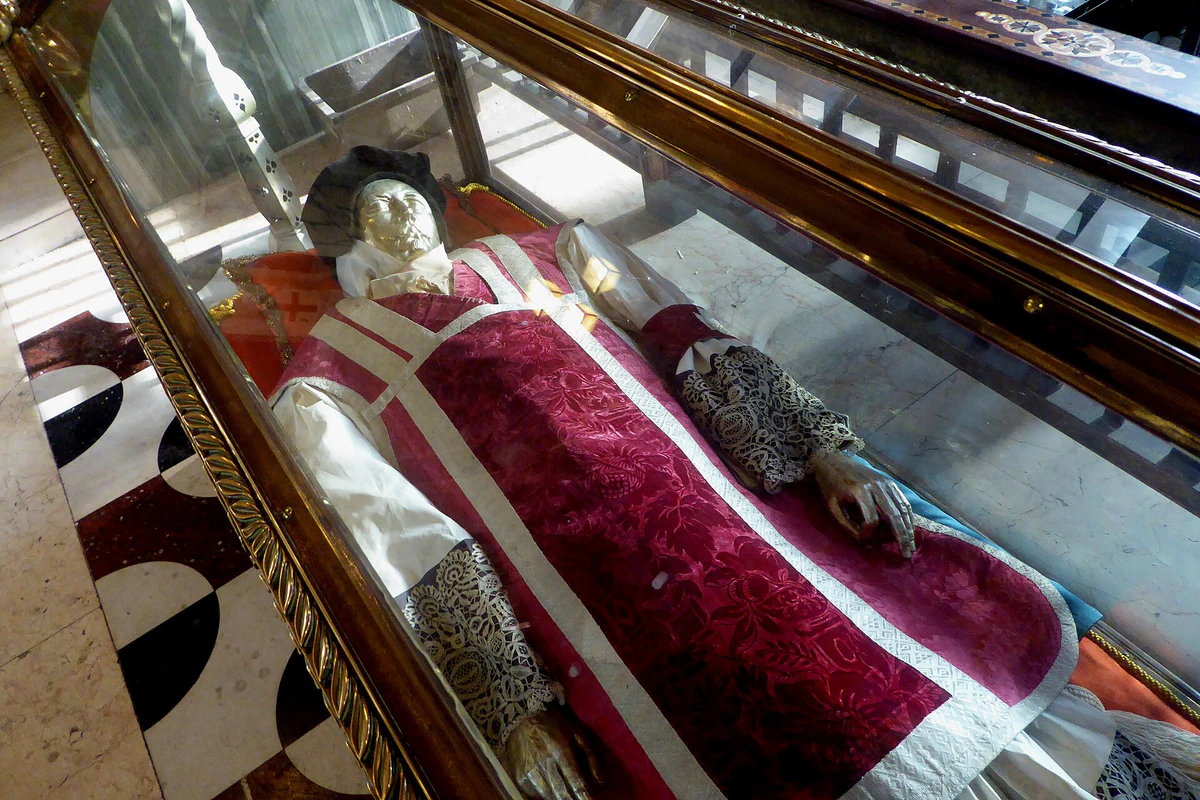
The cathedral’s custodial account remembers his service to poor and sick residents before his final capture. Its present observance places his casket in the nave for his feast. The local relationship comes before the grand title: a priest’s remembered work among neighbors became part of the identity of a much later cathedral community. [3]
IN OUR OWN LIVES
A life beyond the moment of execution
Martyrdom can compress a biography into its last violent event. Southworth’s local remembrance also keeps attention on years of ordinary ministry and care while arrest remained possible. The work gives his fidelity a human setting.
His relic history offers a second useful lesson. A community can say openly that a body was repaired and embalmed. That candor helps a visitor understand what is present without diminishing the person remembered. Respect for the dead and accurate description of their remains can support each other.
THROUGH THE EYES OF FAITH
Faith and daily life
Catholic recognition honors his fidelity to his priestly vocation and his service. In the 1970 canonization homily for the Forty Martyrs, Paul VI placed their remembrance within a hope for Christian unity. Recalling persecution need not renew hostility toward Christians living now. [6]
Martyrdom within a divided history
Paul VI’s homily recognized the martyrs’ loyalty to their convictions while looking toward healing the division between Catholics and Anglicans. The address also distinguished religious communion from a nation’s honor and sovereignty. It offers a Catholic framework for remembrance that can name an execution as wrong without making present-day neighbors inherit personal guilt for it. [6]
THROUGH THE LENS OF SCIENCE
The evidence about the remains
The Diocese of Westminster explicitly records that Southworth’s body was stitched together and embalmed after execution. His remains therefore have a documented history of human preservation and reconstruction. [1]
After the execution
The English College’s account records the Spanish ambassador recovering the body, which was stitched, embalmed and returned to Douai. [7]
The diocesan history describes hiding the lead coffin in an unmarked grave in 1793. Rediscovered in 1927 during demolition, it reached Westminster Cathedral in 1930. This custodial sequence includes deliberate intervention; an untreated-body description would contradict it. [1]
The casket seen today
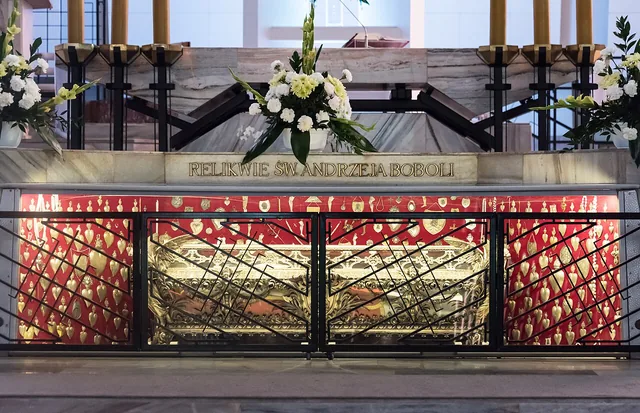
Westminster Cathedral identifies the glass casket as containing Southworth’s remains. Its public description supplies no complete anatomical inventory or conservation history. [3]
READER QUESTIONS
Questions and answers
Was the body deliberately preserved?
Yes. The diocese records stitching and embalming after execution. [1]
Where is the casket now?
Westminster Cathedral identifies it within its own custodial description and feast-day observance. [3]
FOLLOW THE SOURCES
Sources and further reading
- Diocese of Westminster — John Southworth
Institutional source
Ministry, execution, stitching, embalming and Douai-to-Westminster custody.
- Westminster Cathedral — An Architectural Gem
Institutional source
Current casket attribution, local service and feast observance.
- Paul VI — Forty Martyrs canonization homily, 25 October 1970
Institutional source
Primary Catholic interpretation and appeal toward Christian unity.
- The Venerabile, 2018 — Why Our Martyrs Matter
Institutional source
English College magazine, printed p.10; explicitly records reconstruction and embalming.
Sources checked: 2026-10-27. Suggest a correction or a source.