THE PERSON BEHIND THE ACCOUNT
The stranger a frightened town killed
Coloman reached Stockerau as an outsider. According to the tradition preserved by Melk Abbey, the local population suspected him of being a spy, tortured him and hanged him. The abbey labels his royal Irish ancestry and pilgrimage narrative as legend. His own account of what happened has not survived in these sources. [1]
A life obscured by its legend
The abbey recounts a king’s son who refused crown and wealth to journey toward the Holy Land. Vienna’s account more cautiously calls him probably an Irish pilgrim. These descriptions preserve the way Coloman came to be understood; they do not establish his parentage, education or private intentions. [1][2]
The burial at Melk
Melk dates his burial in the Babenberg stronghold to 1014. His association with the ruling family helped make him an important regional patron. The abbey still celebrates him and names him patron of both the monastery and town. The documented continuity of devotion is clearer than many details of his earlier life. [1]
IN OUR OWN LIVES
Before suspicion becomes a verdict
The evidence preserves little of Coloman’s personal voice. The received story still asks a concrete question: how quickly does unfamiliar speech become a reason to believe an accusation?
The shrine also preserves a possibility of moral correction. A society can eventually recognize a victim it once misjudged. The harder work is learning to listen while the person is still alive.
THROUGH THE EYES OF FAITH
Faith and daily life
The man remembered as a threat became a saint and patron. His cult carries a reversal of judgment: the community honors someone whom other Christians had killed. The Archdiocese of Vienna explicitly connects that memory with the danger of fear directed at foreigners. [2]
A martyr killed by Christians
The Vienna account places the hanging in 1012 and describes the barrier of language: the stranger could not explain himself to those who suspected him. It calls attention to his death at Christian hands. This is an uncomfortable memory for a Christian community to keep, because the wrong lies within the community doing the remembering. [2]
Honoring the person after failing to hear him
A present-day reader need not treat every element of the legend as established history to face its moral question. When someone speaks differently, what extra evidence do we demand before believing them? How quickly do we accept an accusation when the accused has difficulty answering? The story makes those failures of listening painfully concrete.
THROUGH THE LENS OF SCIENCE
The evidence about the remains
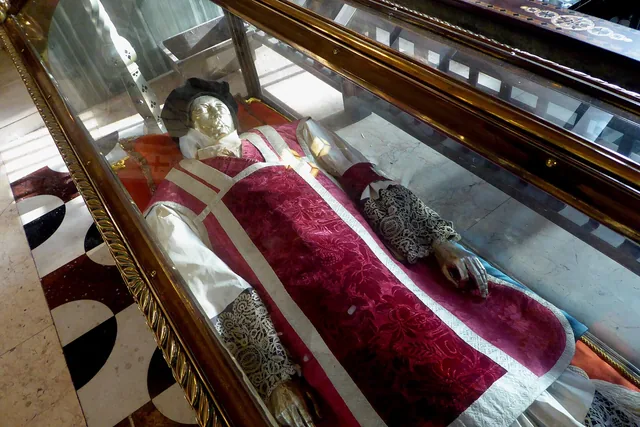
The preservation story says that Coloman’s body remained intact after being left hanging. That is a transmitted medieval claim, without measurements or a contemporary scientific record. Melk Abbey now identifies his mortal remains in a sarcophagus in its church. [2][3]
A sarcophagus and an earlier report
The abbey church guide identifies the sarcophagus at the left transept altar. It does not provide an anatomical inventory or say that an entire soft-tissue body is displayed there. A present burial place and an old report of delayed decay are different pieces of information. Neither supplies the missing history of the body’s condition over a millennium. [3]
READER QUESTIONS
Questions and answers
Was Coloman certainly an Irish prince?
Melk presents the royal ancestry as legend; Vienna calls him probably an Irish pilgrim. His exact origins remain uncertain in these accounts. [1][2]
Is an intact body visible at Melk?
The abbey guide identifies mortal remains within a sarcophagus. It does not describe a visible intact body or supply a modern examination report. [3]
FOLLOW THE SOURCES
Sources and further reading
- Melk Abbey — Saint Coloman, patron
Church or shrine source
Custodian explicitly labels royal ancestry and the narrative as legend; dates Melk burial to 1014 and documents current patronage.
- Archdiocese of Vienna — Saint Coloman
Church or shrine source
Current Church interpretation of received narrative, probable Irish origins, 1012 death, language barrier and preservation report; not an independent contemporary witness.
- Melk Abbey — Abbey church
Church or shrine source
Identifies mortal remains in the left transept sarcophagus; no tissue inventory or laboratory report.
Sources checked: 2026-10-27. Suggest a correction or a source.