THE PERSON BEHIND THE ACCOUNT
She wanted a different kind of monastery, and had to find somewhere to build it.
In 1460 Eustochia left her monastery at Basicò for an old hospital adapted to religious life. Only one sister from Basicò accompanied her. Family resources, a lay supporter and papal permission helped make the new foundation possible; further difficulties forced another move in 1464. [1]
A marriage arranged for a child
Born Smeralda in Messina in 1434, she was promised as a child to an adult widower. The planned marriage ended when he died. She subsequently resisted further marriage proposals and sought religious life despite family opposition, entering the Poor Clares in 1449. The retrospective Church biography supplies this outline; it cannot recover all her private feelings or the perspectives of everyone involved. [1]
Reform required another address
At Basicò she wanted closer observance of the Poor Clare rule, especially poverty. The Church’s account says attempts at internal change failed. Her mother and sister helped finance a new beginning, and Iacopa Pollicino joined her. The move from the adapted hospital to Montevergine in 1464 shows how much the ideal depended on finding workable accommodation. [1]
The women who sustained Montevergine
The foundation required benefactors and companions, not simply its founder’s determination. Messina’s municipal account records later enlargements and rebuilding of the complex. That long architectural history makes the present church a poor guide to the resources available at the beginning. The imposing building visitors see belongs to generations of changes. [4]
IN OUR OWN LIVES
The work behind a fresh beginning
Starting a community can sound like a single brave decision. Eustochia’s history points instead to permissions, a companion who stayed, relatives who contributed resources and rooms that proved inadequate. These details make her persistence easier to understand.
Her life also belongs to the history of women seeking some control over their religious future. The accounts should be read with care for their limitations, but the institutional contribution is clear: she helped create a community that other women could join and sustain. Anyone trying to build a school, household or shared project can recognize the difference between declaring an intention and making space for people to live it.
THROUGH THE EYES OF FAITH
Faith and daily life
At her canonization in Messina in 1988, John Paul II interpreted her enclosed life as prayer offered for other people. In his account, the monastery’s separation from the city did not cancel responsibility for the wider world. [3]
Prayer directed beyond the walls
John Paul II’s canonization homily describes Eustochia’s meditation on Christ’s Passion and her prayer for the suffering of others. Catholic devotion to the crucified Christ joins the suffering person to someone who has undergone abandonment and death. In this interpretation, prayer expresses solidarity with people whom a contemplative cannot personally visit or assist. It remains a religious understanding of her life, rather than a measurable outcome for everyone named in her prayers. [3]
Poverty as a shared commitment
The homily presents her spiritual life through relationship with Christ and the image of branches receiving life from a vine. It is a useful corrective to imagining a founder as entirely self-sufficient. Community poverty also required other people’s gifts and cooperation. The choice was to organize daily life around a common religious commitment; it should not be romanticized as though material need were harmless. [3]
THROUGH THE LENS OF SCIENCE
The evidence about the remains
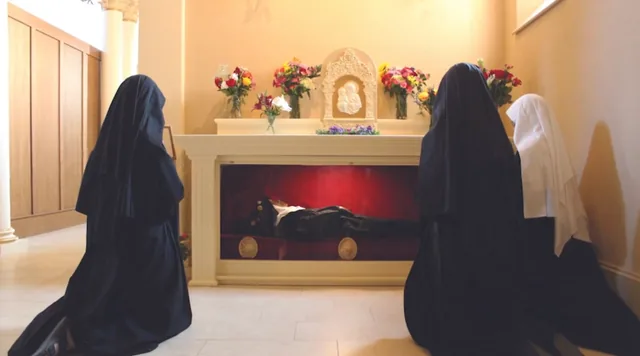
The Montevergine community identifies the body venerated in its upper chapel as Eustochia’s and calls it incorrupt. Its public church description gives no dated anatomical examination or treatment record. [2]
The church survived and was restored
The custodian says much of the church survived the 1908 earthquake and that worship resumed after restoration in 1929. Municipal history adds details of rebuilding and reused architectural elements. These sources document the place surrounding the relics. Neither provides enough information about the body’s examination, preparation or conservation to determine how its condition developed. [2] [4]
READER QUESTIONS
Questions and answers
Did she found the present building in one step?
No. The biography records an adapted hospital in 1460 and a move to Montevergine in 1464; the complex underwent later changes. [1] [4]
Does the visible body have a published scientific explanation?
The custodial page identifies the preservation tradition but supplies no anatomical or conservation report from which to determine a mechanism. [2]
FOLLOW THE SOURCES
Sources and further reading
- Dicastery for the Causes of Saints — Eustochia Calafato
Institutional source
Retrospective biography; family opposition and successive foundations.
- Montevergine community — Church
Institutional source
Custodial body attribution and church restoration; no examination data.
- John Paul II — Canonization homily, 11 June 1988
Institutional source
Primary Catholic interpretation of her contemplative vocation.
- City of Messina — Montevergine
Institutional source
Municipal architectural and institutional history.
Sources checked: 2026-10-27. Suggest a correction or a source.