THE PERSON BEHIND THE ACCOUNT
The king wanted a cure. The hermit stayed to help him face death.
Louis XI asked for Francis of Paola because he hoped the Calabrian hermit could cure him. Francis resisted leaving home until a papal command brought him to France. The king did not recover. The sanctuary’s account remembers Francis remaining beside him as a spiritual companion. [4]
A hermitage acquired neighbors
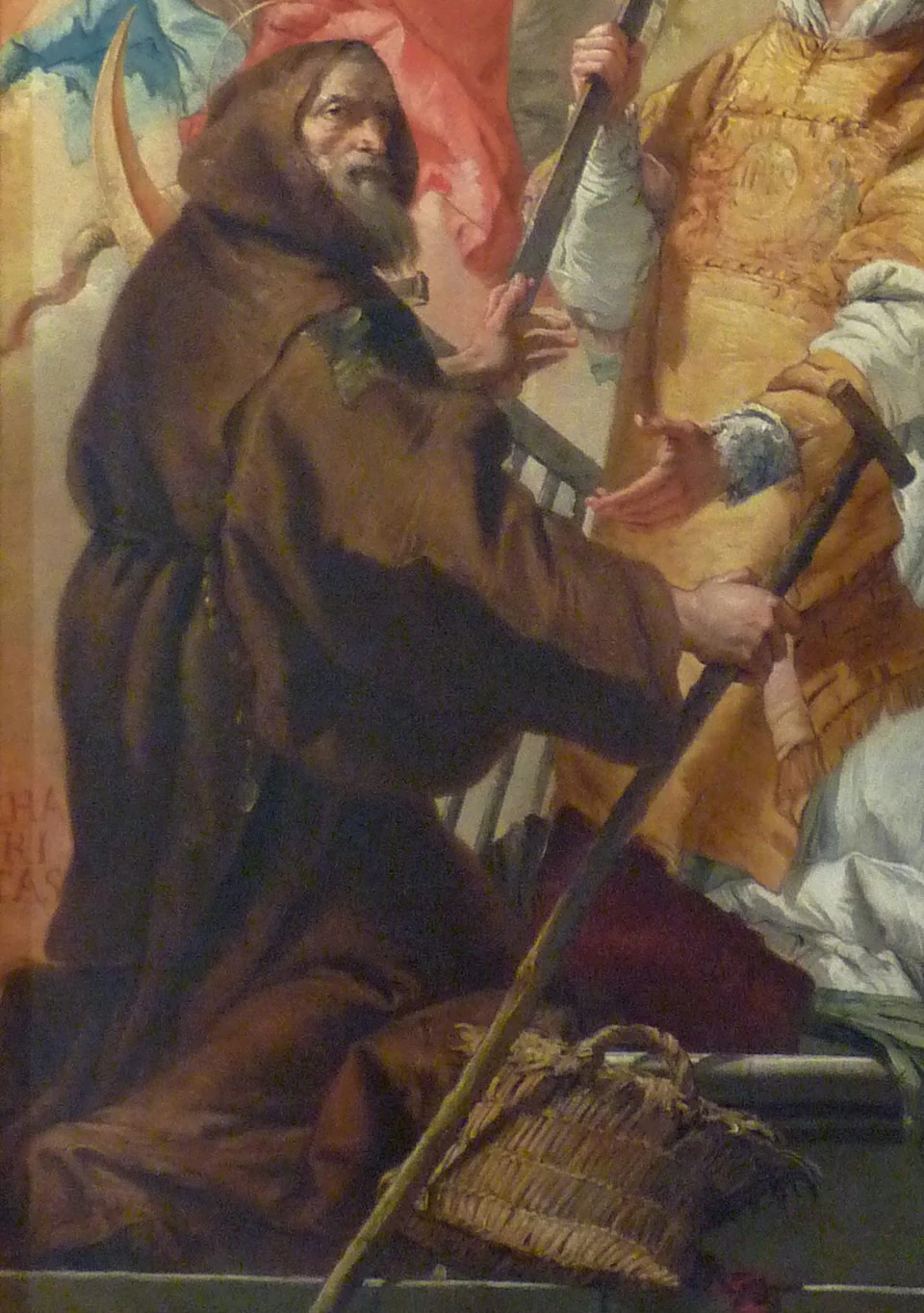
After a period with Franciscans and a pilgrimage, Francis settled as a hermit near Paola. Others joined him, and their needs led to a chapel and accommodation. The public Church biography describes the gradual development of the community later known as the Minims. Solitude became a form of life shared with other people. [3]
Leaving Calabria unwillingly
The sanctuary places his departure within diplomatic dealings among Louis XI, the king of Naples and Sixtus IV. Francis was about sixty-seven when he reached Tours. The friars declined the grand accommodation offered and settled in the park, attempting to continue their simpler pattern of life. He never returned to Calabria. [4]
Help without the hoped-for recovery
The Church account explicitly says that Louis did not obtain the physical healing he wanted. Francis’s continued presence therefore belongs to the history of care for a dying person. A religious reputation had brought him to court, but it could not guarantee the outcome a powerful patient expected. [3]
IN OUR OWN LIVES
Companionship when a solution is unavailable
The court episode is useful for anyone who feels helpless beside a dying person. A visit can still have value when it cannot change the diagnosis or remove the loss. Francis’s remembered role was to remain and help a king prepare for an outcome he had hoped to avoid.
The letter about taxation keeps his spirituality from becoming entirely private. An official may speak respectfully and still impose a burden someone cannot bear. Careful attention to those consequences belongs beside personal restraint. His story asks for both: care for the person nearby and honesty about how institutions treat people with little influence.
THROUGH THE EYES OF FAITH
Faith and daily life
Francis’s penitential life also had a public edge. In a letter reproduced by his sanctuary, he challenged the harsh treatment of poor people by royal tax officials, naming widows, orphans and disabled people among those who needed protection. [5]
A letter about unfair burdens
The sanctuary’s transcription of the letter to Simone Alimena distinguishes lawful public dues from officials’ cruelty. Francis did not call for concealed tax evasion; he wanted judgment tempered by compassion and action against oppressive collection. This is a concrete application of penitence: the person exercising power must examine what that power does to vulnerable neighbors. [5]
The community’s demanding discipline
The religious family that grew around him included friars, nuns and lay members. Its rule made penitence central to daily life. These were particular religious commitments, and their historical austerity should not be offered as a general health recommendation. The lesson available to every reader is narrower: a professed value becomes credible through the habits and limits a person accepts. [3]
THROUGH THE LENS OF SCIENCE
The evidence about the remains
The Paola shrine lists bone fragments and other relics. These should not be confused with a surviving whole body: the historical account describes the burning of his remains in France. [1]
Fragments after a violent history
The shrine describes five bone fragments brought from France in 1935 and lists smaller relics, a tooth and garments. It also mentions the theft of an urn in 1983 without fully reconciling the later inventory on that page. The page does not explain how its inventory relates to the theft. They support a history of fragmentary relics, with losses and movement, rather than a present intact-body claim. [1]
READER QUESTIONS
Questions and answers
Is his whole body preserved at Paola?
No such claim fits the checked record. The shrine describes fragments; the Church history records the body’s burning in 1562. [1] [3]
Did Louis XI receive the cure he requested?
The sanctuary says he did not. Francis remained as a religious companion. [4]
FOLLOW THE SOURCES
Sources and further reading
- Sanctuary of Paola — Basilica and relics
Institutional source
Fragment inventory, 1935 transfer and 1983 theft; later sequence needs clarification.
- Vatican News — Francis of Paola
Institutional source
Religious biography; court, death and destruction of remains.
- Sanctuary of Paola — Life of the saint
Institutional source
Retrospective account of reluctant departure, court life and Louis’s death.
- Sanctuary of Paola — Letters
Institutional source
Transcribed historical letter on officials’ treatment of vulnerable people.
Sources checked: 2026-10-27. Suggest a correction or a source.