THE PERSON BEHIND THE ACCOUNT
Before he built a monastery, he demanded justice for the people displaced by it.
The king wanted a Carthusian monastery at Witham. Hugh insisted that the people displaced for it receive compensation and accommodation. The Diocese of Nottingham’s account remembers a monk willing to confront the patron on whom the new house depended. [5]
The prior who could disagree with a king
Hugh came from Burgundy to lead the Carthusian foundation at Witham. The older scholarly biography records delays over compensation for tenants and his objections to royal interference in church affairs. These were practical conflicts over property and authority, not simply a reputation for being courageous. Supporting a monastery did not free its patron from obligations to the people affected. [7]
A bishop among people at risk
In 1186 he became bishop of Lincoln. The Nottingham account describes his protection of Jewish people against mobs in Lincoln and Northampton, as well as visits to sick people and work to rebuild the earthquake-damaged cathedral. It also preserves his own reported acknowledgment of a sharp temper. The picture is of an active, sometimes forceful pastor rather than an invariably placid saint. [5]
Refusing a royal war levy
The 1910 scholarly biography recounts Hugh’s refusal in 1198 to provide money and knights for Richard I’s war abroad. Richard ordered confiscation of his property, and Hugh traveled to meet him in Normandy. The conflict gave his independence a consequence. A reader need not assume that every medieval jurisdictional argument maps neatly onto a modern political cause to recognize the risk of opposing the crown. [7]
Rebuilding and remembering
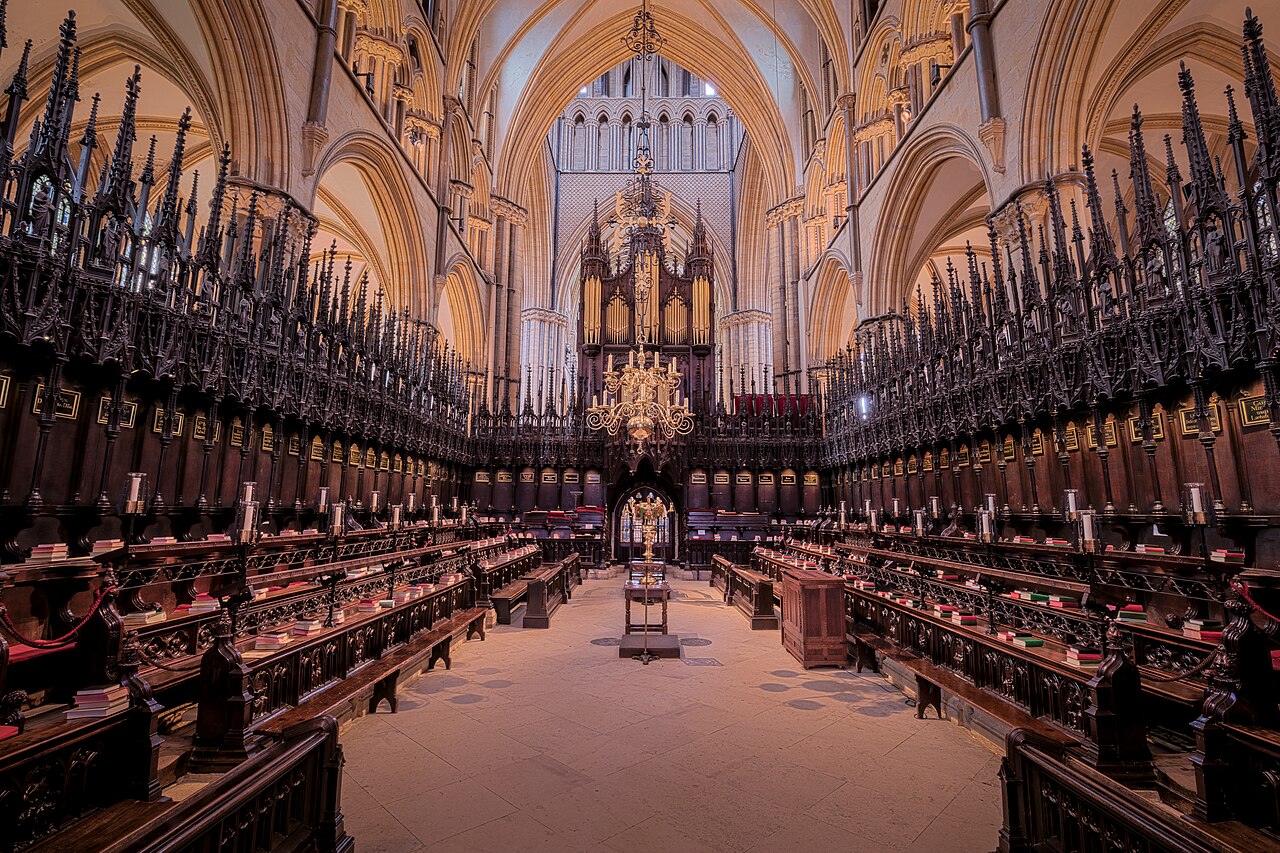
The Catholic parish records Hugh’s role in rebuilding Lincoln Cathedral after the earthquake and his burial there in 1200. Kings and senior churchmen attended the funeral. The later importance of the shrine can make the man seem remote, but the parish’s account also remembers visits to people whose illness separated them from ordinary social life. [6]
IN OUR OWN LIVES
Who pays for an institution’s good work?
Hugh’s demand at Witham reaches beyond a medieval building project. A school, church or charitable foundation can serve an admirable purpose while imposing an unfair cost on people with little power. Its purpose does not settle whether the arrangements are just.
The people displaced by the monastery are easy to omit from a founder’s biography. Keeping them in view makes Hugh’s choice concrete. It also gives a reader something useful to ask about an institution they admire: who had to move, who supplied the labor, and whose objection was heard? Defending the institution sometimes requires challenging its own supporters.
THROUGH THE EYES OF FAITH
Faith and daily life
His religious work included the sacraments, visits to poor and sick people, and care of people with leprosy. Lincoln’s Catholic parish remembers those duties beside his resistance to royal injustices. Prayer and the treatment of neighbors were joined in its account of his vocation. [6]
Hugh and the Jews of Lincoln
The Jewish heritage study by Marcus Roberts places Hugh’s interventions within a city whose Jewish residents also experienced persecution and hostile religious imagery. His actions should not be used to absolve the wider history of Christian antisemitism. They show that protection was possible and that people within the same religious world made different choices. Religious authority can be exercised to restrain a crowd as well as to encourage one. [8]
THROUGH THE LENS OF SCIENCE
The evidence about the remains
Lincoln Cathedral’s Spring 2026 journal says the fate of Hugh’s body and head after the destruction of his shrines remains unknown. A search in 1955 did not identify his remains. This is a lost-remains case, not a documented present display of an intact body. [1]
The detached head and the later search
The 2026 cathedral article recounts a report of unusual preservation when the remains were transferred in 1280, with the head already detached. Both shrines were despoiled in 1540. Investigation of chapter-house graves in 1955 considered a headless skeleton but rejected identification as Hugh. The article explains that several graves were headless and that other features complicated the theory. The proposed identification remains unfulfilled. [1]
READER QUESTIONS
Questions and answers
Is he the child called “Little Hugh of Lincoln”?
No. Hugh of Avalon was the bishop who died in 1200. The later child’s cult arose from a false ritual-murder accusation against Jews in 1255. [8]
Did the 1955 excavation identify his body?
No. The cathedral’s 2026 account states that the quest remains unfulfilled. A headless skeleton was considered but not authenticated. [1]
FOLLOW THE SOURCES
Sources and further reading
- Judi Jones — The Quest for St Hugh’s Remains, Lincoln Cathedral Journal, Spring 2026
Institutional source
Pages 8–9; historical transfer, shrine destruction and unsuccessful 1955 identification.
- Diocese of Nottingham — Hugh of Lincoln
Institutional source
Retrospective biography; displaced tenants, Jewish neighbors and character.
- St Hugh’s Catholic parish, Lincoln — Patron and parish history
Institutional source
Religious duties, care and cathedral rebuilding; later institutional remembrance.
- Richard Urban Butler — Hugh of Lincoln, Catholic Encyclopedia, 1910
Institutional source
Older scholarly biography with medieval-source bibliography; royal disputes.
- Marcus R. Roberts — Lincoln Cathedral Jewish Heritage
Institutional source
Jewish heritage research; Hugh’s protection and the separate blood-libel cult.
Sources checked: 2026-10-27. Suggest a correction or a source.