THE PERSON BEHIND THE ACCOUNT
A church union pursued amid a struggle over churches
Josaphat Kuntsevych promoted communion with Rome in a region where Christians disagreed fiercely about who held legitimate church authority. The Encyclopedia of Ukraine records that he took over Orthodox churches for the union. When an Orthodox hierarchy was restored in 1620, competing claims to his diocese intensified. He was killed at Vitsebsk in 1623. That setting belongs in the account of his martyrdom. [1]
A monk becomes a reforming bishop
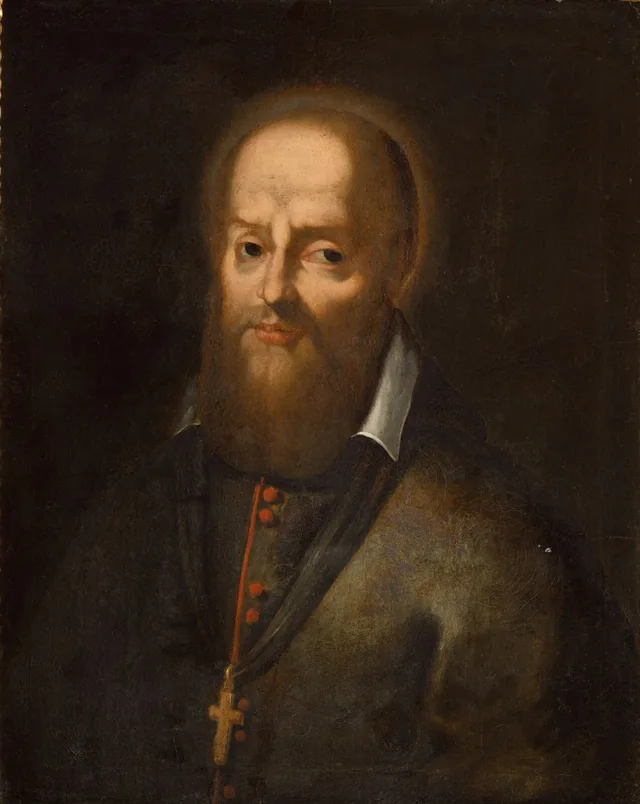
Born Ivan Kuntsevych around 1580, he entered the Basilian monastery of the Holy Trinity in Vilnius in 1604. He became a priest in 1609 and eventually archbishop of Polatsk. The scholarly encyclopedia credits him with raising educational and moral standards among clergy and cooperating with Yosyf Rutsky in reforming Basilian monastic life. [1]
The distinctive work was therefore larger than a death scene. Clergy formation, monastic organization and the authority of a bishop affected the people living in those parishes. Those responsibilities also made his support for union with Rome consequential.
Who controlled the parish church?
The restoration of an Orthodox hierarchy produced a rival claim to the see of Polatsk. The encyclopedia places Josaphat’s seizure of churches within this struggle and attributes his killing to enraged Orthodox opponents. A precise account can name those actions without assigning collective guilt to Orthodox Christians or treating murder as an acceptable answer. [1]
For parishioners, a dispute over communion was also a dispute over where and under whose authority they could worship. Calling the episode a conflict between faith and unbelief would lose the central fact that the parties were Christian.
Why the history remains disputed
Historian Yeronim Hrim’s study of the 1867 canonization describes renewed nineteenth-century controversy, including the use of a 1622 letter associated with Chancellor Lew Sapieha and Catholic responses to accusations against Josaphat. The article documents arguments surrounding canonization; it does not put every earlier accusation beyond dispute. [3]
Canonization expresses the Catholic Church’s judgment about a saint. It does not make every administrative decision beyond historical criticism. Readers can respect Catholic devotion and still investigate whose accounts survive and whose experiences are harder to recover.
IN OUR OWN LIVES
Remembering without inheriting the hostility
Josaphat’s life brings an uncomfortable question close to home: can a community pursue what it believes true while respecting people who decline to join it? The answer has to appear in decisions about access, authority and conscience, as well as in statements about unity.
His profile is also a reason to read across a religious boundary. The histories told by Catholic and Orthodox neighbors may emphasize different losses. Giving those differences an honest place is part of learning what reconciliation would require.
THROUGH THE EYES OF FAITH
Faith and daily life
Catholics honor Josaphat for his commitment to church unity and his willingness to die for his faith. In 2013 Pope Francis recalled his Basilian religious life while calling present-day believers to understanding, mutual respect and fraternity with other churches. Remembering him today carries obligations toward Christians who understand the seventeenth-century conflict differently. [2]
Unity after Balamand
The Catholic–Orthodox joint commission’s 1993 Balamand text rejects “uniatism” as a method for seeking future unity while affirming the right of existing Eastern Catholic churches to live and minister. It acknowledges the conflicts accompanying historical unions. This is a dialogue commission’s agreed text, not evidence that every Orthodox church has ratified every formulation. [4]
That distinction lets a Catholic reader honor an Eastern Catholic saint without presenting the absorption of other Christian communities as the present program for reunion. Shared prayer, freedom of conscience and patient dialogue require different actions from a contest to control buildings.
THROUGH THE LENS OF SCIENCE
The evidence about the remains
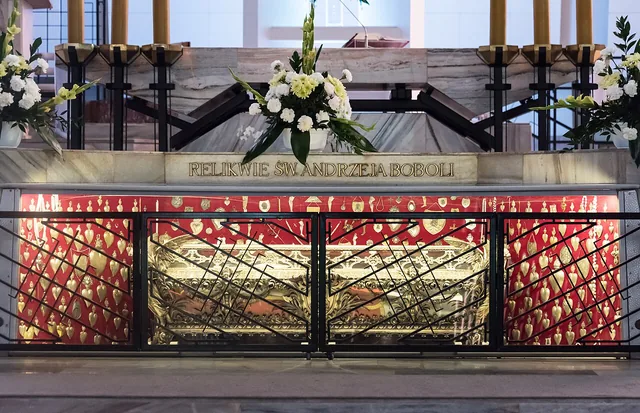
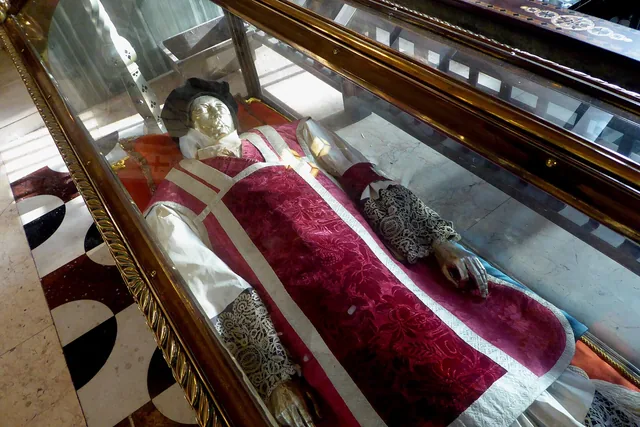
Francis’s 2013 address dates the placement of Josaphat’s remains beneath the altar of Saint Basil in Saint Peter’s Basilica to 22 November 1963. This establishes a public location and a dated transfer. It gives no anatomical inventory or laboratory findings about the remains. [2]
A public shrine, a limited physical record
The dated Vatican account places the remains beneath Saint Basil’s altar in 1963. It gives no inventory of surviving tissue or preparation and conservation, so the shrine’s public location cannot establish a mechanism of preservation. [2]
READER QUESTIONS
Questions and answers
Why do accounts of Josaphat differ so sharply?
His ministry crossed rival claims to church authority and control of parish buildings. Later controversies over canonization continued those disagreements. Catholic veneration should not erase that contested history. [3]
Does Catholic teaching now propose these historical unions as the method of reunion?
The Balamand dialogue text rejects that method while defending the existing Eastern Catholic churches’ right to live and serve their faithful. [4]
Where does the Vatican locate his remains?
Francis’s 2013 address identifies the altar of Saint Basil in Saint Peter’s Basilica and dates their placement there to November 1963. [2]
FOLLOW THE SOURCES
Sources and further reading
- Encyclopedia of Ukraine: Yosafat Kuntsevych
Institutional source
Scholarly biography; reform, competing hierarchies, church seizures and death.
- Francis: Ukrainian pilgrims, 25 November 2013
Institutional source
Catholic interpretation, fraternity and the dated 1963 transfer.
- Yeronim Hrim: The canonization of Josaphat in 1867
Institutional source
Historical study of canonization-era controversy; does not settle all earlier disputes.
- Catholic–Orthodox Joint Commission: Balamand, 1993
Institutional source
Joint dialogue text on reunion and the rights of Eastern Catholic churches.
Sources checked: 2026-10-27. Suggest a correction or a source.