THE PERSON BEHIND THE ACCOUNT
The brother sent to care for sick friars also cared for people the city ranked beneath them.
Martin de Porres learned a trade before entering religious life. The Dicastery describes pharmacy experience and apprenticeship to a barber-surgeon: medical training he later used among Lima’s poor as a Dominican brother. [5]
Ana Velásquez’s son
Martin was born in Lima in 1579 to Juan, a Spanish father, and Ana Velásquez, a formerly enslaved Black woman from Panama. The Dominican Order places that ancestry within a history of humiliation suffered by Black people in the Americas. It belongs in the account of his religious vocation, where prejudice restricted opportunities that others could take for granted. [2]
Admission on unequal terms
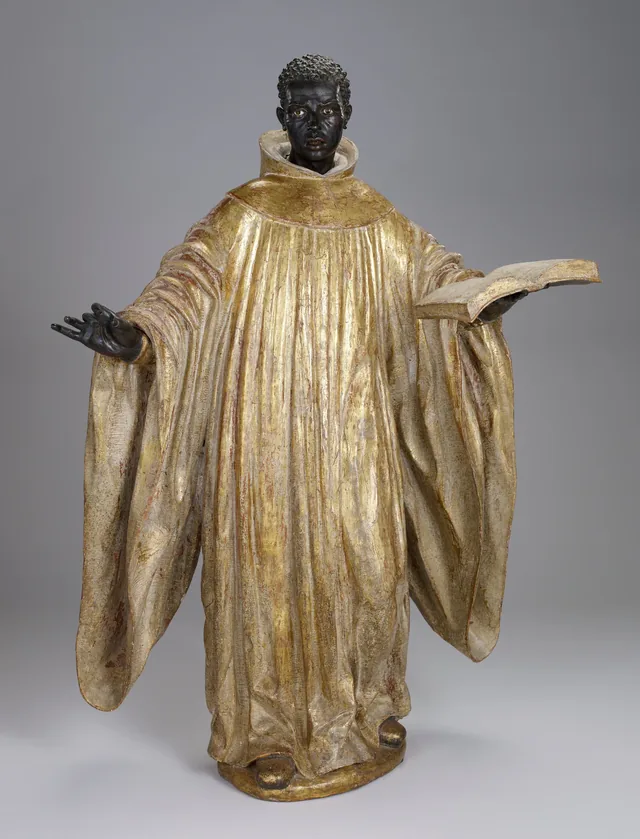
The Western Dominican Province describes Martin’s initial admission as a tertiary amid racial restrictions on entry to religious orders. He later made profession as a lay brother. The Order dates his solemn profession to 1603. He was a brother, not an ordained priest; his work in the infirmary was a religious vocation in its own right. [1][2]
His practical training brought him responsibility for ill and elderly friars. He also treated people beyond the priory. That meant continuing to use skills learned before religious life, now among people with very different access to resources. The community remembers care offered to enslaved people as well as nobles. [1]
Food, clothing, medicine
At Martin’s canonization in 1962, John XXIII named the material help he gave: food, clothing, and medicine. The pope singled out his service to Black people, people of mixed ancestry, and others doing the lowest-paid or least-valued work. These details give charity an address in the social life of colonial Lima. [3]
IN OUR OWN LIVES
The value of work that keeps people well
Martin’s trade makes his life approachable to a nurse, barber, home aide, cleaner, or person caring for a relative. Skill and attention can relieve suffering even when the person doing the work has little institutional power. A patient still needs someone who knows what to do and will make time to do it.
A community honoring Martin can also examine its own habits. Who gets admitted, whose expertise is trusted, and whose work is paid or respected? Admiration for a helpful brother can lead to practical changes in religious institutions and workplaces.
THROUGH THE EYES OF FAITH
Faith and daily life
A Dominican lay brother can preach through the daily work entrusted to him. Martin’s remembered nursing and provision of necessities gave visible form to his conviction that people across Lima’s racial divisions shared a claim to care. [1][3]
The prayer behind the work
The Dominican Order associates Martin’s care with devotion to the Eucharist and Christ’s Passion. John XXIII likewise described prayer and love of neighbor as joined in his life. For Martin, the people receiving care were fellow children of God. The conviction had practical consequences in a society that assigned them unequal standing. [2][3]
Remembering his humility requires care. The racial hierarchy was an injustice he encountered, not something his holiness makes admirable. A reader can value the service he chose while asking why certain doors were closed to him and why so much essential work carried so little status.
From local devotion to canonization
The Dicastery records beatification in 1837 and canonization on 6 May 1962. John XXIII presented Martin’s service as a model for the Church approaching the Second Vatican Council. The recognition concerned a life of prayer and care; the homily did not pronounce on a scientific cause for the condition of his remains. [5][3]
THROUGH THE LENS OF SCIENCE
The evidence about the remains
The clearest specific account linked here concerns the 1664 exhumation testimony, presented by a historian with references to the proceedings. It describes bones and residual flesh. It is neither a contemporary laboratory report nor an inventory of the remains now held as relics. [4]
The 1664 opening
Historian Celia Cussen begins her study with testimony from Martin’s exhumation, twenty-five years after his death in 1639. Witnesses described a skeleton that came apart as it was lifted, traces of flesh, and reported blood and fragrance. The remains were moved bone by bone into another container. This account is quite different from the claim that a complete, lifelike body remained intact. [4]
Cussen cites testimony from the beatification proceedings. That makes the passage valuable evidence about what witnesses said and how they understood the event. It supplies no modern chemical test of the reported blood, no tissue study, and no basis for assigning a preservation mechanism to the remains today. [4]
READER QUESTIONS
Questions and answers
Was Martin a priest or a doctor?
He was a Dominican lay brother trained in the period’s barber-surgeon trade. He was not an ordained priest or holder of a modern medical qualification. [5]
Was a completely preserved body found?
The 1664 testimony discussed by Cussen describes a skeleton, residual flesh, and other reported phenomena. It does not describe a complete body retaining its living appearance. [4]
FOLLOW THE SOURCES
Sources and further reading
- Western Dominican Province — Saint Martin de Porres
Religious order’s account
Barber-surgeon apprenticeship, restricted initial entry, lay-brother vocation and care within and beyond the infirmary.
- Order of Preachers — San Martini de Porres
Religious order’s account
Official order biography: parents, Black ancestry, solemn profession in 1603, prayer and charitable work.
- John XXIII — canonization homily, 6 May 1962
Papal
Primary Catholic interpretation of prayer and practical care across social divisions.
- Celia Cussen — introduction to San Martín de Porres, Instituto de Estudios Peruanos
Scholarly account
Historical study with explicit references to 1664 beatification testimony. Witness reports are not laboratory findings.
- Dicastery for the Causes of Saints — Martino de Porres
Church or shrine source
Current official page identifies Martin as a religious and brother cooperatore, and describes pharmacy/barber-surgeon training and formal recognition. Its attached homily duplicates source 3 and is not treated as independent corroboration.
Sources checked: 2026-10-27. Suggest a correction or a source.