THE PERSON BEHIND THE ACCOUNT
Thirty years available to one town
Nicholas’s adult life narrowed geographically and widened in responsibility. After preaching in several Augustinian houses, he spent his final thirty years in Tolentino. The order remembers a confessor who attended the sick, helped poor people and welcomed visitors. His importance lay in being available repeatedly to a particular community. [1]
Joining a young order
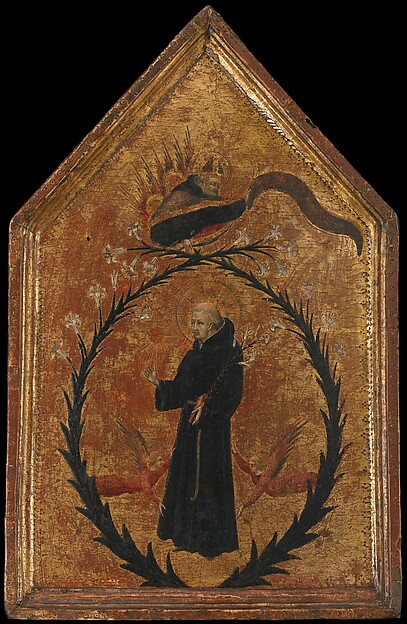
Nicholas was born at Sant’Angelo in Pontano in 1245. He joined the Augustinians soon after their Grand Union, the consolidation that gave the order its new institutional form. He became a preacher and eventually settled at Tolentino, where his ministry continued until his death in 1305. The order regards him as its first canonized member. [1]
Thirty years of work in one town gave this ministry continuity. A visitor’s biography can easily give more attention to a dramatic event than to repeated acts of care. Here the repetition is part of the contribution.
A difficult argument about food
Pietro da Monterubbiano’s early Life preserves an episode that complicates an easy portrait of obedience. It says Nicholas resisted medical advice to eat more nourishing food during illness. His prior appealed to the prior general, who ordered him to follow the physicians. Nicholas finally accepted a small piece of meat. [2]
The text presents the conflict through medieval ascetic theology. It is not clinical evidence that refusing treatment improved his health. What makes the episode revealing is the collision of commitments: an austere personal discipline, concern from fellow friars and the obedience he had promised. The sanctuary’s scholarly introduction explicitly draws attention to that tension. [2]
IN OUR OWN LIVES
The value of being available
Nicholas offers a demanding example for anyone whose work involves repeated care. His remembered ministry consisted of returning to people, not merely appearing for a celebrated event. The early dispute over his diet also keeps him human: devotion could produce difficult judgments that other members of the community challenged. A worthwhile reading makes room for both service and that tension. [1][2]
THROUGH THE EYES OF FAITH
Faith and daily life
Catholics especially associate him with prayer for the souls in purgatory. In Augustinian memory, care for the dead belonged beside care for living neighbours: prayer and charitable work were the two parts of the vocation he tried to sustain. [1]
Bread offered to the sick
A continuing devotion uses small blessed loaves associated with Nicholas. The sanctuary relates their origin to a vision in which Mary instructed him to eat bread dipped in water during an illness. It says he later carried blessed bread to people he visited. This is a received religious account, not a trial demonstrating a treatment’s effectiveness. [3]
The rite uses biblical readings about food and God’s provision, including Elijah and the widow and the multiplication of the loaves. The bread makes his memory concrete: a visitor can understand how feeding someone and praying with them became connected in local devotion. The account places the requested healing within trust in God and Mary’s intercession. [3]
THROUGH THE LENS OF SCIENCE
The evidence about the remains
Tolentino’s sanctuary distinguishes a statue, an empty stone monument, separate arm relics and the remains found in 1926. They should not be combined into a single claim that a visible statue is an intact body. [4][5][6]
A memorial that was always empty
The sanctuary’s art history explains that the stone ark beneath the polychrome statue never held Nicholas’s remains. It was a votive monument marking the burial area. The figure above it is sculpture. A photograph of that monument consequently tells us about devotional art and commemoration, not the condition of human tissue. [4]
The sanctuary dates the rediscovery of the attributed body to 1926 and the construction of its crypt to 1932. Its description names the architect and makers of the later urn. These are useful details of the setting, but the webpage publishes no excavation dossier, anatomical inventory or complete treatment history. It cannot support a claim about an untreated whole body. [5]
Arms, textiles and a long history of care
A separate chapel preserves the arm relics. The sanctuary also describes textiles found during an examination of the reliquary chest: coverings from different periods, altar cloths and liturgical garments. They show that the shrine contains objects of different kinds and dates, each with its own history. [6]
Those distinctions help visitors ask a better question than whether the whole display “looks incorrupt.” Which object is being shown? Is a description about the arms, other bodily remains or a representation? The published sanctuary account is particularly valuable because it gives readers the vocabulary to avoid mistaking one for another. [4][6]
READER QUESTIONS
Questions and answers
Is the figure above the stone ark his body?
No. The sanctuary identifies it as a polychrome statue and says the ark was empty. It must not be captioned as exposed preserved remains. [4]
Why is he linked with purgatory?
The Augustinian order connects that patronage with his sustained prayer for the faithful departed. It belongs to his Catholic theology of continuing prayer for people after death. [1]
FOLLOW THE SOURCES
Sources and further reading
- Order of Saint Augustine: Nicholas of Tolentino
Religious order’s account
Supports life outline, thirty-year ministry, prayer for dead and canonization. No medical findings.
- Pietro da Monterubbiano: Life, chapter 3, sanctuary edition
Historical saint’s life with scholarly commentary
Early Life and Francesco Santi’s introduction discuss conflict between fasting, physicians and obedience. Miraculous interpretation remains the text’s claim, not medical advice.
- Sanctuary: the blessed loaves
Custodian’s account
Explains received bread narrative and blessing rite; not clinical evidence.
- Sanctuary: the ark and polychrome statue
Custodian’s account
Indexed full text inspected after direct fetch timed out. Clearly identifies empty ark and sculpture; does not describe a complete untreated body.
- Sanctuary: crypt
Custodian’s account
Dates 1926 rediscovery and 1932 crypt; describes urn and makers without publishing examination records.
- Sanctuary: Chapel of the Holy Arms
Custodian’s account
Identifies arm relics and textiles of different periods. Their histories should not be generalized into whole-body claims.
Sources checked: 2026-10-27. Suggest a correction or a source.