THE PERSON BEHIND THE ACCOUNT
When the preacher could no longer travel
Pacificus’s early work depended on speech and movement: teaching younger friars and preaching in the surrounding countryside. Deafness, impaired sight and a painful leg later restricted that work. The change was consequential. A friar trained to address other people had to live much of his vocation with fewer opportunities to do so. [1][2]
An orphan becomes a friar
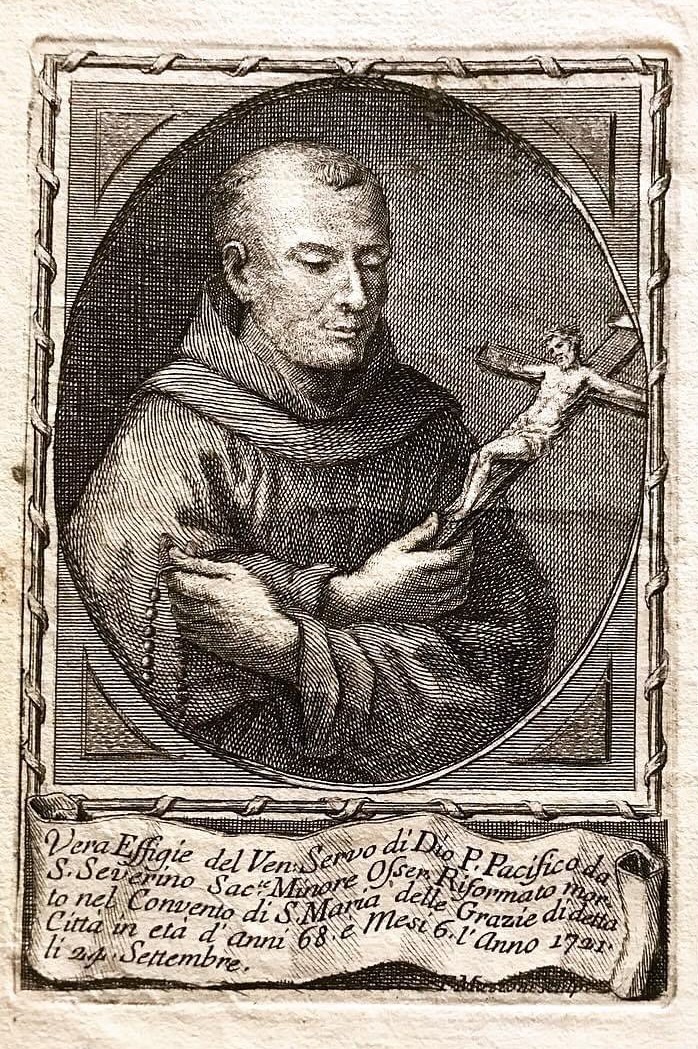
Carlo Antonio Divini was born in San Severino Marche in 1653 and lost his parents young. The Dicastery for the Causes of Saints says his maternal uncle, an archdeacon, brought him up. At seventeen he entered the Friars Minor and took the name Pacificus. He later became a priest. [1][2]
The earlier Catholic Encyclopedia dates his ordination to 1678 and records philosophy teaching from 1680 to 1683. Those details give substance to a life sometimes reduced to suffering: he had an intellectual task and responsibility for the formation of other members of the order before his long period of ill health. [2]
A smaller field of work
Vatican News follows his movements between Franciscan houses, including Urbino, San Severino and Forano. It says declining health eventually prevented his former activity. These were changes in what he could do, rather than evidence of a failed vocation. The sources remember continued community life as his circumstances narrowed. [3]
The Catholic Encyclopedia records that he still served as guardian at Santa Maria delle Grazie in 1692–1693. His disabilities did not make every responsibility disappear at once. The chronology resists a simple division between useful active years and an entirely passive remainder. He lived with changing capacities over a long period. [2]
IN OUR OWN LIVES
A person’s worth when capacities change
Pacificus’s life gives readers a way to discuss disability within a religious biography without treating it as a spectacle. The surviving outline includes education, public work, responsibility and dependence. His later limitations were real; the community still understood him as belonging to it. That combination may be more useful than the shorthand of a saint who merely endured pain. [1][2][4]
THROUGH THE EYES OF FAITH
Faith and daily life
The Church’s official profile remembers his solitude and prayer before the Blessed Sacrament. His place in Franciscan memory rests partly on the religious life he continued when illness limited public ministry. [1]
Prayer when work changes
The official cause profile pairs apostolic work with prayer, penance and Eucharistic devotion. This is the Catholic setting for his reputation: membership in a community, a sacramental life and a form of religious fidelity that could continue without a preaching itinerary. He died in 1721 and was canonized in 1839. [1]
A Franciscan sanctuary guide calls him close to people living with illness and difficulty. That is a description of the devotion surrounding him, not a medical promise. For readers with chronic illness, the worthwhile question is how a community recognizes a person whose contributions have changed. [4]
THROUGH THE LENS OF SCIENCE
The evidence about the remains
The inspected institutional sources identify his relics and their custody. They provide no current anatomical or conservation report from which natural preservation could be established. [3][4]
What the early burial account says
Vatican News reports burial without a coffin in a common grave, followed by exhumation in 1725 and placement in a wooden coffin near a side altar. It relates these events within the history of devotion after his death. It does not give measurements, a tissue description or environmental analysis of the grave. [3]
Consequently that history cannot identify a mechanism of preservation. Nor can a later urn or religious title supply the missing observations. The reliable claim here is that his remains have been the subject of continuing custody and veneration; their present physical condition needs more specific documentation. [3][4]
A temporary home during repairs
The Franciscan sanctuary guide identifies an urn containing his bodily relics at Santa Maria delle Grazie. A municipal press release in August 2026 announced a temporary transfer to San Domenico during post-earthquake restoration work. It described a change of location for worship during the works, not a new examination of the remains. [4][5]
A pilgrimage map should therefore distinguish the historic sanctuary from the temporary arrangements and check access before directing a visitor. Restoration of the building and conservation of human remains are different subjects. The municipal notice supplies information about the first; it should not be used to invent findings about the second. [5]
READER QUESTIONS
Questions and answers
FOLLOW THE SOURCES
Sources and further reading
- Dicastery for the Causes of Saints: Pacificus
Church or shrine source
Supports birth, orphanhood, uncle, entry at 17, Eucharistic spirituality and canonization date. Brief institutional biography.
- Stephen Donovan, Catholic Encyclopedia, 1911
Historical account
Supports teaching, ordination, preaching, disability and guardian term. Older devotional synthesis; no clinical records.
- Vatican News: Pacificus of San Severino
Institutional account
Supports movements, health limitations, burial and 1725 exhumation account. Does not publish anatomical data.
- Friars Minor: guide to Italian sanctuaries
Religious order’s account
Identifies Santa Maria delle Grazie urn and describes devotion among people affected by illness; no physical examination.
- San Severino municipal press release, 13 August 2026, reproduced by Agenparl
Reproduced municipal statement
Announces 18 August 2026 temporary transfer to San Domenico for sanctuary restoration. Building/access notice, not an examination of remains.
Sources checked: 2026-10-27. Suggest a correction or a source.